
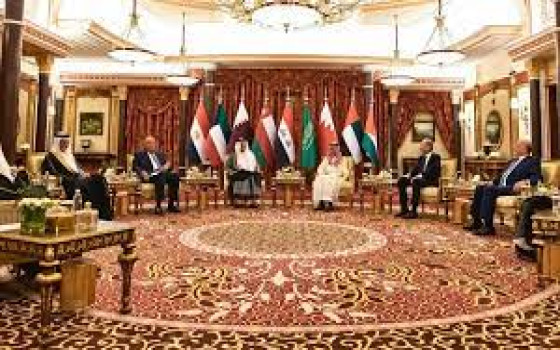
The Arab Ministerial Meeting in Jeddah: discussed a political solution to the Syrian crisis that brings it back to its Arab surroundings and the importance of resolving the humanitarian crisis and combating terrorism and the Israeli attacks on Al-Aqsa
- Europe and Arabs
- Saturday , 15 April 2023 16:47 PM GMT
Brussels: Europe and the Arabs
A statement was issued by the Ministry of Foreign Affairs of the Kingdom of Saudi Arabia at the conclusion of the consultative meeting of the countries of the Cooperation Council for the Arab States of the Gulf, the Hashemite Kingdom of Jordan, the Arab Republic of Egypt and the Republic of Iraq in the city of Jeddah on the 23rd of Ramadan 1444 AH.
Within the framework of the keenness and interest the Kingdom of Saudi Arabia attaches to everything that would serve the issues of our Arab nation and promote the interests of its countries and peoples, and at the invitation of Faisal bin Farhan Al Saud, Minister of Foreign Affairs of the Kingdom of Saudi Arabia, and within the framework of consultation and endeavor to coordinate positions and unify efforts towards a number of issues of concern. Common interest, an informal consultation session was held in the city of Jeddah on Ramadan 23, 1444 AH, at the Suhoor table, hosted by His Highness the Minister of Foreign Affairs, with the participation of Their Highnesses, Excellencies, and Excellencies, the foreign ministers of the Gulf Cooperation Council states, the Hashemite Kingdom of Jordan, the Arab Republic of Egypt, and the Republic of Iraq. According to the Embassy of the Republic of Iraq. Saudi Arabia in Cairo.
During the session, views were exchanged on a number of issues and developments in the region, and the ministers emphasized the centrality and priority of the Palestinian cause, and condemned illegal Israeli practices that undermine the two-state solution, and the chances of achieving a just and comprehensive peace based on the two-state solution, which embodies the independent and sovereign Palestinian state with Jerusalem as its capital. Eastern Province on the borders of June 4, 1967 AD, and in accordance with the resolutions of international legitimacy and the Arab Peace Initiative. They also condemned the Israeli attacks on the blessed Al-Aqsa Mosque / Al-Haram Al-Sharif, and the violation of the sanctity of the holy places, and stressed the need to respect the historical and legal situation existing therein, and that the blessed Al-Aqsa Mosque / Al-Haram Al-Sharif is a pure place of worship for Muslims, and that the administration of the Jerusalem Endowments and Al-Aqsa Mosque affairs The Jordanian entity is empowered with exclusive jurisdiction to manage the affairs of the mosque and regulate access to it within the framework of the historical Hashemite Custodianship over the Islamic and Christian holy places in Jerusalem.
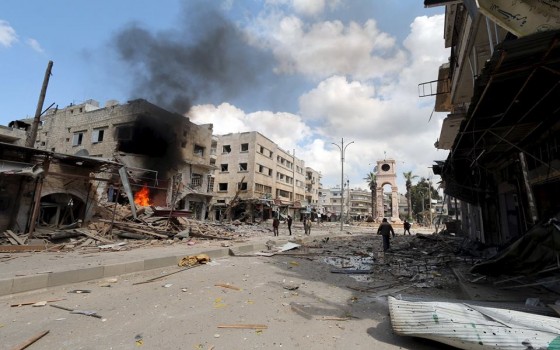
They also consulted and exchanged views on the efforts exerted to reach a political solution to the Syrian crisis that would end all its repercussions and preserve Syria's unity, security, stability, and Arab identity, and return it to its Arab surroundings, in a way that achieves the good of its brotherly people.
The ministers agreed on the importance of resolving the humanitarian crisis, providing a suitable environment for aid to reach all regions in Syria, creating the necessary conditions for the return of Syrian refugees and displaced persons to their areas, ending their suffering, enabling them to return safely to their homeland, and taking more measures that would contribute to stabilizing the situation in the country. the entire Syrian territory.
The ministers stressed the importance of combating terrorism in all its forms and organizations, combating drug smuggling and trafficking, and the importance of state institutions preserving Syria's sovereignty over its lands to end the presence of armed militias there, and external interference in Syrian internal affairs.
The ministers also stressed that the political solution is the only solution to the Syrian crisis, and the importance of having an Arab leadership role in efforts to end the crisis, setting up the necessary mechanisms for this role, and intensifying consultations among Arab countries to ensure the success of these efforts.
The ministers expressed their thanks to the Kingdom of Saudi Arabia for its initiative in calling for this consultative meeting in order to discuss the efforts made to resolve the Syrian crisis, and their aspiration for the continuation of consultations among them to follow up on these efforts.





No Comments Found