

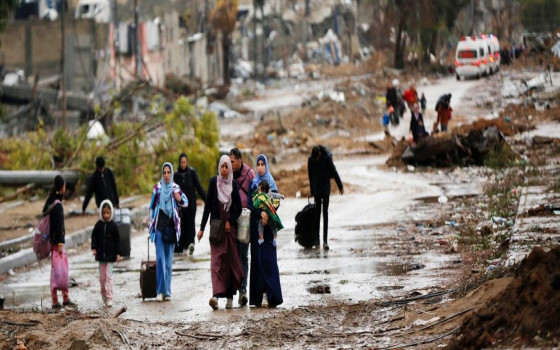
The number of Palestinian deaths approaches 20,000 people, the majority of whom are women and children...hours before the UN General Assembly meeting on developments in Gaza.

- Europe and Arabs
- Tuesday , 12 December 2023 12:41 PM GMT
New York - Gaza: Europe and the Arabs
Hours before a scheduled session of the United Nations General Assembly at noon on Tuesday to consider developments in the situation in Gaza and other occupied Palestinian territories, the United Nations Office for the Coordination of Humanitarian Affairs said that two hundred and eight Palestinians were killed and 416 injured between noon on Sunday and Monday, one thousand people, according to the Ministry of Health in Gaza. , which reported that the number of Palestinian deaths as of Monday afternoon had reached 18,205, 70% of whom were children and women.
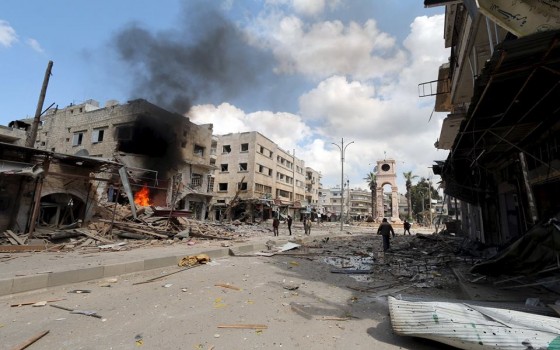
The United Nations Office in the Occupied Palestinian Territory reported continued violent Israeli bombardment from the air, land and sea across the Gaza Strip, especially in the central regions, including the Nuseirat and Maghazi camps.
In its daily update on the situation, the office indicated the continuation of ground operations and intense fighting between Israeli forces and Palestinian armed groups, especially in Khan Yunis, Jabalia, and the northern areas of the Gaza Strip.
He said that, according to reports, the air strikes targeted residential homes in areas in western and central Rafah, areas that the Israeli army determined were safe for displaced Palestinians. The UN office reported the continued firing of rockets by Palestinian armed groups into Israel.
Kamal Adwan Hospital
The office stated that the maternity department at Kamal Adwan Hospital in Beit Lahia, north of Gaza, was bombed, resulting in the killing of two mothers, according to reports, and the wounding of several people. The Office for the Coordination of Humanitarian Affairs said that the hospital is still surrounded by Israeli forces and tanks, with fighting reported with armed groups in the vicinity of the hospital for three consecutive days.
There are currently 65 patients in the hospital, including 12 children, in the intensive care department, and 6 children in nurseries. About 3,000 displaced people are still stranded in the hospital awaiting evacuation, amid severe scarcity of water, food, and electricity.
Difficult conditions in Rafah
The office said that tens of thousands of displaced people who arrived in Rafah, south of Gaza, since the third of this month, are still facing massive overcrowding conditions inside and outside shelters.
Large crowds wait for hours around aid distribution centers, hoping to receive food, water, shelter, health care and protection. By 10 pm on Monday, 100 trucks loaded with aid from Egypt entered Gaza.
The office indicated that about 121,000 liters of fuel entered the Gaza Strip from Egypt, an increase from the daily average during the previous three days, estimated at 67,000 liters. The UN office said that this increase is the minimum necessary to prevent the collapse of basic services.
The United Nations Office for the Coordination of Humanitarian Affairs reported that the Rafah Governorate in Gaza is witnessing a limited distribution of aid, while relief distribution has largely stopped in the rest of the Strip due to the intensity of fighting and restrictions on movement on main roads, with the exception of a limited delivery of fuel to major service providers and a high-risk mission to Al-Ahli Hospital. On the ninth of this month.
The office stressed that the humanitarian community continues to make tireless efforts to meet the basic needs of the people of Gaza wherever the need arises. He stressed the need for an urgent ceasefire.
This came after the United Nations Emergency Relief Coordinator, Martin Griffiths, renewed his deep concern about the situation of the residents of Gaza, in light of reports of violent fighting between Israeli forces and armed Palestinian factions in Gaza City and Jabalia in the northern Gaza Strip, and in Khan Yunis in the south, at a time when The Israeli bombing of Gaza continued.
The President of the United Nations General Assembly announced that he will hold on Tuesday the forty-fifth plenary session of the tenth emergency special session on: “Illegal Israeli actions in occupied East Jerusalem and the rest of the occupied Palestinian territory.”
The resumption of the emergency special session, at three in the afternoon on Tuesday, New York time, comes at the request of both Egyptian Ambassador Osama Abdel Khaleq - who holds the rotating presidency of the Arab Group, and Mauritanian Ambassador Sidi Ould Mohamed Lagdhaf - who holds the rotating presidency of the Organization of Islamic Cooperation group.
The tenth emergency special session of the General Assembly was held for the first time in April 1997 at the request of the Permanent Representative of Qatar after a series of Security Council and General Assembly sessions to consider the start of construction of the Har Homa settlement south of occupied East Jerusalem.
The session resumed on 26 October 2023, when the General Assembly adopted a resolution entitled “Protecting civilians and upholding legal and humanitarian obligations.”
Pursuant to its resolution entitled “United for Peace” of 3 November 1950, the General Assembly may convene an “emergency special session” if there appears to be a threat to the peace, a breach of the peace, or an act of aggression, and the Security Council is unable From being acted upon due to a negative vote (use of veto) by a permanent member.
To date, the General Assembly has held 11 emergency special sessions, five of which are on the Middle East.


No Comments Found