
The United Nations: We work side by side with the Egyptian government in the midst of the Gaza and Sudan crises.
- Europe and Arabs
- Friday , 9 February 2024 15:30 PM GMT
New York: Europe and the Arabs
Elena Panova, the United Nations Resident Coordinator in Egypt, confirmed that the United Nations is working side by side with the Egyptian government and the Egyptian Red Crescent to support efforts to coordinate and deliver humanitarian aid to Gaza. Nevin Al-Kabbaj, Minister of Social Solidarity in Egypt and Vice President of the Egyptian Red Crescent Society, said that the Society was ready to strengthen its efforts since the first day of the escalation. According to what the United Nations published in its daily news bulletin
This came in a joint dialogue conducted by United Nations News with Ms. Panova and Ms. Al-Kabbaj about cooperation between Egypt and the United Nations to enhance relief efforts heading to Gaza, and to assist refugees fleeing the war in Sudan in search of safety.
Al-Qabbaj said that the Egyptian Red Crescent has provided many volunteers since the beginning of the crisis in Gaza, especially since it has 36,000 volunteers ready for emergency situations, noting that they have “operations rooms equipped at the highest levels that monitor the situation and coordinate with the Palestinian Red Crescent.”
She added that since the beginning of the crisis in Gaza, “we have prepared ourselves through our warehouses, our connection with the country’s Supreme Emergency Committee and the relevant governors, and we are making sure that we have the goods, medical staff, coordination regarding medical issues, trauma and hygiene supplies, and the provision of food and water facilities.” "As well as coordination with local and international non-governmental organizations."
She also touched on the need to provide cash to train volunteers on the seriousness of the event, and the importance of the presence of volunteers, in addition to providing psychological and social support, and preparations in the city of Arish in North Sinai Governorate and the surrounding governorates.
Al-Kabbaj explained that the Egyptian Red Crescent Society is present in hospitals, and is also helping to provide housing and food, especially for the Palestinians stranded in Al-Arish, who “need cash assistance in order to live throughout their stay in Egypt. The cash support is greatly appreciated.”
The United Nations Resident Coordinator in Egypt, Elena Panova, said that the crisis in Gaza, and before that in Sudan, is in addition to two other major crises, namely the Covid-19 epidemic and the repercussions of the war in Ukraine.
She added, "All of these things forced us to rethink the way we work, because we are in a situation where we have to support development in an emergency situation," noting that the main role of the United Nations team in Egypt, before those crises, was primarily aimed at supporting the acceleration of... Achieving sustainable development goals in Egypt.
She stressed that the United Nations team was able to quickly expand the scope of its work, praising the “very close” partnership with the Egyptian government, especially the Ministries of Social Solidarity and Health and Population, which are “leading the response to these crises,” in addition to the Egyptian Red Crescent Society.
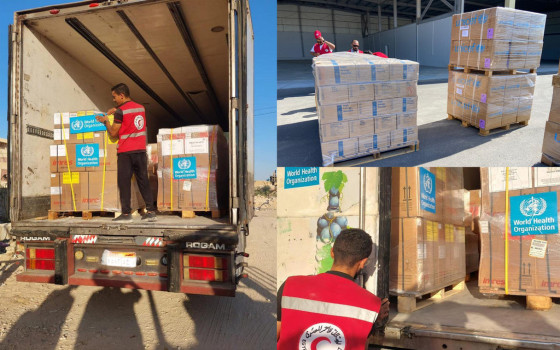
Regarding cooperation on Gaza, Panova said that the United Nations is working “side by side” with the Egyptian government and the Egyptian Red Crescent to support the “extremely demanding” process of delivering cross-border aid to Gaza.
She explained that the United Nations deployed a small humanitarian technical team in the city of Al-Arish working with the Egyptian Red Crescent, and it consists mainly of specialists in the logistical field, as well as experts in the management chain, and people to support the coordination of humanitarian aid and information management.
She added that of the number of trucks that have arrived in Gaza since the beginning of the crisis from the Rafah crossing and Kerem Shalom, about more than 35 percent of it is aid that the United Nations mobilized through several international bodies and agencies, namely: the World Food Program and UNICEF. , the United Nations Population Programme, the World Health Organization, the United Nations Development Programme, UN Women, the International Organization for Migration, and the United Nations High Commissioner for Refugees.
She stressed that the process of delivering aid is “very complicated,” as aid trucks coming from Al-Arish are subjected to inspection at the Nitzana crossing and then return to Gaza from the Rafah crossing, and each truck is examined separately by the Israeli authorities.
The UN official pointed out the use of a coding system used for aid trucks, which she described as "very important for transportation management as well as for transparency regarding the aid delivered to Gaza."
She praised the cooperation of the local authorities in North Sinai with the United Nations, as the Governor of North Sinai provided additional land to be used to manage and store humanitarian aid.
The Egyptian Minister of Social Solidarity noted the support provided to refugee women and children from Sudan.
In this regard, the United Nations Resident Coordinator in Egypt said that the United Nations team supported partners in Egypt to create “safe spaces” for women who, while fleeing the conflict in Sudan, are exposed to sexual and gender-based violence “and need a safe space where they can receive support.” Psychological, social and medical support.
Panova added that about 300 people arrive in Egypt daily from Sudan, “so, you can imagine, the numbers that come to Egypt and the pressure that they endure when it comes to the social system, the education system, and the health system.”
She explained that shortly after the first refugees began arriving in Egypt, the United Nations Emergency Relief Coordinator, Martin Griffiths, allocated funding from the Central Emergency Relief Fund to the United Nations team in Egypt in order to be able to expand the scope of the response.
The UN official stated that they worked to establish water, sanitation and hygiene facilities on the route that the refugees took on their way to Egypt, and more than 270,000 people received cash assistance from the United Nations and basic medical support.
The United Nations Resident Coordinator in Egypt, Elena Panova, thanked all humanitarian workers in Gaza, in Sudan, as well as in all other conflict countries, “because they perform life-saving work, often at great risk to their lives."
She recalled the memory of more than 150 fellow United Nations employees who lost their lives in Gaza since October 7, in addition to the Palestinian Red Crescent workers who died there.
She praised colleagues in Egypt, the United Nations, the NGO community and the Egyptian Red Crescent, as well as the Egyptian government “for its tireless efforts in establishing vital and life-saving operations.” “What unites us is our common humanity to serve all those in need,” she said.



No Comments Found