

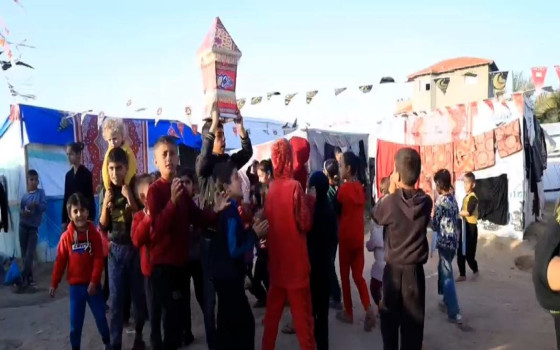
In light of the lack of food security in Gaza...one lantern is enough to cheer up a group of children in Ramadan...and the occupation authorities refuse the entry of the UNRWA commissioner

- Europe and Arabs
- Tuesday , 19 March 2024 14:4 PM GMT
Gaza - New York: Europe and the Arabs
Amidst simple tents made from whatever fabrics, plastic and wood were available, Ramadan decorations and some lamps and lanterns extended to illuminate the camp crowded with displaced people in Deir al-Balah in the central Gaza Strip, spreading a ray of hope amid the rubble of war. The goal of the children there is to change the atmosphere of war and decorate the camp in the holy month of Ramadan, despite all the difficulties. According to what was stated in a report on the United Nations News Bulletin website, which is affiliated with the international organization, which published a picture of a group of children carrying one large lantern to celebrate in a Ramadan atmosphere, the report added, “The child Shahad is one of the children in the camp who are having fun carrying decorations and Ramadan lanterns, which came this year while the war in Gaza entered its month.” The sixth, which resulted in the deaths of more than 31,000 people, most of whom were women and children.
Shahad told the UN News correspondent in Gaza, Ziad Talib, who visited the camp in Deir al-Balah, "Every year we welcome Ramadan in our homes, but this year is different. Ramadan has come upon us while we are in the middle of war."
She added, with a smile on her face and enthusiasm filling her voice, “We agreed to change the atmosphere of war and decorate the camp.”
In the same camp, Amira, who was displaced from the far north of Gaza to Deir al-Balah “from built houses to tents on the dirt,” follows the joy of children and their singing in a small square between the displacement tents. Amira said, "The children's joy is our joy. Despite the war and tragedy we are living through, we love joy, and we love to change the situation we are living in, and raise our morale and the morale of our people."
Amira confirmed that they decided to celebrate Ramadan despite the grief, loss, and distance from family, loved ones, and families.
Tragic situation
The United Nations Office for the Coordination of Humanitarian Affairs says that the hostilities in Gaza have displaced more than 1.7 million people, and that as the hunger crisis in Gaza worsens, almost the entire population has become dependent on food aid, which is still insufficient to meet the growing needs.
In the midst of this situation, people are trying hard to find something to support their families, especially during the month of Ramadan, including Ahmed Abd Rabbo Musleh, who was displaced from Beit Hanoun in the northern Gaza Strip, to Deir al-Balah in the center of the Strip.
Musleh told our correspondent in Gaza, "Ramadan is upon us and we are in the worst situation. Prices constitute a difficult tragedy." Musleh stressed that, despite the circumstances, he is able to provide food and drink for his family, but "there are those who cannot afford even bread."
He said that a simple meal could cost about 40 shekels (about 11 dollars), adding, "We cannot live at these prices."
One of the other displaced people said that he did not have any money, which forced him to get breakfast from one of the hospices, saying, "The situation this Ramadan is unprecedentedly tragic."
The displaced people and residents of the city of Deir al-Balah alike are suffering from difficult conditions, including Ahmed Thabet, who said, “Ramadan this year is different from any Ramadan we have experienced throughout our entire lives,” also pointing out the “exorbitant high prices,” and that no one can afford these high prices. .
The conditions that people in Gaza are experiencing were highlighted in the Integrated Food Security Phase Classification report, which was issued yesterday, Monday. The report stated that all Gazans face crisis levels of food insecurity or worse. He stated that half the population, 1.1 million people in Gaza, have completely exhausted their food supplies and coping capacities and are suffering from catastrophic hunger (IPC Phase 5) and starvation.
In the same context, Philippe Lazzarini, Commissioner-General of UNRWA, stated that the Israeli authorities refused him entry into the Gaza Strip on Monday. In light of the international report on food insecurity in Gaza and the impending famine in the northern Strip, Lazzarini said he tried to visit Gaza to coordinate and improve the humanitarian response.
He pointed out that the Relief and Works Agency for Palestine Refugees (UNRWA) has the largest presence on the ground among all other humanitarian agencies in Gaza. Lazzarini said that a lot of time had been lost and stressed the need to open all land crossings now to deliver relief. He added that famine can be avoided with political will.
UNRWA is the backbone of the humanitarian response in Gaza. The agency currently employs about 3,000 people in Gaza, and other agencies, whether UN or international, rely on it to continue their activity on the ground in the Strip.
The Integrated Food Security Phase Classification report issued yesterday stated that famine is imminent in the northern part of Gaza, which is home to about 300,000 people, and is expected to occur between mid-March and May. The report also stated that all Gazans face crisis levels of food insecurity or worse.
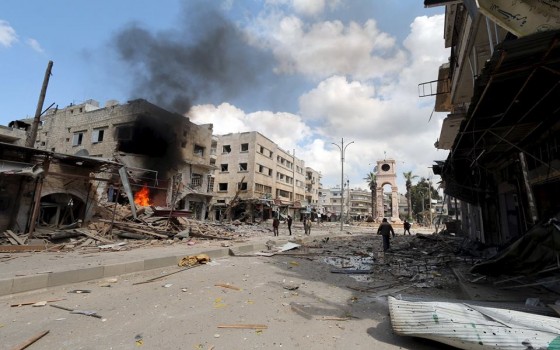
On the other hand, the United Nations Office for the Coordination of Humanitarian Affairs reported the continuation of intense Israeli bombing and ground operations, in addition to violent fighting between Israeli forces and armed Palestinian groups, in most parts of the Gaza Strip, especially in Deir al-Balah (central Gaza Strip) and near Al-Shifa Hospital in Gaza City (north).





No Comments Found