
European Union Foreign Minister: We are putting more pressure on Israel and will invite its Foreign Minister and the new Palestinian Prime Minister to visit Brussels
- Europe and Arabs
- Tuesday , 19 March 2024 15:51 PM GMT
Brussels: Europe and the Arabs
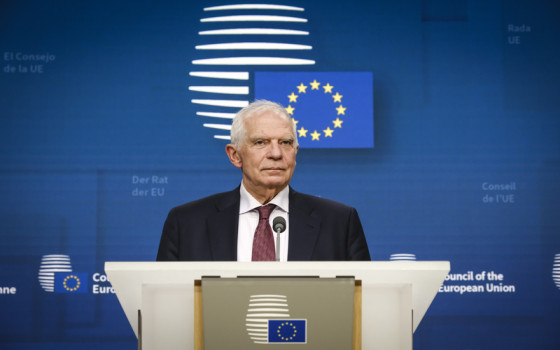
European Foreign Policy Coordinator Josep Borrell said that the unified bloc is already exerting pressure on Israel, and that this matter began some time ago. The matter is not limited only to the European Union and its member states, but also the United States is also exerting pressure on the Israeli government due to the current catastrophic situation in Gaza. Borrell received journalists’ questions in The final press conference on Monday evening received the following question: We read the reports, we hear you talking, and we listen to the ministers who enter the Foreign Affairs Council meeting denouncing the famine in Gaza. But what can the European Union do to literally and literally help the people in Gaza? You are now inviting the Minister of Foreign Affairs of Israel; What do you expect from him? Do you want to put some pressure on him to stop the famine or not attack Rafah?
Borrell said: Of course, we will apply pressure. We do it. German Chancellor Olaf Scholz went to discuss with Israeli Prime Minister Benjamin Netanyahu and I think he put a lot of pressure, saying that the Europeans cannot sit back and watch what is happening, they cannot look at the starvation of the Palestinian people. The Palestinians did nothing. So, I understand that this statement - and other statements - also coming from the United States are an expression of the desire to put pressure on Israel to make it understand that it has to allow more humanitarian support to reach Gaza. But on our part - perhaps others can take other measures - but on our part it is political and diplomatic pressure on Israel, in order to make them understand that this situation is unacceptable. This is what all political leaders in the European Union say. Today there was a clear consensus that the situation is unacceptable, and the only solution is to exert political pressure on Israel.
Another question: Regarding Israeli extremists, can you name the organizations? Are there individuals? What exactly are the penalties? Is it a travel ban in addition to freezing their assets? How do you identify those assets?
Borrell said: These are specific people who have been identified as responsible for acts of violence against settlers. Our sanctions are always individual, and they are always of the same nature: preventing access to European territory, and freezing assets if they are identified. What else can we do? We always punish individuals and organizations in the same way. You are not allowed to come to Europe, and if you have assets we will freeze them.
And that would be the same thing we do with those violent people whose names, as Don Quixote says, I don't want to remember. I also don't think the name in particular is important, because it doesn't exist in my mind. But they have already been fully identified, and sanctions have been proposed.
Now what was not approved in the previous Foreign Affairs Council will be put back on the table, and that has now been done.
During his statements at the press conference, Borrell said that the World Food Program issued a report today on the situation in Gaza. The report says that they have never seen a famine like that suffered by people in Gaza. 70% of the population is at risk of famine, and 100% - that is, almost everyone - is suffering from severe nutritional stress.
We have discussed the Cyprus sea route. I issued a statement this afternoon with [Humanitarian Aid and Crisis Management] Commissioner Janez] Lenarčić about this situation in Gaza.
Certainly, when we talk about the situation in Gaza, we must reiterate our condemnation of Hamas' attacks and demand the release of the hostages - as we always do. But this statement from this body linked to the World Food Program is very important to get a clear understanding of what is going on there.
The Cyprus sea route must certainly be developed, but Israel must facilitate greater access to it by land.
I want to reiterate once again that all hostages should be released unconditionally. No one should compromise the lives of civilians.
Then we talked about the sanctions imposed on Hamas. We also agreed to impose sanctions on extremist settlers. It was not possible in the last Foreign Affairs Council; This time it was possible.
A strong working compromise has been agreed. I hope this continues until full adoption soon. But the political agreement exists.
We also had a steering discussion on the EU-Israel Association Agreement. This Partnership Agreement is clearly based on the values we share – respect for human rights, the rule of law and democracy.
We must continue to work with Israel to continue discussing the situation in Gaza. Certainly, the call for an Association Council was complex and did not [receive] strong support because first, you have to agree on the agenda, you have to agree on a common position from the member states, which will be very difficult to get. .
On the contrary, many Member States had to, instead, in order to continue communicating with Israel and discuss this issue, once again invite the Minister of Foreign Affairs of Israel [Yisrael Katz] to attend the Foreign Affairs Council, and certainly the President should also be invited New Palestinian Authority Minister Muhammad Mustafa to listen to the Palestinian side.
In any case, respect for human rights around the world is a matter of concern to us, wherever there is a problem. We have an EU Special Representative for Human Rights [Olov Skoog] who looks after these issues around the world. What is happening in Gaza is also a matter of concern to all of us, as we remember, again and again, the terrorist attack launched by Hamas against the Israeli people. But the answer from Israel must be studied and taken into account. Many voices have been raised demanding that Israel not attack Rafah and take further measures to protect civilians.


No Comments Found