

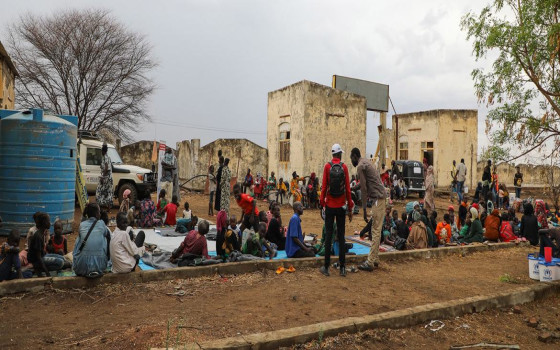
UN officials in the Security Council: The situation in Sudan is one of the worst humanitarian disasters in recent memory

- Europe and Arabs
- Thursday , 21 March 2024 16:28 PM GMT
New York: Europe and the Arabs
The UN Security Council held a session to discuss food insecurity in Sudan under the item “Protection of Civilians in Armed Conflicts.” The Council heard briefings from the Food and Agriculture Organization (FAO), the Office for the Coordination of Humanitarian Affairs, and the World Food Programme. According to what was stated in the daily news bulletin of the United Nations
The meeting on Wednesday came in the wake of the white paper on food insecurity in Sudan that the Office for the Coordination of Humanitarian Affairs sent to Council members on March 15.
The White Note was sent in accordance with Resolution 2417 of 2018, which requests the Secretary-General to promptly report when “the risk of conflict-induced famine and widespread food insecurity” occurs.
Over the past 11 months, Sudan has been suffering from the devastating humanitarian consequences of the fighting that broke out on April 15, 2023 between the Sudanese Armed Forces and the Rapid Support Forces. More than 14,790 people have been reported killed since the beginning of the conflict until 15 March.
Speaking via videoconference, Maurizio Martina, deputy director of the Food and Agriculture Organization (FAO), said the scale of hunger across Sudan is deeply concerning, as some areas - particularly in West and Central Darfur - are likely to slide into a catastrophic state of food insecurity. As the lean season approaches in May.
Conflict is driving this hunger crisis, restricting agricultural production, destroying key infrastructure and livelihoods, disrupting trade flows, causing sharp price increases, restricting humanitarian access, and leading to large-scale displacement, he said. He explained that the spread and escalation of fighting directly affects food security, especially with the conflict reaching new areas, especially in the states of Gezira, Sennar, and White Nile, which are the main food basket in Sudan.
Maurizio Martina said that Sudan's economy depends heavily on the agricultural sector - as nearly 65 percent of its population works in agriculture - noting that the people who succeeded in producing food despite the conflict are rapidly depleting their reserves, and those who depend on markets to obtain Food is suffering from a sharp rise in prices, while those who depend on humanitarian aid are becoming increasingly difficult to reach.
He added: “During the last harvest season - which runs from October to February, which is usually the time when food is most available in Sudan, an estimated 18 million people are expected to face crisis or worse levels of insecurity.” "This is the worst level of hunger ever recorded by the IPC during the harvest season."
On Tuesday, FAO released its annual Sudan Crop and Food Supply Assessment Report, which examined food production in 2023 and assessed food supplies across Sudan's 18 states.
The FAO Deputy Director said that the results of the report showed the damage caused by the conflict to agricultural production, including that the performance of the main cereal production season for 2023 was very poor due to the impact of the conflict, as it decreased by 46 percent from the previous year’s crop. Maurizio Martina described the prospects for food production in 2024 as bleak.
One of the worst humanitarian disasters in recent memory
Edem Wosorno, Director of Operations and Advocacy at the Office for the Coordination of Humanitarian Affairs, said that a humanitarian farce is taking place in Sudan under a cover of international neglect and inaction. “Simply put, we are failing the people of Sudan,” she added.
It warned of widespread and rapidly deteriorating food insecurity in Sudan. She went on to say: “By all standards – the sheer scale of humanitarian needs, and the numbers of displaced people facing hunger – Sudan is one of the worst humanitarian disasters in recent memory.”
The conflict has already led to the largest internal displacement crisis in the world: 6.5 million people have been internally displaced since the beginning of the current crisis, in addition to the 3 million who were already displaced before the start of the last war. Another 1.8 million people took refuge in neighboring countries.
In such a situation, she and Surno stressed the need for the delivery of humanitarian aid to be a lifeline for millions of people who have lost almost everything due to the conflict. She expressed regret at the severe obstacles that still face the process of reaching the most vulnerable groups, especially in the states of Khartoum, Darfur, Kordofan and Gezira.
She described the high-level conference on Sudan and its neighbors scheduled to be held in Paris on April 15 as an important opportunity to make concrete commitments to support the aid operation and address suffering - including by increasing financial contributions to the Sudan 2024 Humanitarian Appeal, which received $131 million - 5 percent. - Out of a total of $2.7 billion required.
The content of the white note
Edem and Sorno said that the white paper recently submitted by the Office for the Coordination of Humanitarian Affairs to the Security Council includes recommendations on urgent steps to address the escalating food insecurity crisis. These include:
First, to ensure that parties respect their obligations under international humanitarian law – including the prohibition of the use of starvation as a means of warfare and the protection of vital goods, infrastructure and services needed for food systems and production,
Secondly, to ensure the parties’ commitment to a sustainable humanitarian dialogue to facilitate humanitarian access across conflict lines and borders,
Third, increase funding for humanitarian operations,
Fourth, press for an immediate ceasefire and a peaceful solution to the conflict.
A forgotten crisis that requires political solutions to stop the fighting and prevent famine





No Comments Found