

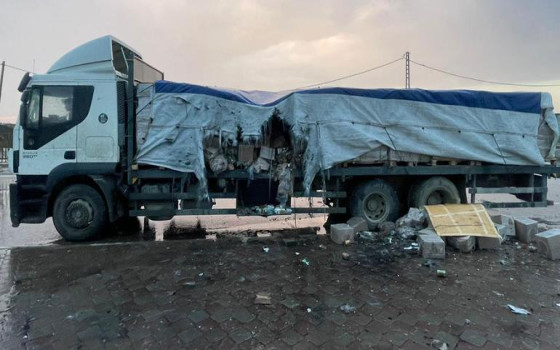
The bombing of hospitals continues, and Israel has informed the United Nations of its refusal to allow UNRWA food convoys to pass into northern Gaza

- Europe and Arabs
- Monday , 25 March 2024 14:14 PM GMT
Gaza - New York: Europe and the Arabs
Palestinian media said, on Monday, that an Israeli bombing targeted the upper floor of the Al-Shifa Medical Complex in Gaza City and the vicinity of Al-Amal Hospital in Khan Yunis in the southern Gaza Strip.
Shehab News Agency reported that Israeli forces also bombed the areas of Al-Batn Al-Samin and Qaizan Al-Najjar in Khan Yunis.
On Sunday, the World Health Organization expressed grave concern about the safety of patients and health workers at Al-Amal Hospital in Khan Yunis in the southern Gaza Strip, amid reports of Israeli forces’ siege and attack on the hospital again, and called for urgent permission to allow safe access to the hospital to provide life-saving care to patients.
The Israeli authorities have informed the United Nations that they will no longer approve the passage of any UNRWA food convoys into northern Gaza. UNRWA Commissioner-General Philippe Lazzarini described the decision as outrageous and said it made it intentional to obstruct life-saving aid during a man-made famine in the north of the Strip.
Lazzarini stressed the need to lift these restrictions. He said that UNRWA - the backbone of the humanitarian response in Gaza - is the largest relief agency in the Strip and has the greatest ability to reach displaced communities in Gaza.
He stated in a post on the X website: “As of today, UNRWA - the lifeline of Palestine refugees - is prevented from delivering life-saving humanitarian aid to northern Gaza. Despite the tragedy unfolding before us, the Israeli authorities have informed the United Nations that they will no longer approve convoys.” UNRWA food heading to the north.
He added: "By preventing UNRWA from fulfilling its mandate in Gaza, the clock will tick faster towards famine and many more people will die from hunger, dehydration and lack of shelter." He stressed the need not to allow this to happen, and said that this would tarnish our collective humanity.
Director-General of the World Health Organization, Dr. Tedros Ghebreyesus, said that preventing UNRWA from delivering food is depriving starving people of the ability to survive. He stressed the need to reverse this decision, given the levels of acute hunger in Gaza.
“All aid delivery efforts must not only be permitted, but food delivery must be immediately expedited,” he said.
The Integrated Classification of Food Security Phases report in the Gaza Strip reported that famine is imminent in the northern part of the Strip and is expected to occur between now and May in the two northern governorates, which are home to about 300,000 people.
“Let us determine who is responsible for obstructing relief.”
Under-Secretary-General for Humanitarian Affairs, Martin Griffiths, said in a post on his account on the
He added: “The restrictions imposed on the distribution of aid inside Gaza are placed by those who prevent the movement of convoys that aim to feed tens of thousands of people suffering from extreme hunger. They are placed by those who refuse to open the crossing points leading directly to the north, where hundreds of thousands are at imminent risk of starvation. "Putted by those who continue to bomb Gaza."
Martin Griffiths stressed the need for Israel to lift all obstacles to aid, and for a ceasefire now.
US financing situation
On the other hand, and earlier, the Commissioner-General of UNRWA said that the US foreign aid spending bill for 2024 limits funding to UNRWA until March 2025. He added that this decision will have consequences for Palestine refugees in Gaza and the region.
He added that the humanitarian community in Gaza is racing against time to avoid famine and that any gap in funding for UNRWA - which is the backbone of the humanitarian response in the Strip - will undermine access to food, shelter, primary health care and education at an extremely difficult time.
He said that Palestine refugees are counting on the international community to increase its support to meet their basic needs.
The United Nations Relief and Works Agency for Palestine Refugees (UNRWA) supports about 5.9 million Palestinian refugees in its five areas of operations: Gaza, the West Bank including East Jerusalem, Jordan, Lebanon and Syria.
Lazzarini expressed his appreciation for UNRWA’s supporters from members of Congress “who speak on behalf of the agency during this difficult period,” and the support of US Secretary of State Anthony Blinken last week with the European Union.
He stressed that the agency will continue to work with the United States on the path of joint commitment towards Palestine refugees and peace and stability throughout the region. He said that UNRWA, along with donors and partners, will continue to implement its mandate entrusted to it by the United Nations General Assembly to protect the rights of Palestine refugees until a lasting political solution is reached.
The United Nations General Assembly established UNRWA in 1949 and mandated it to provide humanitarian assistance and protection to Palestine refugees registered in the Agency’s areas of operations until a just and lasting solution to their plight is reached.
UNRWA operates in the West Bank - which includes East Jerusalem - the Gaza Strip, Jordan, Lebanon and Syria.
Seventy-five years later, tens of thousands of Palestine refugees who lost their homes and livelihoods due to what happened in 1948 are still displaced and in need of support.
UNRWA helps Palestine refugees achieve their full potential in human development, through the qualitative services it provides in the fields of education, health care, relief and social services, protection, infrastructure and camp improvement, microfinance, in addition to emergency aid. UNRWA is funded almost entirely through voluntary contributions.




No Comments Found