

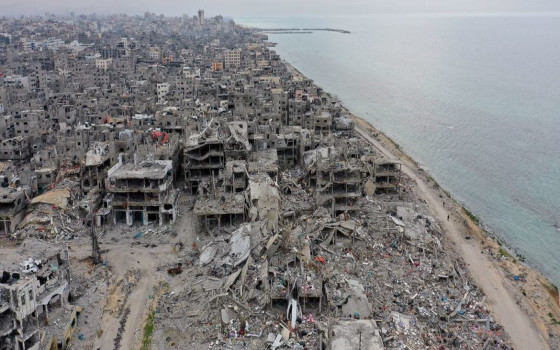
The Israeli response to the Security Council’s decision to stop the fighting...a new bombing in the vicinity of the Al-Shifa Medical Complex in Gaza, killing dozens...and the Arab League announces international action to impose sanctions
- Europe and Arabs
- Tuesday , 26 March 2024 15:49 PM GMT
Capitals: Agencies
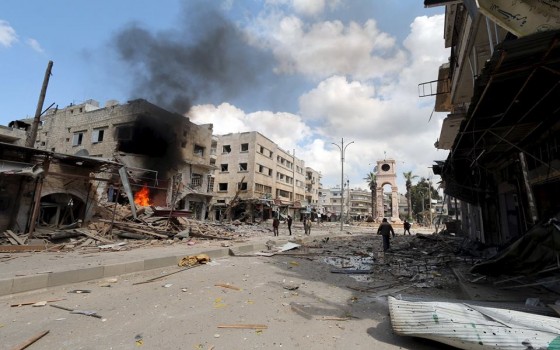
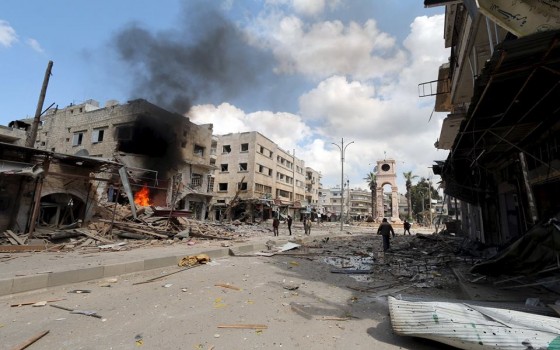
Palestinian media reported that 30 martyrs were killed in an Israeli bombing that targeted a house in the vicinity of Al-Shifa Medical Complex, west of Gaza, according to urgent news from the Cairo News Channel.
The Palestinian Ministry of Foreign Affairs warned against the consequences of any explanations or mechanisms that would empty the Security Council resolution of its content, adding that the Security Council resolution constitutes a valid basis for reaching a permanent ceasefire in Gaza.
The Palestinian Foreign Ministry called for the immediate implementation of the UN Security Council resolution regarding the ceasefire in the Gaza Strip.
Former US President Donald Trump said that Israel made a grave mistake in its response to the October 7 attack, and that it is losing a lot of support around the world, but at the same time he said that he would have behaved in a very similar way as Israel did if he had been subjected to such an attack.
Commenting on the issuance of the Security Council resolution regarding the ceasefire resolution in Gaza, Ambassador Majed Abdel Fattah, head of the Arab League mission to the United Nations, said, “The importance of issuing this resolution comes after the use of the veto on the American draft resolution, which was opposed by the Arab group and which was voted on.” It was approved last week and included a large number of positions that constitute red lines for the Arab group, whether it was condemning Hamas as a terrorist organization and including it on the terrorist lists in the United Nations, changing the status of UNRWA, transferring its powers, dealing with the issues of prisoners and detainees, and other provisions with which the Arab group was dissatisfied. Noting that action has begun in the United Nations General Assembly to impose sanctions against Israel in the event of non-compliance with the Security Council resolution.
Ambassador Majed Abdel Fattah indicated, during press statements, that the resolution that was approved was submitted by 10 countries elected to the Security Council, namely: Algeria, Japan, Switzerland, Mozambique, Malta, Guyana, South Korea, Slovenia, Sierra Leone and Ecuador, and stays away from political issues and focuses on a number of important factors, and he explained. The decision includes a ceasefire until the end of Ramadan and work to reach a permanent and comprehensive ceasefire.”
He pointed out that the United States is interested in the ongoing negotiations in Doha with Egyptian-Qatari mediation, and therefore recognizes the importance of these negotiations and its role in the possibility of reaching a ceasefire, adding that after that, the process of exchanging Israeli hostages for Palestinian prisoners will be considered.
He said, "The basic element is the unity of the Arab position, adding that the Union of Arab States, alongside the League of Arab States, can achieve its goals."
He added, "Before the beginning of the session, we refused to condemn Hamas by the United States, and Washington realized that it could not continue talking about a humanitarian truce."
In response to a question about Israel’s non-compliance with the Security Council ceasefire resolution, Ambassador Majed Abdel Fattah, head of the Arab League mission to the United Nations, said, “In accordance with Article 25 of the Organization’s Charter, Security Council resolutions are binding on all member states of the United Nations, even if “Israel has decided not to implement the resolutions. The Security Council will be resorted to issuing punitive resolutions under Chapter Seven for anyone who defies the Council’s decisions.”
Ambassador Majed Abdel Fattah added, "Movement has begun in the United Nations General Assembly to impose sanctions against Israel in the event of non-compliance with the Security Council resolution. There are also a large number of countries that have begun to stop exporting weapons to Israel, such as Belgium, Portugal, Greece, and even the loading workers in India have refused." Loading loads of weapons that were to be exported to Israel.”
He called on all countries to impose sanctions or an arms embargo on Israel, or a visa ban on settlers, and a ban on purchasing settlement products, noting that there are many punitive measures that can be imposed on Israel through the Security Council or the General Assembly, and the punitive measures will be escalated on it until it adheres to the Security Council’s resolution.
He said, "Israel is taking shelter in America, so it is not complying with Security Council resolutions," explaining that the United States allowed the resolution to pass because it has certain information that a ceasefire and prisoner exchange agreement is approaching, through the Doha negotiations, pointing out that America is trying to distance its ally, Israel, from The United Nations, where agreements are made outside the United Nations and when the final agreement is approved in the United Nations.”
He added, "America does not want the United Nations to take decisions that force Israel to implement anything, and therefore when these punitive measures are requested, the United States will use its veto power against it, which prompts us to resort to the alternative, which is the United Nations General Assembly, in which talk has already begun about these measures." procedures".





No Comments Found