

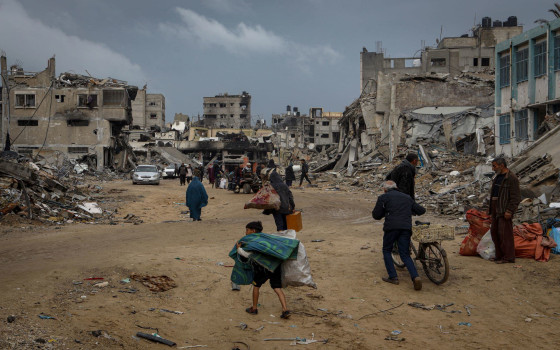
The international community continues to remain silent in light of the continued suffering of the Palestinians. The United Nations: Any effort to distribute aid in Gaza without UNRWA is doomed to failure.

- Europe and Arabs
- Tuesday , 2 April 2024 15:4 PM GMT
Gaza - New York: Europe and the Arabs
Under-Secretary-General for Humanitarian Affairs and Emergency Relief Coordinator, Martin Griffiths reiterated that the Palestine Relief and Works Agency (UNRWA) is the backbone of the humanitarian operation in Gaza. He said, "Any effort to distribute aid without UNRWA is doomed to failure."
In a post on his X account, Martin Griffiths stressed that “no other agency has the same reach, experience or community trust needed to do this job.”
UNRWA, in turn, emphasized its vital role in the humanitarian operation, as it said in a post on the X website that it had provided flour to more than 1.8 million people, equivalent to 85% of the population, since the beginning of the war in Gaza, in addition to nearly 600,000 people receiving food parcels. Emergency.
UNRWA also reported that it provided approximately 3.6 million medical consultations and shelter to hundreds of thousands of families. According to what was stated in the United Nations daily news bulletin, a copy of which we received on Tuesday morning
A firm position towards UNRWA
In response to a journalist's question about what was published by the media that Israel had submitted a proposal to dismantle UNRWA and that the proposal was presented to United Nations officials in Israel and they referred it to the Secretary-General, United Nations spokesman Stephane Dujarric denied that any colleagues in the region were aware of such a document.
Dujarric said in the daily press conference, yesterday, Monday, that the Office of the Secretary-General had not received such a document until this morning. Dujarric added: “Our position on UNRWA remains consistent, which is that UNRWA is a lifeline of hope and services for millions of Palestinians in the region, including in Gaza. It is currently the backbone of our humanitarian operations there.”
The death toll among UNRWA employees has increased
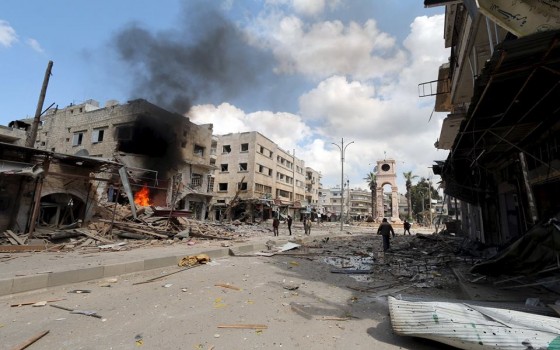
UNRWA said in its latest update issued on Monday that Israeli forces continued their military operations throughout the Gaza Strip, which led to more civilian casualties, the displacement and destruction of homes and other civilian infrastructure, and air strikes and bombing continued in northern Gaza, Khan Yunis and Rafah.
UNRWA estimates indicate that about 1.2 million people now live in Rafah, the vast majority of them in formal and informal shelters. It reported that as of March 30, up to 1.7 million people, or more than 75% of the population, had been displaced throughout the Gaza Strip, the majority of whom had been displaced several times, as families were forced to move repeatedly in search of safety.
UNRWA added that as of 30 March, two UNRWA staff members had been confirmed killed, bringing the total number of UNRWA staff killed since the start of the war in Gaza to 173.
The United Nations Office for the Coordination of Humanitarian Affairs reported at the weekend that since March 1, the Israeli authorities have prevented the access of 30% of humanitarian aid missions to northern Gaza and 10% of missions to the southern Gaza Strip.
The office warned that the blockade imposed on Gaza, including closed crossings, and the lack of water and electricity, are key elements of the major humanitarian catastrophe unfolding in Gaza.
In the same regard, “major destruction makes it impossible to work again at the Al-Shifa Medical Complex in northern Gaza. In this way, the Al-Shifa Medical Complex has ended forever.” This is what Dr. Marwan Abu Saada, Acting Director of Al-Shifa Medical Complex, said after the end of the Israeli siege on the complex, which lasted about two weeks.
Before the war, Al-Shifa Complex was the largest hospital in the Strip, and it treated four hundred and fifty patients on a daily basis, but it has now turned into rubble. Dr. Marwan Abu Saada says about this: “All the buildings of Al-Shifa Medical Complex were destroyed and burned completely. There was great destruction of buildings and facilities.” The Ministry of Health is to the point where it is not possible to work again at Al-Shifa Medical Complex.”
Dr. Marwan Abu Saada spoke about the condition of Al-Shifa Medical Complex before the current war, saying: “This medical complex contained seven hundred and fifty beds, more than twenty-six operating rooms, thirty-two intensive care rooms, a central laboratory for the Ministry of Health, and a dialysis department with a capacity of fifty-two.” Four hundred and fifty patients were treated daily, and the emergency department had a capacity of sixty-two beds. The number of visitors to the emergency department annually reached more than a quarter of a million, and more than seventeen thousand operations were performed annually in this complex.”
Yesterday, Monday, United Nations spokesman Stephane Dujarric said that the United Nations is planning to send a mission to the hospital as soon as possible, indicating that the mission will provide medical assistance to the people there as well as evaluate the hospital’s condition. He added that the World Health Organization reported the death of 21 patients during the siege.




No Comments Found