

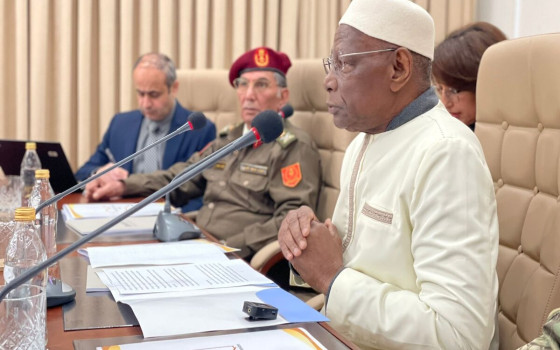
Resignation of the United Nations representative in Libya: “It is frustrating to see individuals in positions of authority putting their personal interests above the needs of their country.”
- Europe and Arabs
- Wednesday , 17 April 2024 14:8 PM GMT
New York - Tripoli: Europe and the Arabs
The “selfish insistence” of Libya’s current leaders to maintain the status quo through “stalling tactics and maneuvers at the expense of the Libyan people” must stop, said the Special Representative of the UN Secretary-General for Libya, Abdullah Batili. He stressed that the narrow interests of a few people should not be allowed to overshadow the aspirations of 2.8 million registered voters in Libya. According to the United Nations daily news bulletin
After presenting his briefing on the situation in Libya to the Security Council yesterday, Tuesday, Batelli spoke to reporters outside the Council hall, declaring that he had submitted his resignation to the Secretary-General.
"With a deep sense of disappointment, it is disappointing to see individuals in positions of power putting their personal interests above the needs of their country," Battelle told the Security Council.
Batelli, who also heads the United Nations Support Mission in Libya (UNSMIL), stressed that across the country, well-meaning Libyans from political parties, civil society organizations, various communities, the business sector, military and security groups, as well as women and youth, are expressing their impatience. To break the current stalemate and save their country from the dynamics of chaos and failure.
Batelli noted the intensification of his contacts with the five main Libyan stakeholders since his invitation to dialogue to resolve all disputed issues related to electoral laws and the formation of a unified government, as he proposed ways to address their concerns while maintaining the integrity of the dialogue initiative as originally proposed.
He added, "Unfortunately, my attempts to address their concerns were met with stubborn resistance, unreasonable expectations, and indifference to the interests of the Libyan people."
"A competitive arena"
The Special Representative of the UN Secretary-General for Libya noted that the preconditions put forward by the Libyan leaders contradict their stated intention to find a Libyan-led and Libyan-owned solution to the conflict, and that “so far, they have not demonstrated their good faith.”
He warned that these entrenched positions are stimulated by a divided regional and global landscape, which leads to the perpetuation of the status quo that may expose Libya and the region to further instability and insecurity.
The UN official said that since the end of 2022, UN-led efforts to help resolve the political crisis in Libya through elections have faced national and regional setbacks, revealing a deliberate challenge to engage seriously and an insistence on permanently delaying the elections.
Batelli pointed to growing concerns about the weakening of the international consensus on Libya among Libyans, “as their country has become an arena for fierce competition between regional and international actors motivated by geopolitical, political and economic interests, as well as competition that extends beyond Libya and relates to its neighbours.”
He added, "The renewed scramble for Libya, its location, and its enormous resources among internal and external players makes a solution out of reach."
Meetings across Libya
The head of the United Nations Support Mission in Libya (UNSMIL) spoke about his visits he made recently to areas in Libya, including Tarhuna, Jado, and Bani Walid, and his meetings with notables, representatives of local communities, and political activists.
Batelli said that during these meetings, he heard concerns about political and economic exclusion, social injustice, and the plight of political prisoners, as well as aspirations for equal rights.
He added that during those meetings, he stressed the importance of achieving true, rights-based national reconciliation for the success of the political process, and urged local residents to increase their political activity through their representatives to generate the necessary social pressure to support the elections.
He also noted that he encouraged the High National Elections Commission to move forward with municipal council elections, which are still facing obstacles due to insufficient government support for this crucial process.
Economic situation
The UN official touched on the economic situation in Libya, which he said was witnessing severe exhaustion, amid warnings from the Central Bank of Libya of an imminent liquidity crisis.
He called on the Libyan authorities to address not only the symptoms, but also the root causes of the ongoing harmful economic and financial practices, adding that these practices affect the entire country, and the well-being of the general population, while enabling Libyan stakeholders to maintain the status quo.
He urged the Libyan authorities to quickly agree on a national budget and decisively address significant shortcomings in the transparent, fair and responsible management of state resources for the benefit of all Libyans, including those living in marginalized areas in the south.
He also stressed the need to give priority to women's economic empowerment, adding that despite the great potential available to women to contribute to the Libyan economy, there are various structural barriers that hinder their participation.
Patelli called for "intensifying efforts to enable women to participate fully in the economy, and to ensure that both women and men contribute to the country's prosperity."
A worrying trend
The Special Representative of the United Nations Secretary-General for Libya warned that the economic dimension of shifting alliances between institutional, political and security actors constitutes a worrying trend with an increasing potential to undermine peace and stability, noting that this trend was particularly evident in western Libya, especially in cities such as Tripoli and Misrata.
Batelli added, "The presence of armed actors and heavy weapons in the Libyan capital is a source of great concern as it poses a major threat to the safety of the civilian population. I urge all stakeholders to seek a peaceful solution to the growing tensions and avoid any further escalation."
The UN official pointed to some "worrying internal trends" at the security level, including the city of Zawiya, but stressed that no violation of the ceasefire agreement had been recorded.
He pointed out that progress in implementing the pending provisions of the ceasefire agreement, especially with regard to the withdrawal of foreign fighters, foreign forces and mercenaries, “remains hampered by political stagnation and instability in the southern countries neighboring Libya, where many foreign fighters and mercenaries hail from.”
Undermining freedoms and spreading fear
The head of the UNSMIL mission expressed deep concern about the increase in kidnappings, disappearances and arbitrary arrests in Libya, committed by security forces with impunity in both the eastern, southern and western regions, undermining basic freedoms and spreading fear.
He stressed that legislative reforms to protect civic space are crucial, calling on the Libyan authorities to continue to support the initiative led by the Special Rapporteur on freedom of assembly and association to uphold human rights obligations.
Batelli also expressed deep concern about the dire situation of migrants and refugees in Libya who are subjected to human rights violations throughout the migration process.
He said that the discovery of mass graves in southwestern Libya on March 22, which contained the bodies of 65 migrants who died while being smuggled across the desert, is “very sad,” calling for strengthening regional cooperation to ensure the protection of migrants.
He also touched on recent reports from Sebha of horrific treatment of migrants during arbitrary detention, saying that this underscores the urgent need for the Libyan authorities to take measures to alleviate human suffering.
An indispensable condition
The UN official expressed regret at the postponement of holding a national reconciliation conference, which was scheduled in Sirte on April 28.
He stressed that UNSMIL will continue to support the national reconciliation process, including setting a new date, place, agenda and other preparations for this conference.
At the conclusion of his briefing, he called on the members of the Security Council to assume their responsibility in word and deed, individually and collectively, by demonstrating unity to force Libyan and regional stakeholders to support the efforts of the United Nations Support Mission in Libya to restore unity and legitimacy to Libyan institutions through political dialogue.
“Peace and stability in Libya remain an indispensable condition for the stability of the Sahel and the region as a whole,” Batelli said. “Renewed and coordinated commitment between regional and international actors is more imperative than ever before.”




No Comments Found