
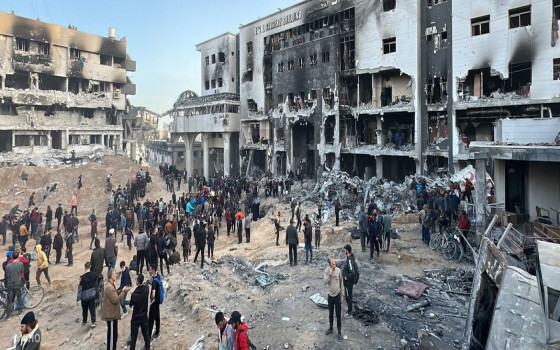
On the eve of the 200th day of Israeli bombing, the series of Palestinian martyrs continues, and the United Nations announces the purchase of new trucks to enhance the delivery of humanitarian aid.

- Europe and Arabs
- Sunday , 21 April 2024 12:33 PM GMT
Gaza - New York: Agencies - Europe and the Arabs
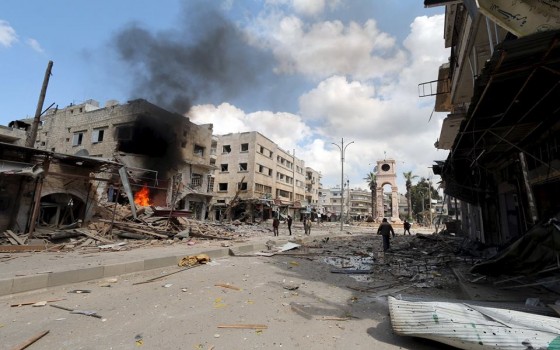
Israeli aircraft continued their bombing of various areas of the Gaza Strip on the 198th day of the war, leaving dozens of martyrs and wounded. According to what was published by the Nablus Television website this morning, it added, “The Israeli occupation committed four massacres against families in the Gaza Strip, leaving 37 martyrs and 68 injured within 24 hours.” The toll of the Israeli aggression rose to 34,049 martyrs and 76,901 injuries since the seventh of last October.
Israeli occupation aircraft continued their raids on the city of Rafah, south of the Gaza Strip, leaving 18 martyrs and a large number of wounded within 24 hours.
A citizen from the Jouda family was also martyred along with his pregnant wife and daughter, while doctors were able to perform a cesarean section on the mother before she was martyred, as the fetus survived death.
The occupation aircraft targeted a house near the Egyptian-Palestinian border, without causing any casualties.
In Khan Yunis, two citizens were martyred and a number of others were injured in a raid that targeted the tents of displaced people in Mawasi Khan Yunis, south of the Gaza Strip.
The occupation aircraft had previously bombed the tents, causing many casualties.
Civil defense crews in Khan Yunis Governorate recovered the bodies of 50 martyrs of different categories and ages, who had been collected by the occupation forces and buried collectively inside the Nasser Medical Complex.
The Civil Defense indicated that search operations will continue and the rest of the martyrs will be recovered during the coming days, as there are still a large number of them.
Palestinian doctor Moin Saed was martyred and his son was seriously injured in the bombing of his clinic in the Bureij refugee camp in the central Gaza Strip.
Two citizens were also martyred in a bombing that targeted the vicinity of Abu Helu School in the center of the camp. They were transferred to Al-Aqsa Martyrs Hospital, which received two martyrs who died near Wadi Gaza.
The occupation artillery bombed the Al-Mughraqa area in the central Gaza Strip.
A citizen and his wife were martyred in the bombing of a citizens’ gathering in the town of Jabalia and were taken to Kamal Adwan Hospital.
The occupation army also destroyed a house in the Shati camp, west of Gaza, without causing any casualties.
Artillery shelled various areas north and east of Gaza City.
In the same context, the United Nations transferred 15 trucks to Gaza out of 30 it purchased to enhance the delivery of humanitarian aid to the Strip and increase the fleet of trucks, which has become very limited in the Strip after most of the trucks transporting aid in the Strip since the beginning of the war were destroyed or damaged.
Stephane Dujarric, spokesman for the Secretary-General, said that the cost of purchasing and transporting the trucks amounted to approximately $3.5 million, financed by the Humanitarian Fund for the Occupied Palestinian Territory.
On the other hand, Dujarric said that the United Nations received information that the amount of solid waste accumulated throughout the Gaza Strip had reached 270 thousand tons, according to the Union of Gaza Municipalities. He stated that this would cause an environmental and public health disaster. He pointed out that the destruction of garbage management facilities and medical waste centers has greatly undermined municipal solid waste collection and disposal. According to what was stated in the daily news bulletin of the United Nations
Continuing obstacles
The United Nations Office for Humanitarian Affairs said that the ongoing hostilities in Gaza, destroyed roads and widespread unexploded ordnance pose significant risks to humanitarian workers.
These challenges also hamper the transportation of relief supplies throughout Gaza, in addition to restrictions on fuel supplies, delays and insecurity at checkpoints on the coastal road, restrictions on communications equipment, and the insufficient number of drivers and trucks who are allowed by Israel to use what is known as the barrier road.



No Comments Found