

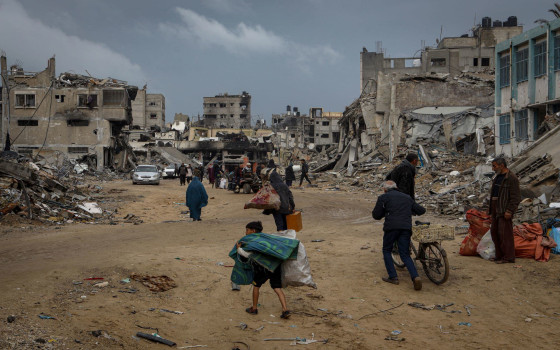
The United Nations warns of a "massacre" in Rafah if an Israeli incursion occurs

- Europe and Arabs
- Saturday , 4 May 2024 14:17 PM GMT
Geneva - Rafah: Europe and the Arabs
The United Nations Office for the Coordination of Humanitarian Affairs (OCHA) said that any Israeli ground military operation in Rafah “could lead to a massacre” and would paralyze life-saving humanitarian work throughout the Gaza Strip. According to what was reported in the daily news bulletin of the United Nations, which added that in a press conference held in Geneva yesterday, Friday, OCHA spokesman, Jens Laerke, said that any ground operation “would mean more suffering and death” for the civilian and displaced population of 1.2 million Palestinians in the city. Located in the far south of the Strip and its environs.
Mr. Larke said that the city of Rafah is “the heart of humanitarian operations” in Gaza, where dozens of relief organizations store supplies to provide to civilians across the Strip, including food, water, and health, sanitation and hygiene supplies.
In response to a question about the possibility of transferring civilians from Gaza, the OCHA spokesman reiterated that the UN “will not be involved in any order for the involuntary evacuation of people,” and said: “That is not what we do.” He stressed that the United Nations will do everything in its power to ensure the continuation of the humanitarian operation "under any circumstances."
"Just a bandage"
For its part, the World Health Organization said that it is preparing contingency plans in the event of a large-scale military incursion, but they will not be sufficient to prevent the worsening humanitarian catastrophe in Gaza.
Speaking from Jerusalem via video, Dr. Rick Pepperkorn, WHO Representative in the Occupied Palestinian Territory, said: “This emergency plan is just a bandage. This will not at all prevent the additional large numbers of deaths and spread of diseases expected resulting from the military operation.”
The WHO official warned that the ground military operation would lead to a new wave of displacement, more overcrowding, reduced access to basic food, water and sanitation “and certainly more disease outbreaks.”
He said: "The faltering health system will not be able to withstand the scale of the potential destruction that the incursion will cause." He noted that the deteriorating security situation could severely hamper the movement of supplies into and through Gaza, adding that the organization hopes and expects “that this military incursion will not occur and that we will move towards a permanent ceasefire.”
“What will happen to the patients?”
After nearly seven months of heavy Israeli bombing, only 12 out of 36 hospitals in Gaza and 22 out of 88 primary health care facilities in the Strip are “partially functioning,” according to the World Health Organization.
Dr. Ahmed Daher, head of the WHO team in Gaza, explained that these include Al-Najjar Hospital in Rafah, which provides dialysis treatment to hundreds of people.
He said: “The health system is barely able to continue... If any (ground) operation occurs - which means that residents and patients will not be able to reach these hospitals - what will happen to these patients? Ultimately it will be a disaster.”
Despite a “slight improvement” in the availability and diversity of food in Gaza in recent weeks, Dr Pepperkorn rejected any suggestion that the risk of acute malnutrition had receded for the most vulnerable groups in the Strip.
He added that 30 children have died so far due to diseases related to malnutrition, stressing that he saw two-year-old children in Kamal Adwan Hospital who weighed "four kilograms, when their weight should range between ten and 14 kilograms." He stressed that hundreds of children suffering from similar conditions will suffer the repercussions of malnutrition for many years and could last a lifetime.
Dr. Pepperkorn said that the mechanism to avoid putting humanitarian workers at risk had improved somewhat, but they still faced major problems, including delays to humanitarian convoys. He added: "What we can do in one mission, we have to do in four. This requires us to do very labor-intensive work and is incredibly expensive, and of course it diverts us from other priorities."





No Comments Found