

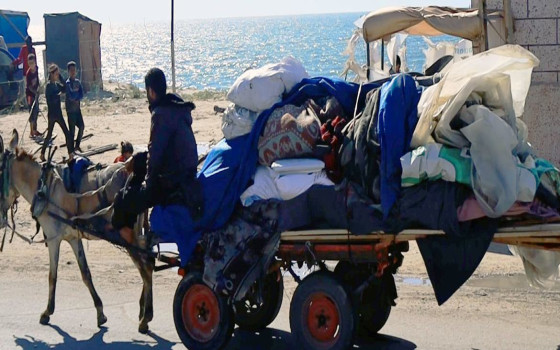
UNRWA: Palestinians have been forced to flee several times - since the start of the war in Gaza - in search of safety that they have never found.

- Europe and Arabs
- Sunday , 19 May 2024 13:56 PM GMT
Rafah - Gaza: Europe and the Arabs
Philippe Lazzarini, Commissioner-General of UNRWA, said that 800,000 people, nearly half of the displaced people who were residing in Rafah, had once again been forced to flee after Israeli forces began a military operation in the area on 6 May.
He added in a statement published on his account on the X website: “In response to the evacuation orders that asked people to flee to the so-called safe areas, people headed mainly to the central areas and Khan Yunis, including in the destroyed buildings.”
The Commissioner-General of the United Nations Relief and Works Agency for Palestine Refugees (UNRWA) said that Palestinians have been forced to flee several times - since the start of the war in Gaza - in search of safety that they have never found, including in UNRWA shelters. According to what was stated in the daily United Nations news bulletin
He said that people are more exposed to risks when they move without safe passage or protection. He pointed out that every time they are forced to leave, they leave behind their simple belongings such as mattresses, tents, cooking utensils, and basic supplies that they cannot carry or transport, “and every time they are forced to start from scratch.”
The areas they are fleeing to, Lazzarini said, do not have clean water supplies or sanitation facilities. He gave an example of this in the Al-Mawasi area, a sandy agricultural land covering an area of 14 square kilometers, where people are left outdoors with little or no buildings and roads.
The UN official said that the region lacks the minimum necessary to provide emergency humanitarian aid in a safe and dignified manner. Before the recent escalation in Rafah, more than 400,000 people lived in Al-Mawasi, so the area is overcrowded and cannot accommodate more people. Lazzarini said that the same situation applies to Deir al-Balah in central Gaza.
There is no safe place in Gaza
The Commissioner-General of UNRWA stressed that the claim that Gazans can move to “safe or humanitarian” areas is a false claim. He said that there is no safe place in Gaza.
Lazzarini warned that the situation could worsen again due to the lack of basic humanitarian aid and supplies. He said the humanitarian community no longer had any other supplies to distribute, including food and other essential items.
He reported that the main crossings into Gaza are still closed or that access to them is unsafe because they are near or inside combat zones. He also said that distributing aid is almost impossible without the regular introduction of fuel, with interrupted telecommunications and the continuation of military operations.
There is no alternative to land routes for relief
While he welcomed reports of the first relief shipments arriving at the new floating dock, he stressed that land routes are the most feasible, effective, efficient and safe way to deliver aid. He stressed the need to reopen the crossings and ensure that access to them is safe. “Without reopening these roads, the denial of assistance and catastrophic humanitarian conditions will continue,” he said.
The Commissioner-General of UNRWA stated that the obligations of all parties to the conflict, including Israel, Hamas and other Palestinian armed groups, are clear, and identified several points:
The rapid and unhindered passage of humanitarian aid to all civilians in need, wherever they are, is essential and must be allowed and facilitated.
Displaced populations must have access to basic items needed for survival, including food, water and shelter, as well as hygiene, health, assistance and, above all, safety.
Humanitarian relief teams need to ensure their safe and free movement to reach those in need of assistance and protection wherever they are.
Parties to the conflict have an obligation to protect civilians and civilian objects everywhere.
Above all, Lazzarini stressed that the time has come to agree on a ceasefire. He said that any further escalation in fighting would only lead to more devastation for civilians and make it impossible to ultimately achieve the peace and stability that Israelis and Palestinians so desperately need and deserve.





No Comments Found