
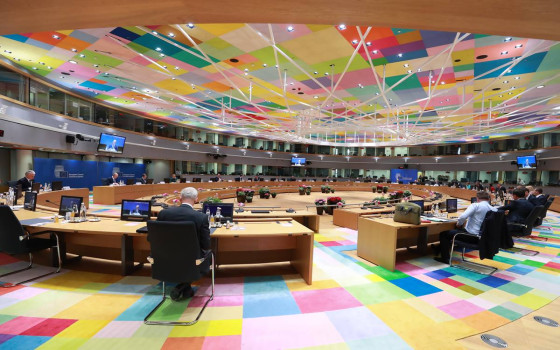
The foreign ministers of Egypt, Qatar, Saudi Arabia, Jordan and the UAE, along with Aboul Gheit and the Secretary-General of the United Nations, participate in a discussion by the foreign ministers of the European Union countries on the situation in the Middle East.

- Europe and Arabs
- Saturday , 25 May 2024 13:11 PM GMT
Brussels: Europe and the Arabs
Next Monday, European Union Foreign Ministers will hold a discussion on the situation in the Middle East, and will exchange views informally with the Foreign Ministers of Saudi Arabia, Jordan, Egypt, the United Arab Emirates and Qatar, as well as the Secretary-General of the United Nations. And the Secretary-General of the League of Arab States. According to what was issued by the European Union institutions in Brussels regarding the upcoming ministerial meeting on Monday, May 27, chaired by Josep Borrell, the European Union’s Foreign and Security Policy Coordinator.
The Council meeting will be followed by the Eighth Brussels Conference on “Supporting the Future of Syria and the Region.”
According to the European Ministerial Council, the European Union foreign ministers will discuss the Russian aggression against Ukraine, after an informal exchange of views with the Minister of Foreign Affairs of Ukraine, Dmytro Kuleba, who is expected to join the beginning of the meeting via videoconference to provide updates on the latest developments on the ground and Ukraine’s current priorities.
Current affairs
The Council will also be informed of the latest developments in Venezuela, with a focus on the ongoing electoral process leading to the presidential elections on July 28, 2024, in addition to discussing the situation in Georgia.
The American Associated Press saw that the formal recognition of the Palestinian state by Norway, Ireland and Spain next Tuesday may generate momentum for recognition of the Palestinian state by other European Union countries, and could stimulate further steps in the United Nations that would in turn lead to deepening Israel’s isolation.
The agency stated in the context of a report published on Thursday that these confessions represent a step towards the long-awaited Palestinian aspiration, and have occupied the forefront of the world's attention recently amid growing international anger over the number of civilian deaths and the humanitarian crisis in the Gaza Strip, which is stricken as a result of the continuing Israeli aggression.
She pointed out that there are seven countries from the European Union consisting of 27 countries that officially recognize the Palestinian state at the present time, including five countries in the former Eastern Bloc that announced recognition in 1988, as well as Cyprus, before joining the bloc, while Sweden announced recognition in 2017. 2014.
She noted that about 140 countries out of the 190 countries represented in the United Nations have already recognized the Palestinian state, noting that the partition plan proposed by the United Nations in 1947 called for the establishment of a Jewish state alongside the Palestinian state, but the Palestinians and the wider Arab world rejected it because it would have given them Less than half of the land, even though the Palestinians at that time constituted two-thirds of the country's population.
On the other hand, the United States, Britain, and other Western countries supported the idea of establishing an independent Palestinian state alongside Israel as a solution to the most difficult conflict in the Middle East, but they insist that the establishment of a Palestinian state must come as part of a negotiated settlement, an idea that has long been absent from substantive negotiations since 2009.
The Associated Press said that global diplomatic pressure has already increased on Israel as the battle with Hamas enters its eighth month, as the United Nations General Assembly voted by a large margin on May 11 to grant new “rights and privileges” to Palestine, in reference to growing international support for voting on full membership for Palestine. Which has the right to vote with the fact that the Palestinian Authority currently exercises observer status.
The leaders of Spain, Ireland, Malta and Slovenia said last March that they were considering recognizing the Palestinian state as a “positive contribution” to ending the war. Spanish Prime Minister Pedro Sanchez said yesterday, Wednesday, that “this recognition is not against anyone, and is not against the Israeli people, but rather it worked for the benefit of Peace, justice and moral consistency.”
The Associated Press quoted Norwegian Foreign Minister Espen Barth Ede as saying, “We have been with the establishment of a Palestinian state for decades, and that recognizing it represents a card that you can only play once.” He said, “We believed that recognition would come at the end of the process. We have now realized that recognition "It must come as a driving force and as an enhancement to the process."
The American agency confirmed that the recent recognition could constitute a major achievement for the Palestinians, who believe that it will give international legitimacy to their struggle, as Norway said that it would raise the level of its representative office in Palestine to an embassy, but it was not clear what Ireland and Spain would do.


No Comments Found