
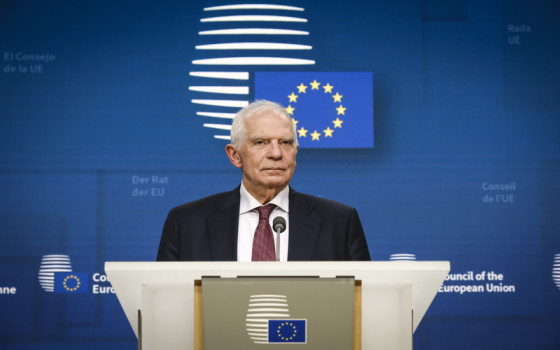
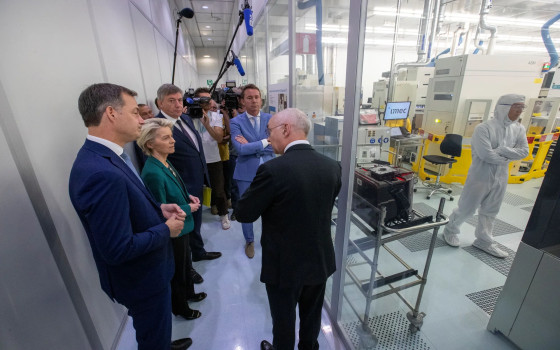
Change in senior European positions...a competition between the heads of government in Belgium and Estonia to succeed Borrell, the Supreme Coordinator for Foreign and Security Policies.
- Europe and Arabs
- Wednesday , 12 June 2024 15:59 PM GMT
Brussels: Europe and the Arabs
Belgian Prime Minister Alexander De Croo will not participate in rebuilding his "Liberal" party after the blow he received from voters. But he still has to work hard on current affairs. Such as the International Conference for the Reconstruction of Ukraine in Berlin. On the sidelines of the conference, there were also bilateral meetings with German Chancellor Olaf Scholz. To get everyone on the same path regarding all types of cooperation. But also to talk about top European jobs.
The mandates of the President of the European Commission, the President of the European Council and the High Representative for Foreign Affairs will soon have to be refilled. If two European heads of state or government can talk to each other these days - G8 summits, European summits, official visits, it doesn't matter - that's the point anyway. The top coordinator in particular is something that suits De Croo. Especially since now there is no direct major role for him in his country. Moreover, given the balance of power in Europe, it seems certain that the Supreme Coordinator will become a liberal. According to media reports in the Belgian capital, Brussels, including the newspaper Nieuwsblad, which added that although the election results may be against De Croo’s interest. In other European capitals, they also realized that his Open VLD party's result had been dramatic. This seriously undermines De Croo's credibility in a senior European position. But this in itself is less important for the position of High Representative, where experience and status are more important. However, De Croo was not given the opportunity to be appointed. Estonian Kaya Kalas will be the biggest competitor.
They assume within the resigned Belgian government that De Croo will be abroad more in the coming weeks. Whether that's true or not, the rumor mill will continue to spin until the top three spots are filled. There should be an agreement between the European powers by the end of the month.
Kaya Kallas is an Estonian politician who has been serving as Prime Minister of Estonia since January 26, 2021, becoming the first woman to hold this position. She has been leader of the Reform Party since 2018 and a member of the Riigikogu since 2019 and previously from 2011 to 2014. The Estonian parliament approved her appointment following the resignation of her predecessor Jüri Ratas in light of an investigation into a real estate project
Former Estonian Prime Minister Andrus Ansip, who is currently a member of the European Parliament, said that Prime Minister Kaia Kallas (Reformist) will take the position of European Commissioner that she can get, the Reform Party will have a new leader and Estonia will have a new head of government by the end of the summer.
He added in statements to European media, "Votes are still in favor of the so-called grand coalition of the European Parliament, as the European People's Party, the European Renewal Party and the European Socialists seek to obtain 409 seats in the 720-seat Parliament. Does this mean that there will not be a major shift?" In EU policy?
There are no major changes in store at the European level. It is true that the far right has gained more ground while the Greens have lost some ground, as have the Liberals, but these changes are still relatively marginal. The balance of power remains the same in the grand scheme of things.
Can change happen through member state politics, with Olaf Scholz's Social Democrats losing big in Germany, and Emmanuel Macron's Liberals losing ground in France, while right-wing forces have done well in each of the major European countries? France is also heading towards parliamentary elections.
There will be changes at member state level and they will affect European politics as a whole. The changing balance in France will have a major impact on European politics, while attitudes towards Ukraine remain the most polarizing issue for us.
We know that people known as extremists in Italy are strong supporters of Ukraine. Support may shift [to Ukraine] in France, while the party that won the elections in Germany is a strong ally of Ukraine and will continue to support them. German aid to Ukraine has been more than ten times that of France, while I also do not see these positions changing much.
Andros Ansip (born 1 October 1956) is an Estonian politician, Member of the European Parliament, former European Commissioner for the Digital Single Market and Vice-President of the European Commission, in office from 2014 to 2019. Previously, he was Prime Minister of Estonia from 2005 to 2014 He was president of the liberal Estonian Reform Party from 2004 to 2014.



No Comments Found