
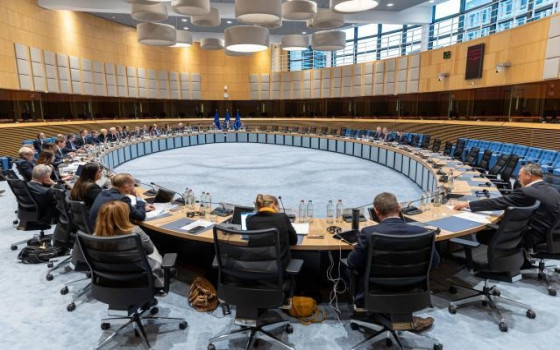
Greek Kyriakos Pierrakakis elected president of the Eurogroup following a ministerial meeting attended by a representative of the International Monetary Fund. Belgium and Spain were late in submitting their draft budget plans.
- Europe and Arabs
- Friday , 12 December 2025 10:50 AM GMT
Brussels: Europe and the Arabs
The Eurogroup elected Kyriakos Pierrakakis, the Greek Minister of Economy and Finance, as its president, in accordance with Protocol No. 14 of the Treaties of the European Union. The new president will assume office today, December 12, 2025, for a term of two and a half years. The first Eurogroup meeting under the presidency of Kyriakos Pierrakakis is scheduled for January 19, 2026. The European Union institutions in Brussels published a statement by Akis Keravnos, the acting president of the Eurogroup, following the group's meeting yesterday, December 11, 2025: "I chaired the Eurogroup meeting on an interim basis, following the departure of Pascal Donohoe, who, as you know, has moved to a new position at the World Bank.
I take this opportunity to commend – as many others have – his years of dedicated service to the Eurogroup." Thanks to Pascal's enthusiasm, energy, and contribution to fostering a team spirit within the Eurogroup, we successfully navigated the end of the pandemic, the energy crisis triggered by Russian aggression against Ukraine, and the new challenges emerging from across the Atlantic.
I will assume the presidency of the Economic and Financial Council for six months, starting in January, but this presidency of the Eurogroup is a one-time event.
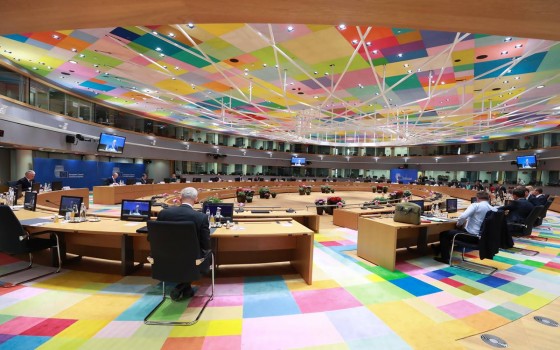
Let me give you a brief report on Thursday's Eurogroup meeting. We began our agenda with a discussion of the euro area economy, alongside the IMF's Director for European Affairs, Alfred Kammer.
The euro area has demonstrated remarkable resilience, given the specific shocks it has faced in recent years. We have managed to maintain positive growth, keep unemployment at record lows, and maintain inflation within the target range. However, the security situation remains the biggest challenge, even for the economy. There are well-known obstacles that we must overcome if we are to revitalize the economy while ensuring the stability of our budgets.
My colleagues offered their feedback on several points, including the issue of centralized supervision, our fiscal rules, and the difficulty of meeting defense investment needs within a tight budget. We took all these input into account today, and I am confident that these topics will be discussed within the relevant preparatory bodies.
There is a consensus on the need to effectively implement the new economic governance framework, ensuring fiscal sustainability while encouraging the necessary investments and reforms to address shared challenges.
Today was a valuable opportunity to exchange views with the IMF on the euro area's priorities ahead of their formal consultations and recommendations in June.
We then moved on to budget coordination, as part of our regular practice of discussing draft budget plans, the fiscal situation, and the outlook for the euro area as a whole.
Draft budget plans are the cornerstone of fiscal policy coordination within the Eurogroup. As usual, we adopted a statement that was published.
We agreed with the Commission that a broadly neutral fiscal stance for 2026 in the euro area is appropriate, with current spending being controlled in some highly indebted countries and offset by increased investment spending, including defense spending.
We also discussed country-specific assessments based on the net spending growth indicator. We welcomed the draft budget plans that we considered to be in line with the net spending path recommended by the Council. We reaffirmed our firm commitment to fiscal soundness, while supporting sustainable economic growth. Based on the Commission’s assessment, three draft budget plans are at risk of non-compliance, and two of these are at risk of material non-compliance.
Noting the varying risks to fiscal sustainability, the Eurogroup calls on these Member States to ensure compliance with the requirements of the Stability and Growth Pact during their budget preparation process.
Two Member States, Spain and Belgium, have not yet submitted a draft budget plan and have been urged to do so as soon as possible. The Eurogroup is ready to assess these plans based on the Commission’s views as soon as they are published.
Today, the Eurogroup launched the process to select a successor to the Vice-President of the European Central Bank, Luis de Guindos, whose term ends at the end of May 2026. The European Council appoints the Vice-President of the ECB on its recommendation, after consultation with the ECB and the European Parliament. The candidate recommended by the Council is selected at a Eurogroup meeting. We have set the deadline for nominations in early January, which will allow the Eurogroup to discuss the matter at its meeting in January.
We also elected Pascal's successor as President of the Eurogroup on Thursday. I am pleased to announce that the Eurogroup has a new President, Kyriakos Perakakis, whose term will begin on December 12, 2025, for a period of two and a half years.


No Comments Found