
Brussels on the 30th anniversary of the Dayton Agreement: Bosnia and Herzegovina must seize the opportunity to shape its future in the European Union

- Europe and Arabs
- Sunday , 14 December 2025 8:53 AM GMT
Brussels: Europe and the Arabs
The Dayton Peace Accords brought an end to one of the darkest chapters in European history and established a peace that has endured to this day. However, thirty years later, challenges from the past still linger in Bosnia and Herzegovina. A statement issued by the European institutions in Brussels also noted, "Despite the political obstacles of this year, the country has demonstrated resilience. The ultimate goal must remain progress towards EU membership as a unified, sovereign state in a stable and secure region. All political leaders must focus on the necessary reforms to move forward. The EU stands ready to guarantee peace and stability in Bosnia and Herzegovina. Our military operation, EU Force ALTHIA, remains essential to achieving this." The European statement concluded, "Thirty years after Dayton, Bosnia and Herzegovina must seize the opportunity to shape its future within the European Union." The Bosnian War began in 1992 after Bosnia declared its independence from Yugoslavia. This war was one of the wars that led to the breakup of Yugoslavia. The conflict was fought between Serbs, Croats, and Bosniaks.
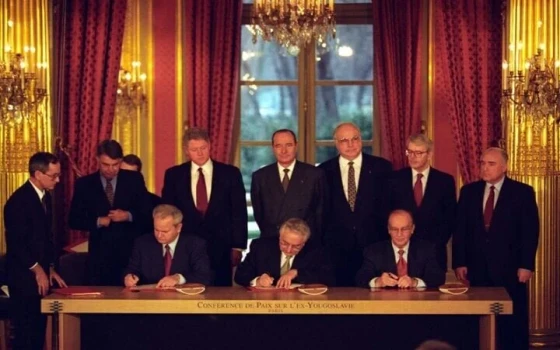
The General Framework Agreement for Peace in Bosnia and Herzegovina, also known as the Dayton Peace Agreement, ended the armed conflict that had raged in Bosnia and Herzegovina between 1992 and 1995. Negotiations aimed at ending the three-year war in the Balkans took place at Wright-Patterson Air Force Base near Dayton, Ohio, between November 1 and 21, 1995. The participating delegations were headed by Slobodan Milošević for the Serbs, Franjo Tuđman for the Croats, and Alija Izetbegović for the Bosniaks. This agreement resulted in the division of Bosnia and Herzegovina into two relatively equal entities: the Federation of Bosnia and Herzegovina and Republika Srpska. It also led to the deployment of the international peacekeeping force, IFOR.
The agreement resulted in the division of Bosnia and Herzegovina into two relatively equal entities: the Federation of Bosnia and Herzegovina and Republika Srpska. Although the formal signing of the agreement took place in Paris on December 14, 1995, the agreement is known as the Dayton Agreement, where it was initialed.




No Comments Found