
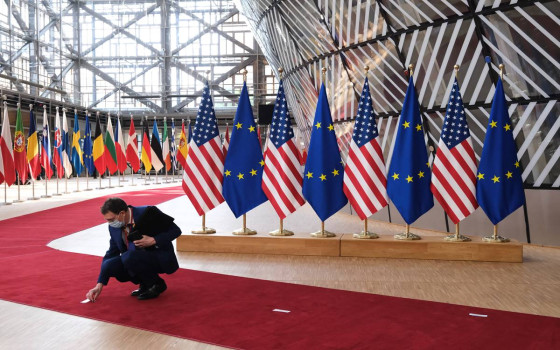
The new EU presidency faces a potential clash with the United States following threats to seize Danish Greenland and control Venezuelan oil, jeopardizing a European economic agreement with South America.
- Europe and Arabs
- Wednesday , 7 January 2026 10:39 AM GMT
Brussels: Europe and the Arabs
As Cyprus assumes the rotating presidency of the European Union, today marks a crucial moment in efforts to win over skeptics to the EU-Mercosur trade agreement ahead of Friday's decisive vote. With Donald Trump's surprise move in Venezuela further destabilizing the global order, the agreement has acquired new geopolitical weight. According to a report in Playbook, the European edition of Politico, EU Trade Commissioner Maroš Šefčovič, Agriculture Commissioner Christof Hansen, and Food Safety Commissioner Olivér Várhelyi are meeting with EU agriculture ministers this afternoon, along with Cypriot Agriculture Minister Maria Panayiotou, whose country holds the Council presidency.
Officially, it is a "political meeting" to discuss the future budget of the Common Agricultural Policy and farmers' grievances following the violent protests in December.
Unofficially, the meeting is about Mercosur. As one diplomat, Lucia MacKenzie of Politico, described it, the agenda is “skillfully disguised,” but France and Poland have already made it clear they want the trade agreement top of the agenda.
The plan: The goal is to secure the approval of EU agriculture ministers and the support of ambassadors on Friday for the agricultural protection agreement, a prerequisite for European Commission President Ursula von der Leyen to travel to South America for the formal signing. (That trip is still scheduled for next week, though there are doubts about the logistics and timing.)
Who else is left to convince? Italy remains the deciding factor, although the mood in Rome is now leaning toward approval. Questions remain about Romania and the Czech Republic. France and Poland continue to be openly hostile and are expected to use today’s meeting to raise their concerns about reciprocity and market protection.
The incentives on offer: Much of the groundwork was laid on Tuesday. In a letter to the European Council presidency and European Parliament President Roberta Mizzola, von der Leyen offered early access to up to €45 billion in farm financing within the post-2027 budget, a move widely interpreted as an attempt to secure Italy’s loyalty. The move was warmly welcomed by French President Emmanuel Macron and Italian Prime Minister Giorgia Meloni.
Timing is crucial: transatlantic tensions have given the agreement a more acute geopolitical dimension.
A weapon or diversification? The EU-Mercosur agreement was presented as a way for the bloc to diversify its trade in a volatile, tariff-ridden environment—one not necessarily hostile to Washington. But as the Trump administration, in the wake of its takeover of Nicolás Maduro, speaks of protecting “our hemisphere,” doing business in that hemisphere carries significant risks.
“This is exactly his Monroe Doctrine,” one EU diplomat remarked sarcastically, referring to the 19th-century foreign policy under which the United States asserted its dominance over the Western Hemisphere while maintaining neutrality in European affairs. (One can’t help but admire the diplomatic corps in Brussels.)
Trump has enthusiastically embraced this two-hundred-year-old Monroe approach, dubbing it the “Donroe Doctrine,” and has increasingly brazenly demonstrated his intention to use America’s superior military and economic power to prevent rivals from gaining a foothold in Washington’s periphery. “No one will question American hegemony in the Western Hemisphere anymore,” he declared this week after the raid on Maduro.
How does the EU-Mercosur agreement fit into this? Commission spokeswoman Anita Heber declined to comment when asked how the US president would frame the trade deal in light of the political rhetoric in Washington. “We remain calm and focused because we firmly believe in the importance of this agreement to Europe’s global standing,” she said.
A diplomat from a European country that supports the agreement insisted it should not be seen as anti-American, saying, “I have never heard the United States say it doesn’t want its partners and allies to trade with each other.” But another European diplomat acknowledged that this is a legitimate question, one that is now being raised in Brussels.
So far, there has been no official comment from the Trump administration (or the president himself) on the EU-Mercosur agreement, and the U.S. mission in Brussels did not respond to Playbook’s request for comment. But it is not difficult to imagine that Washington views the EU’s ambition to deepen its economic engagement with South America as a strategic encroachment on its influence, just as U.S. officials have long viewed China’s infrastructure development efforts in the region.
Brussels insists it needs Mercosur, but it could ultimately become another point of contention in an already strained transatlantic relationship. Playbook adds: The European Union and the United States remain at odds over the transition in Venezuela. The European Commission announced on Tuesday that it will not recognize Delcy Rodríguez as part of the new government in Caracas, even after she was sworn in as interim president.
Therefore, Brussels will continue what a spokesperson described as "meaningful engagement" with Venezuelan authorities to protect EU interests, while emphasizing that Venezuela's future must ultimately be determined by those elected by the Venezuelan people.
The oil deal: Trump stated last night that the interim government would hand over between 30 and 50 million barrels of sanctioned crude oil to the United States, which would then sell it at market prices. He wrote on Truth Social: "I will control these funds... to ensure they are used for the benefit of the people of Venezuela and the United States!"
Greenland and EU concerns in recent days.
Today marks the official inauguration of the Cypriot presidency. The presidency will officially begin with a ceremony in Nicosia, attended by: European Council President António Costa, European Commission President Ursula von der Leyen, and Ukrainian President Volodymyr Zelensky, who has just returned from Paris after the "Coalition of the Willing" meeting. Underscoring Cyprus's strategic location at the crossroads of three continents, the list of other important figures includes Moldovan President Maia Sandu, Lebanese President Joseph Aoun, and Iraqi President Abdullatif Rashid.
Greenland: Will Greenland's fate cast a shadow over the celebrations? Perhaps. EU leaders, including Costa and von der Leyen, have so far remained silent, even after Donald Trump reiterated his position that US control of Greenland, currently under Danish rule, is essential to American national security.
But Washington is not backing down, despite the unease Trump's insistence is causing in Europe. The White House issued a statement last night saying the president and his advisers are "discussing a range of options" regarding Greenland, adding that "the use of the US military is always an option available to the commander-in-chief."
How might this happen? Politico's Zoya Šeftalović spoke with EU officials, NATO experts, defense specialists, and diplomats to analyze how a US takeover of this mineral-rich and strategically important Arctic island might unfold. To the Danes' alarm, it appears to have already begun. The opposition in Europe has come from the capitals, not Brussels. On Tuesday, the leaders of France, Germany, Italy, Poland, Spain, the United Kingdom, and Denmark issued a statement responding to Trump's claim that Europe is not committed to Arctic security, asserting that NATO shares collective responsibility, in partnership with the United States. "Greenland belongs to its people," the leaders declared.
In a show of solidarity, Dutch Prime Minister Dick Choof, Greek Prime Minister Kyriakos Mitsotakis, Luxembourg Prime Minister Luc Frieden, and Slovenian Prime Minister Robert Golube all posted messages on the X platform supporting the statement. Belgian Prime Minister Bart De Wever endorsed Danish Prime Minister Frederiksen's call for "respect for sovereignty among NATO allies."
In response to a question from POLITICO about why no EU institutional figure had commented, a spokesperson for the European Commission stated that the EU's principles remain "very clear." This means supporting Greenland's territorial integrity and cooperating with the United States—a "key partner"—on Arctic security. Meanwhile, in Nuuk: The Greenland government has requested an urgent meeting with US Secretary of State Marco Rubio to discuss "significant statements" made by Washington regarding the Arctic territory.



No Comments Found