

80th Anniversary of the United Nations: Secretary-General: Major Powers Conspire to Undermine Global Cooperation; Algorithms Reward Lies, Fuel Hatred, and Provide Authoritarian Regimes with Powerful Tools of Control
- Europe and Arabs
- Sunday , 18 January 2026 8:6 AM GMT
London – New York: Europe and the Arabs
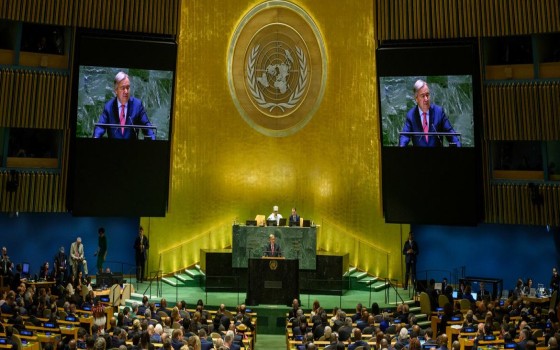
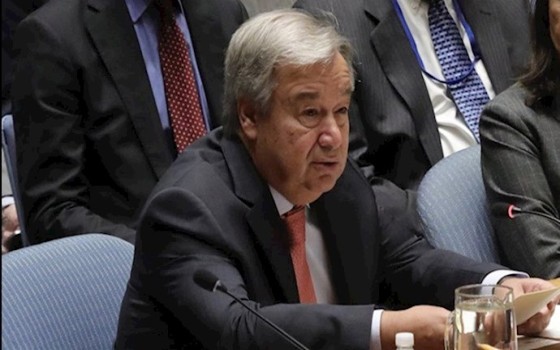
UN Secretary-General António Guterres warned that major powers are conspiring to undermine global cooperation, but stressed that "humanity is stronger when we are united." This came during a historic event held Saturday in London to commemorate the 80th anniversary of the United Nations.
In his address at Westminster Central Methodist Hall – the same hall that hosted the first General Assembly meeting on January 10, 1946 – Guterres urged delegates to be "courageous enough to change, and courageous enough to draw inspiration from the courage of those who gathered in this hall 80 years ago to build a better world." According to the UN Daily News,
The event, organized by the United Nations Association of the UK on Saturday, brought together more than 1,000 delegates from around the world. Speakers included the President of the UN General Assembly, Annalena Baerbock; UN Space Advocate Professor Brian Cox; and UNHCR Goodwill Ambassador Maya Ghazal.
The event also commemorated the 80th anniversary of the first meeting of the UN Security Council, held on January 17, 1946, at nearby Church House.
In his keynote address, Guterres reflected on the symbolic location of the commemoration. The first General Assembly convened within these walls just four months after the end of World War II, in a bomb-ravaged London where tens of thousands were killed—a powerful reminder of why the United Nations was created. The Secretary-General said: “To reach this hall, delegates had to pass through a war-torn city. Buckingham Palace, Westminster, and the Houses of Parliament were bombed by the German Luftwaffe. As those bombs fell, terrified civilians took shelter here, in the basement of Central Methodist Hall—one of the largest public air-raid shelters in London.”
During the period of intense air raids, as many as 2,000 people gathered in the hall for protection, before the nations of the world met here in 1946 to “save succeeding generations from the scourge of war.”
He continued: “In many ways, this hall is the physical embodiment of what the United Nations stands for: a place where people place their trust—for peace, security, and a better life.”
The world of 2026 is not the same as the world of 1946.
In the 80 years since the first General Assembly, the United Nations has grown from 51 members to 193. Mr. Guterres affirmed that the General Assembly—the principal deliberative, policy-making, and representative body of the United Nations—is “the parliament of the family of nations. It is a platform where all voices are heard, a crucible for consensus-building, and a beacon of cooperation.”
While acknowledging that the work of the General Assembly “may not always be smooth or obstacle-free,” he described it as “a mirror to our world, with its divisions and hopes. It is the stage upon which our common story is played out.”
Reflecting on the past decade, Mr. Guterres spoke of how “the conflicts in Gaza, Ukraine, and Sudan have been brutal and utterly ruthless; artificial intelligence has become almost ubiquitous; and the pandemic has fanned the flames of nationalism, setting back progress on development and climate action.”
Mr. Guterres emphasized that 2025 was a “challenging” year for international cooperation and the values of the United Nations. He added: “Aid has been cut. Inequality gaps have widened. Climate chaos has accelerated. International law has been violated. Crackdowns on civil society have intensified. Journalists have been killed with impunity. UN staff have been repeatedly threatened or killed while carrying out their duties.”
The UN reported that in 2025, global military spending reached $2.7 trillion – more than 200 times the UK’s current aid budget – and equivalent to more than 70% of the UK’s GDP. Mr. Guterres noted that fossil fuel profits continued to rise while the planet shattered temperature records.
In cyberspace, the Secretary-General said, algorithms rewarded lies, fueled hate, and provided authoritarian regimes with powerful tools of control.
Multilateralism, not division
Mr. Guterres called for a “strong, responsive, and adequately resourced” multilateral system to address interconnected global challenges, but warned that “the values of multilateralism are being eroded.” The Secretary-General cited the landmark international agreement to protect marine life in international waters and on the seabed, which enters into force today, Saturday, as an example of “a model of modern diplomacy, led by science, and involving not only governments, but also civil society, indigenous peoples, and local communities.”
He added: “These quiet victories of international cooperation—wars averted, famines avoided, and vital treaties concluded—don’t always make the headlines. Yet they are real and important. If we are to achieve more of these victories, we must ensure full respect for international law and defend and strengthen multilateralism in our time.”
In his address to the audience in London, the Secretary-General expressed his “gratitude to the United Kingdom for its crucial role in the creation of the United Nations” and for being “a strong pillar of multilateralism and a supporter of the United Nations today.”
High Stakes for a Better World
Looking ahead, the Secretary-General called for an international system that reflects the modern world, including reforms to the international financial system and the Security Council. He said: "As global power centers shift, we have the ability to build a future that is either more just or more turbulent." The Secretary-General reminded delegates in London that when the United Nations first opened its doors, “many of its staff bore the visible marks of war—limping, scarring, or burns.” Mr. Guterres said, “There is a persistent myth—one that grows louder every day—that peace is naive. That the only real politics is the politics of self-interest and power.” He added, “But the founders of the United Nations were not out of touch with reality. On the contrary, they had witnessed war and understood that peace, justice, and equality are the most courageous, practical, and necessary endeavors of all.”

No Comments Found