

Sudan: The spirit of struggle for peace, justice, and freedom remains unbroken. Meanwhile, in neighboring South Sudan, the UN calls for political de-escalation as fighting resumes in Jonglei.
- Europe and Arabs
- Monday , 19 January 2026 7:3 AM GMT
Khartoum – Nairobi: Europe and the Arabs
The UN High Commissioner for Human Rights, Volker Türk, warned that the war in Sudan has plunged the country into an abyss of unimaginable depths, stressing that human rights must be at the heart of the process of ending the war and rebuilding Sudan. He described it as "a difficult task, but not impossible thanks to the resilience and strength of the Sudanese people." This was reported in the UN Daily News Bulletin.
The High Commissioner held a press conference in Nairobi on Sunday, following a five-day visit to Port Sudan and the Northern State, highlighting the repercussions of the war, which he said has affected every inch of the country and every one of its people.
The spirit of the struggle for peace, justice, and freedom has not been broken.
Referring to his recent visit to Sudan in November 2022, Turk noted that he was inspired by Sudan’s vibrant civil society, particularly the young people and women who spearheaded the 2018 revolution. Despite nearly three years of devastating war, Turk emphasized that the struggle for peace, justice, and freedom continues. “For those who think the spirit of the struggle for peace, justice, and freedom has been broken… this spirit has not been broken,” he said.
During his visit, Turk witnessed unspeakable trauma and remarkable resilience. He highlighted the crucial role of young people as first responders, organizing and delivering aid despite bureaucratic obstacles and the risks of arrest and violence.
“We don’t have the power to stop the war,” one civil society leader told him, “but we will do what we can to preserve civilian lives.” Another young volunteer underscored the heavy price the younger generation is paying as a result of the conflict: “It is the youth who are paying the price of war.” Turk also pointed to the repeated attacks on civilian infrastructure, including the Merowe Dam, which used to supply 70% of Sudan’s electricity and has been repeatedly struck by drones launched by the Rapid Support Forces.
He warned that these attacks disrupt hospitals, irrigation, and access to clean water, facilitating the spread of disease and suffering. These attacks could amount to war crimes. However, Turk also encountered defiance and determination. An engineer at the dam told him, “They haven’t stopped the attacks, and we won’t stop our efforts to keep Sudan’s electricity running.”
The Plight of Displaced People from El Fasher
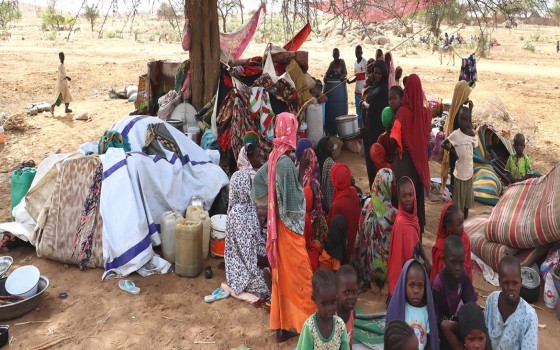
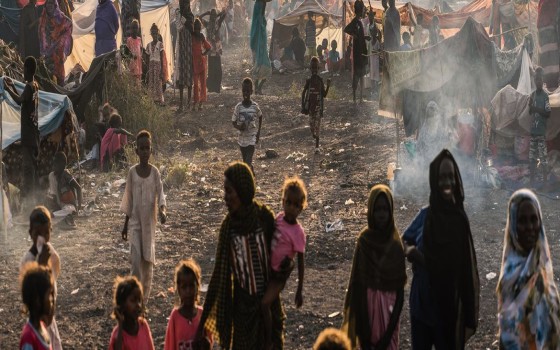
The High Commissioner devoted a significant portion of his remarks to the plight of civilians, particularly those displaced from El Fasher who have sought refuge in the Northern State. He described meeting children deeply scarred by the violence, including a four-year-old who lost his hearing due to the bombing and a three-year-old who “doesn’t smile.” He shared testimonies from war survivors like Hawa, a graduate student who lost her son in a bombing, and whose husband was abducted, tortured, and held for ransom by the Rapid Support Forces.
Women’s and girls’ bodies as a weapon
The High Commissioner also shared the account of 20-year-old Aisha, who described being abducted and raped while fleeing El Fasher after her brother was shot and her mother beaten. Turk stated that “the bodies of women and girls have been used as a weapon,” emphasizing that sexual violence is being used as a weapon of war and constitutes a war crime. His office has documented patterns of widespread and systematic sexual violence linked to the conflict in Darfur and along escape routes.
Turk also reported on extrajudicial killings, enforced disappearances, arbitrary detention, and the deliberate use of siege tactics, including the blocking of food supplies, which has led to what he described as a “man-made famine.” “We are witnessing chapters of cruelty,” he warned, calling on all those with influence—including regional actors and arms suppliers—to act immediately to end the war.
Concern over a repeat of the El Fasher tragedy
Regarding the future, Turk expressed grave concern that the atrocities committed in El Fasher could be repeated in the Kordofan region, particularly around Kadugli and Dilling, where famine conditions are already present. He stressed that previous warnings had been ignored in Darfur and issued a “stark warning” that the same mistakes must not be repeated.
He also condemned the proliferation of sophisticated weapons, especially drones, stating that “it is shameful to spend vast sums of money on increasingly sophisticated weapons—money that should be used to alleviate the suffering of the population.”
He added, “No reasonable person can believe that continuing the fighting is the solution. I keep asking myself: What are those waging this war trying to achieve?” Militarization of Society and Child Recruitment
Turk also expressed concern about the increasing militarization of society, including the arming of civilians and the recruitment of children, as well as the shrinking of civic space. Journalists, lawyers, and civil society actors face arrest, smear campaigns, enforced disappearances, and violence, while restrictions on humanitarian access continue to claim lives.
In closing, Turk called for immediate action to protect civilians, ensure safe passage and humanitarian access, release arbitrarily detained civilians, and reveal the fate of the missing.
He reiterated his appeal from three years ago, saying, “Three years ago, when I last visited Sudan, I made an appeal that I find myself repeating today: I urge all concerned to set aside entrenched positions, power games, and personal interests, and focus on the common interests of the Sudanese people.” In the neighboring country, the United Nations Commission on Human Rights in South Sudan* expressed concern about the deteriorating political and security situation in the country, and condemned the renewed fighting in Jonglei State, warning that this escalation represents a serious deterioration of the revitalized peace agreement and puts civilians at risk of death, displacement and deprivation.
The Committee called for an immediate de-escalation and cessation of hostilities in civilian-populated areas, including airstrikes, ground attacks, and military operations. It urged an immediate return to the framework, commitments, and guarantees of the peace agreement.
In a statement issued on Sunday, the Committee warned that the deliberate sabotage of the 2018 Revitalized Peace Agreement and its resulting deterioration have led to a renewed conflict, with dire consequences for the lives of civilians and the stability of the country and the wider region.
It noted that indiscriminate aerial bombardments, ground fighting, and the obstruction of humanitarian access reflect a brutal pattern that the Committee has repeatedly documented, indicating a near-total disregard for the safety and well-being of citizens and communities.
Direct and indiscriminate attacks on civilians
With the political stalemate continuing, the past few weeks have seen an escalation of hostilities in Jonglei State, including direct and indiscriminate attacks on civilians and reports of the mobilization of armed civilian militias. The already dire humanitarian and human rights crisis is being exacerbated by the blatant disregard for the protection afforded to civilians under international law, according to the UN commission.
Humanitarian partners estimate that more than 100,000 people, mostly women, girls, the elderly, and people with disabilities, have been forcibly displaced across the state since late December 2025, many of them fleeing without shelter, food, or medical care.
Protecting civilians is not an option. “Protecting civilians is not an option, it is a legally binding obligation of the government,” said Yasmin Sooka, head of the UN Commission on Human Rights in South Sudan. “The renewed aerial bombardments in civilian areas, coupled with restrictions on humanitarian access by parties to the conflict… are once again putting lives in imminent danger, while systematically undermining the peace agreement and exposing civilians to fear, displacement, and death. These acts are unlawful and must stop immediately: humanitarian workers must be granted safe passage to reach those in desperate need.”
The Commission on Human Rights in South Sudan is an independent body mandated by the UN Human Rights Council. The Commission was first established in March 2016, and its mandate has been renewed annually since then. Its members are appointed by the President of the Human Rights Council; they are not United Nations staff members and do not receive a salary for their work on the Commission. The Commission members receive support from its Secretariat, based in Juba, South Sudan.
No Comments Found