
EU Finance and Economy Ministers' Meeting: New Presidency's Work Program, Early Warning Mechanism Report, Economic Governance, Recovery and Resilience Mechanism, and the Repercussions of the War in Ukraine
- Europe and Arabs
- Tuesday , 20 January 2026 7:19 AM GMT
Brussels: Europe and the Arabs
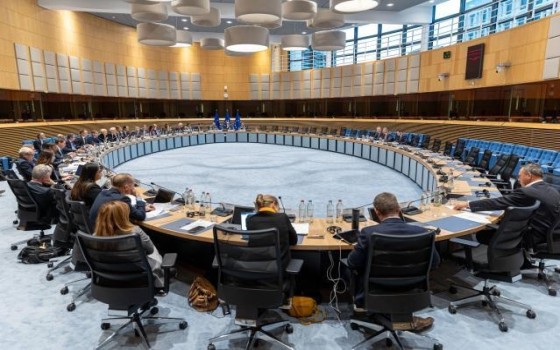
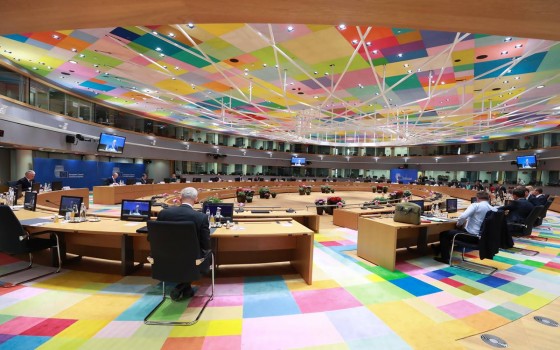
The European Council of Ministers resumes its meetings today in Brussels, following Monday's meeting of Eurozone countries. Today's meetings are attended by the finance ministers of all EU member states. According to the agenda, the Cypriot Presidency will present its work program for the first semester in the area of economic and financial affairs. This is in addition to the European Semester 2026 agenda, where the Council is expected to approve the conclusions of the 2026 Early Warning Mechanism report, which launches the annual macroeconomic imbalance procedure for the European Semester. Regarding the third agenda item, economic governance, ministers will be called upon to adopt a decision to open a new Excessive Deficit Procedure (EDP) for Finland, and a recommendation outlining the steps Finland should take to eliminate its excessive deficit. The ministers will then move on to the fourth agenda item, the Recovery and Resilience Mechanism, where the Council is expected to adopt implementing decisions approving the revised Recovery and Resilience Plans submitted by member states.
These Recovery and Resilience Plans enable member states to draw on the EU Recovery and Resilience Fund, a financial support program to help repair the economic and social damage caused by the COVID-19 pandemic. Finally, the issue of the Russian war against Ukraine will be discussed, with ministers exchanging views on the current economic and financial impact of the Russian aggression against Ukraine. This is a recurring item on the agenda of the meeting of economic and financial ministers.
It is worth noting that at the conclusion of a meeting of Eurozone finance ministers in Brussels on Monday evening, a statement was issued announcing that the meeting addressed the latest developments regarding Bulgaria's transition to the euro, following the Eurogroup's celebration of Bulgaria's accession to the Eurozone. The Bulgarian Minister, the European Commission, and the European Central Bank provided updates to the ministers on the latest developments regarding the transition to the euro. The ministers also exchanged views on policy priorities for the eurozone, based on the Commission's draft eurozone recommendation. In addition, the ministers were briefed on the outcome of the G7 ministerial meeting discussions. The EU institutions also released a statement containing remarks by Minister Kyriakos Perakakis, the new President of the Eurogroup, who said late Monday evening after the meeting: “First of all, I would like to emphasize that this is a historic occasion for Bulgaria, as it will become the newest member of the eurozone on January 1, 2026. I was honored to receive one of the coin sets from Minister Petkova, which were made available in Bulgaria to help the people prepare for the transition to the euro. I remind you that these coins embody our motto, 'United in Diversity': two sides – one European and one national. Some of these coins feature the exquisite Madara Rider motif, an 8th-century rock relief inscribed on the UNESCO World Heritage List. Accordingly, we began Our discussions today included a briefing by Minister Petkova on her country's transition to the euro. Bulgarians will use euro banknotes and coins as legal tender from January 1, 2026. The Eurogroup congratulates the Bulgarian authorities on the smooth implementation of this process.
The euro is a cornerstone of our European project. It is the foundation of economic stability and prosperity, and now includes 21 countries using the single currency.
We then moved to a regular item on the agenda: the governance of the euro area. The Eurogroup adopts a set of recommendations annually, outlining the agreed priorities for the euro area for the coming period. Today, ministers discussed the Commission's proposal for 2026. The focus is on the competitiveness, resilience, and macroeconomic and financial stability of the euro area.
Our deputies and experts will now begin working on finalizing the recommendations in preparation for their adoption at our meeting in February.
We then continued our discussion of the latest developments at the G7 level. We are living in a highly volatile geopolitical context, where dialogue, unity, and coordination remain essential. Key issues.
I briefed my colleagues on the details of the virtual meeting of G7 finance ministers and central bank governors held on December 19, which saw the presidency pass from Canada to France. Minister Lescure outlined his objectives for the year, focusing on global imbalances, international partnerships, and balanced growth.
These priorities received strong support from colleagues today, and many are highly relevant to the ongoing work of the Eurogroup, particularly, in my view, those related to imbalances and growth. He also informed us of his intention to convene a meeting of G7 finance ministers later this week.
Commissioner Dombrovskis also briefed us on the details of a ministerial-level meeting convened by the US Treasury last week to discuss critical raw materials.
The global economy faces multiple challenges: rising tariffs, industrial overcapacity, geopolitical tensions, Russian aggression on our borders, and critical dependencies in areas such as technology, security, and metals. Many of these issues are interconnected.
While the euro area economy has shown remarkable resilience, we must recognize that resilience alone is not enough in the long run. The future is distant. We need to return to a path of sustainable and dynamic economic growth.
The Eurogroup is committed to playing its part.


No Comments Found