
The World Enters an Era of "Water Bankruptcy" Amid Drought and Declining Resources

- Europe and Arabs
- Wednesday , 21 January 2026 5:48 AM GMT
New York: Europe and the Arabs
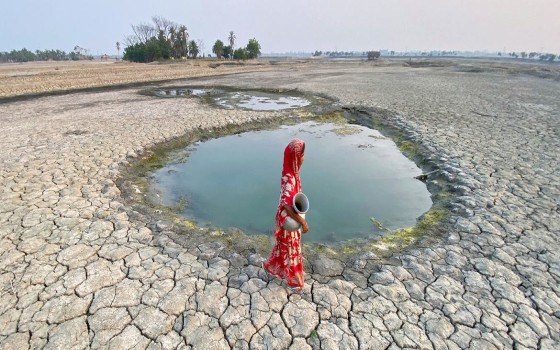
The world has entered an era of "global water bankruptcy," where water systems are no longer able to return to their previous levels, according to a new report released by the United Nations University. The report explains that the terms "water stress" and "water crisis" are no longer sufficient to describe the new reality of water in the world. Many rivers, lakes, aquifers, wetlands, and glaciers have passed tipping points and cannot return to their previous levels, meaning that the term "temporary crisis" is no longer accurate in many regions.
This was also confirmed by Kaveh Medani, Director of the United Nations University Institute for Water, Environment and Health, at a press conference at the United Nations headquarters in New York on Tuesday, saying: "What we have documented in this report is a different reality."
Medani stressed that this declaration does not mean that the entire planet is already suffering from water bankruptcy. However, he added: "We now have enough bankrupt or near-bankrupt systems around the world, which has led to a radical change in the global risk landscape through food markets, supply chains, migration pressures, climate impacts, and political dependencies." According to the UN Daily News Bulletin,
The director of the institute explained that, in practical terms, water insecurity combines "insolvency and irreversibility." Insolvency means "we are depleting and polluting water beyond regenerative flows and safe depletion limits." Irreversibility means "we have damaged key parts of water-related natural capital in ways that are realistically irreversible in the human timescale, or the cost of restoring them would be prohibitively high."
Water Insecurity
The director of the UN University Institute for Water, Environment and Health noted that:
Nearly three-quarters of the world's population lives in countries classified as water insecure or in a critical situation.
More than two billion people still lack access to safely managed drinking water.
3.5 billion people lack access to safely managed sanitation services.
Around four billion people experience severe water scarcity for at least one month each year.
The water levels of more than half of the world's great lakes have declined since the early 1990s. Approximately 35% of natural wetlands have been lost since the 1970s.
Around 70% of the world's major aquifers are showing long-term decline.
Calling for a structured recovery plan and to stop the bleeding
The report identifies a growing pattern of "human-induced drought," the effects of which are estimated to cost around $307 billion annually. In 2022 and 2023, "nearly two billion people were living under drought conditions."
Madani stated that this is not just a problem for arid regions, adding, "The water crisis is not just about drought; it's about the imbalance between water resources and consumption, and the erosion of natural capital."
He emphasized that "bankruptcy is not the end, but the beginning of a structured recovery plan. The bleeding must be stopped, essential services must be protected, unsustainable claims must be restructured, and investment must be made in rebuilding the water sector."
He clarified that "the report is primarily a diagnosis, not a guide to one-size-fits-all solutions." Madani warned against “quick fixes that produce reassuring narratives, unrealistic promises, and policies that fail to be implemented in practice.”
Transition to a Well-Considered Strategy to Prevent Harm
The report called for an urgent shift from short-term emergency responses to a well-considered strategy that prevents further irreversible harm, reduces and redistributes demand, transforms water-intensive sectors, addresses illegal water withdrawals and pollution, and ensures just transitions for those whose livelihoods must change.
The Director of the United Nations University Institute for Water, Environment and Health emphasized that “water is a practical common denominator linking climate, biodiversity, land, food, health, and stability. Investing in water is an investment in achieving the goals related to these areas and rebuilding cooperation in a fragmented world.”
He concluded, “Our message today is not one of despair, but of clarity. The sooner we confront the reality of the situation, the more options we have. The longer we delay, the more we transform manageable stress into irreversible losses worldwide.”



No Comments Found