

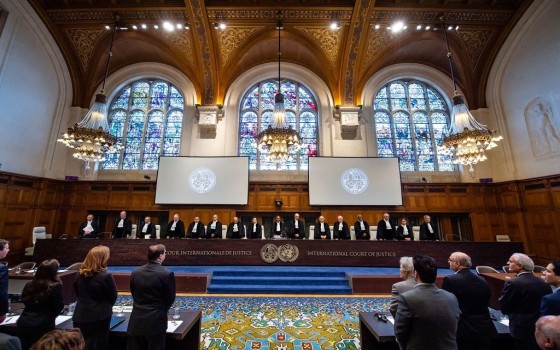
The United Nations calls for respect for the International Court of Justice's rulings and warns of the erosion of the rule of law. On its 80th anniversary, the caseload is "more crowded than ever."

- Europe and Arabs
- Saturday , 18 April 2026 4:21 AM GMT
The Hague – New York: : Europe and the Arabs
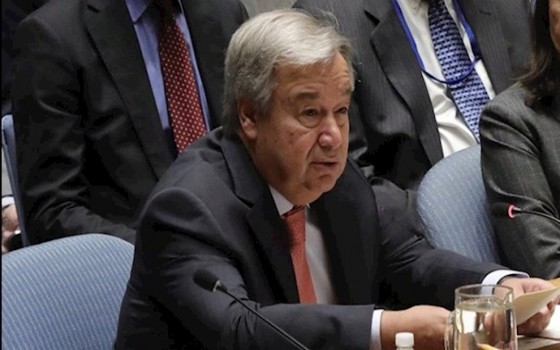
UN Secretary-General António Guterres warned of increasing violations of international law and the erosion of trust in international institutions, stressing that respect for the rulings of the International Court of Justice (ICJ) is not optional, but rather an obligation under the UN Charter.
Guterres' remarks came during a speech he delivered in The Hague on the occasion of the Court's 80th anniversary. He recalled the words of the President of the first session of the UN General Assembly, Paul-Henri Spaak, who said at its opening eight decades ago: "There can be no civilized world, no lasting peace, unless there is full and absolute respect for international jurisdiction and its rulings." The Secretary-General affirmed that the ICJ, over the course of eight decades, has contributed to shaping the features of the modern international order. He noted that the list of cases before the Court is "more crowded than ever," considering this clear evidence of the growing confidence in its authority and independence.
He also noted that the increasing number of female judges within the Court strengthens its legitimacy, describing it as "a sign of progress that must continue," along with modernizing its working methods to enhance its effectiveness and resilience.
Guterres stressed that the Court remains the guarantor that the principles of sovereignty and equality do not become "mere words on paper," adding: "Bulge force, however great, cannot—and should not—replace legal obligation." This was reported in the UN Daily News, a copy of which we received this morning.
The Secretary-General affirmed that "the Court's decisions, including provisional measures, are binding on the parties concerned… and respecting those decisions is not optional."
Increasing Violations and Questioning of Institutions
Antonio Guterres pointed out that violations of international law "are unfolding before our very eyes," explaining that military operations are violating the fundamental rules of the conduct of armed conflict, while humanitarian obligations, and even the rules protecting the United Nations itself, are being disregarded.
He added that institutions established to uphold justice are facing "increasing skepticism and challenges," stressing that this erosion is not occurring on the margins of the international system, but "at its very core," including by states that bear unique responsibilities for maintaining international peace and security.
The Secretary-General warned that "when the law of force replaces the rule of law, instability becomes contagious," noting that conflicts spread across borders, the repercussions of economic crises reverberate globally, and the most vulnerable are the hardest hit.
Two Choices, No Third
Guterres emphasized that the world stands at a "decisive moment" requiring a choice between a future governed by the rule of law or the logic of force. He explained that "adherence to international law is more important than ever."
In closing, Secretary-General António Guterres affirmed that international law provides a common framework for the peaceful resolution of disputes, warning that weakening it undermines global stability, while strengthening it represents "an investment in building a world governed by justice, not fear." He called for a renewed commitment to the peaceful settlement of disputes, respect for the rulings of the International Court of Justice and its advisory opinions, and adherence to the purposes and principles of the Charter of the United Nations.
The International Court of Justice is an international judicial body established under the Charter of the United Nations. Also known as the World Court, its role is to settle international disputes submitted to it by states, in what are known as "contentious matters" under international law, and to provide advisory opinions on legal questions referred to it by organs of the United Nations and authorized international agencies.
It also adjudicates disputes between countries on the basis of the voluntary participation of the states concerned. If a state agrees to be a party before the Court, it is obligated to comply with its decisions.


No Comments Found