

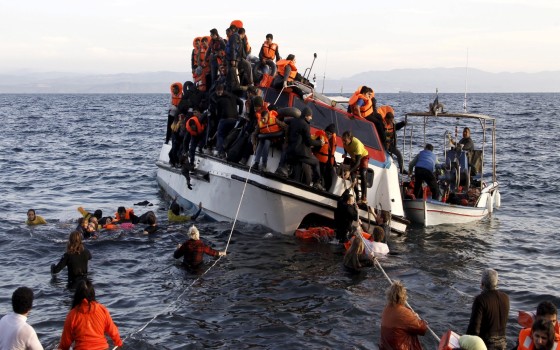
European border controls, the Italian-Spanish dispute, and the US role in fueling the flames: Efforts to end the migrant crisis in Ceuta

- Europe and Arabs
- Monday , 10 August 2026 7:45 AM GMT
Brussels: Europe and the Arabs
The European Commission’s main task this week will be to find a solution to the dispute between Italy and Spain following a bitter political row over border controls that threaten to undermine the EU’s passport-free Schengen Area. These restrictions were introduced by Rome after some 72,000 people crossed from Morocco into the Spanish enclave of Ceuta in North Africa at the beginning of the month. Almost all of those who arrived have since returned.
According to Playbook, the Brussels-based European edition of Politico, the Spanish and Italian governments held talks with EU Home Affairs Commissioner Magnus Brunner over the weekend, with Brussels pressing both sides to back down from reciprocal border checks.
EU officials are targeting the internet networks used by traffickers to prevent a recurrence and ensure Italy can abandon its measures without losing face, three EU officials involved in the talks told Playbook on condition of anonymity. The Commission is also trying to revive long-awaited anti-smuggling directives. An unexpected escalation: The dispute comes as Spain’s Socialist Prime Minister Pedro Sánchez and Italy’s right-wing government are at odds over immigration policy, with both facing elections next year where the issue will be a major dividing line for voters. The response has left travelers from both countries facing long airport lines at the height of the holiday season as they are forced to go through passport control.
The United States has also fanned the flames, with the State Department accusing Sánchez of a “shameful refusal to defend her people from an invasion of migrants.” Adding to the pressure, an estimated 70,000 people took to the streets of Ceuta on Sunday to demand answers from the authorities and “solidarity” from Spanish society, according to the newspaper El País.
Rome has already hinted at backing down. Foreign Minister Antonio Tajani said the measures targeting ships and planes arriving from Spain would remain in place until August 15, amid claims that smugglers would organize a second wave of entry attempts on that date. But after that, “when the situation returns to normal, we are ready to reinstate the previous arrangements,” he said. Technical support: The EU Commissioner for Sovereignty and Technology, Heina Verkonen, summoned Meta and TikTok to meetings last week and will continue discussions today to determine how to eliminate the digital channels that the platforms say human traffickers use to lure many of those who have crossed into Ceuta.
Blocking their internet access: “The platforms have identified a group of traffickers offering services via various illegal routes or with forged documents,” said an EU official who participated in the meetings, and focused on “what can be done to prevent this from happening again.”
Thus: A Meta spokesperson confirmed to Eliza Gkritsi that they have a team monitoring the situation in Ceuta in real time to remove “content that offers, facilitates, or seeks out human trafficking services.” TikTok said it has established a task force and is using advanced technology to address exploitative schemes. The biggest lesson is that the crisis, which saw an estimated 100 people die trying to reach the European Union, shows the bloc needs to “learn from events [and] continue to strengthen infrastructure and deployments, combat smuggling networks, and manage revenues effectively and efficiently,” Commission spokesman Guillaume Mercier told Politico.
Until next time: According to Karel Lanu, head of the Centre for European Policy Studies, a think tank, even after this row, the Schengen Area will continue to be weakened because “the Commission has been too weak in enforcement” in the past when countries like Germany imposed their own controls on people entering their territories.
On the right: Italian Prime Minister Giorgia Meloni’s tough rhetoric on immigration is aimed at securing support from her base against far-right leader Roberto Vannaci ahead of next year’s general election, writes Giorgio Leale and Jacopo Parigazi.





No Comments Found