

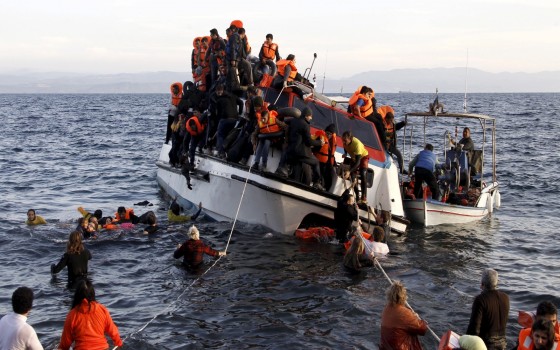
The suffering of migrants in Libya returns to the fore, amid European assistance to the authorities to stop them

- Europe and Arabs
- Wednesday , 24 August 2022 17:18 PM GMT
AFP
Libya is not a "safe" country for the thousands of migrants and refugees who pass through it trying to reach Europe. However, the EU financially supports the Libyan authorities to intercept migrants and keep them on Libyan soil. When Godwin wanted to reach the Italian coast on a rubber boat, Libya was in the midst of a civil war. "It was in 2019, when I paid 6,000 dinars (about $1,100) to get on the boat," recalls the 34-year-old Nigerian. The day laborer, who wore a shirt with paint stains on it, told AFP that at the time he boarded a boat from the coast of Zawiya, near Tripoli. "It was dark, and I didn't know the exact destination." Like most immigrants, he clings to a romantic image of the ancient continent. "I just wanted to go to Europe to live a good life." But the Nigerian was aware of the risks. He says with some resignation, "I told myself that if I survived, it would be praise be to God, and if I died, it would be by His will." The perilous voyage in the Mediterranean turned into a nightmare. "When I saw a Libyan boat with armed men arriving, I thought I was going to jump into the water. I didn't want to go back to Libya." - ransom - "They brought us back. I was imprisoned and my family was asked to pay 3,000 dinars ($550). They paid the ransom and I was released," recalls Godwin, who wants to try again soon. Hussein, for his part, says that he tried "to reach Europe by sea in 2017." Agence France-Presse met this Sudanese immigrant while he was waiting under a bridge to get daily construction work for $10 to $20 a day. Driven by misery, this 26-year-old refugee set out on the migration path "in the middle of the night" on a boat that was intercepted by the Libyan Coast Guard shortly after. "I was imprisoned for 28 hours before I was able to escape," he says. Like Goodwin and Hussein, tens of thousands of migrants and refugees attempt to reach Europe every year, often falling victim to human traffickers, when they do not die at sea. Since January, some 13,000 people who tried to cross the Mediterranean have been returned to Libya, some of whom have been imprisoned, according to the International Organization for Migration (IOM) which also reported 206 dead and 712 missing at sea. Last year, more than 32,000 migrants were returned to Libya, according to the same organization. Migrants are detained in centers controlled by armed groups. There are also "illegal" and "secret" centers that are subject to those involved in human trafficking. Migrants are detained in an "arbitrary and systematic" manner, and they are often subjected to "murder, enforced disappearance and torture" or "slavery, sexual violence, rape and other inhumane acts," according to the United Nations. But all this does not prevent the European Union from providing financial support to the Libyan Coast Guard with the aim of preventing arrivals from reaching European coasts. - 'Taxpayers' - At the beginning of August, Human Rights Watch accused the European border agency (Frontex) of supporting, using drones, "the efforts of Libyan forces to intercept boats" of migrants, despite "compelling evidence of torture and exploitation." . On social networks, many migrants stranded in Libya denounced this European aid. "We live in fear, tortured with European taxpayers' money," wrote the "Refugees in Libya" account on Twitter. The criticism is not limited to the financial support provided by the Europeans. In a mid-August report, Alarm Phone, a non-governmental organization that runs a hotline for migrants in difficulty, says it has "witnessed the policy of not providing assistance countless times, while ignoring the boats at risk of capsizing in the (rescue) zone." Maltese. Sometimes he doesn't know what happened to her. Hussein criticizes the countries from which migrants originate, saying, "Instead of Europe pushing Libya to stop immigration, African countries should take care of their people so that they do not emigrate. If my situation was good, I would not have come here." The Libyan authorities defend themselves, stressing that they do not resort to any violence. In mid-May, Libya announced the interception of 3,000 migrants within days, about 300 of whom were presented to the media, while they appeared to be in good shape in a detention center. "The arrests are carried out according to the measures in place" in the country, the center's official told AFP.






No Comments Found