
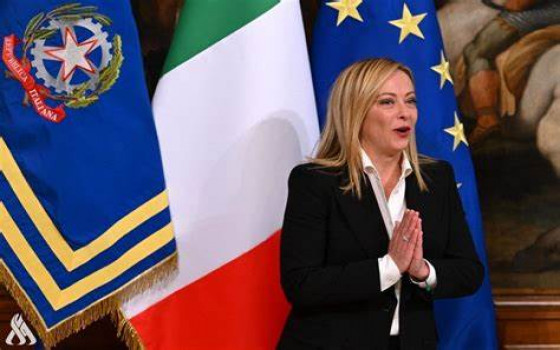
Meloni asserts before Parliament that Italy is "part of Europe and the Western world."
- Europe and Arabs
- Tuesday , 25 October 2022 16:12 PM GMT
Italian Prime Minister Georgia Meloni affirmed Tuesday that Italy is "a whole part of Europe and the Western world", in her public policy address to Parliament, which she delivered exactly a month after her far-right party's historic victory in legislative elections.
Meloni, who heads the Euro-skeptic "Fratelli d'Italia" (Brothers of Italy) party, said Italy's approach was not to "repress and torpedo European integration" but to make the group's machine work better.
The House of Representatives will vote in the evening to vote on confidence in her government and the Senate on Wednesday, and she will surely get it because her coalition occupies an absolute majority in Parliament.
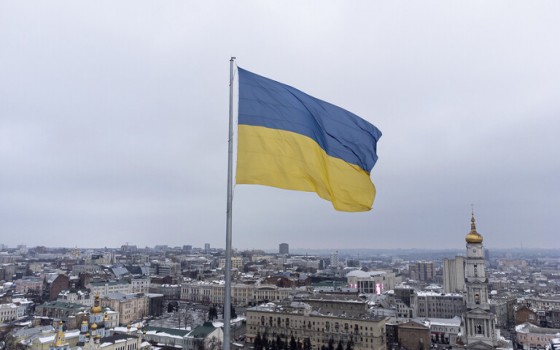
Meloni also promised that Rome would remain "a reliable partner of NATO to support Ukraine."
Before starting her speech, her ally and Deputy Prime Minister Matteo Salvini, leader of the anti-immigrant League, outlined in a series of tweets on Monday evening a program that includes pension reform, major aid for families and companies, a 15% tax and the construction of a controversial bridge at a very high cost between Sicily and the Italian mainland.
It is true that these promises were part of the electoral program of the right-wing coalition, which also includes the "Forza Italia" led by Silvio Berlusconi, but Meloni in recent weeks intensified the statements calling for caution in spending.
"Hurricane Salvini on Meloni," La Repubblica newspaper wrote on its front page on Tuesday.
Meloni, who succeeded Mario Draghi in this position, will surely be credited with the fact that her coalition holds an absolute majority in both houses.
It is ironic that while her party was in outright opposition to the government of Mario Draghi, its program is set to be part of the continuity of the program of the former president of the European Central Bank, at least in the economic sphere.
In fact, the important economic portfolio was entrusted to a former minister in Draghi's government, Giancarlo Giorgetti, a representative of the moderate wing of the League.
"In terms of economic policy, there is general popular support in Italy for what Draghi was doing," Gilles Moeck, an economist at the Axa group, told AFP.
Abolition of the minimum wage? -
Its approach aims to reassure markets, as well as Brussels and the European partners of the third-largest economy in the eurozone, whose growth depends on about 200 billion euros in subsidies and loans granted by the European Union under the post-pandemic recovery fund.
These funds depend on a series of reforms, ranging from the judiciary to the digitization of public administration, and are supposed to be implemented by 2026. The Meloni coalition has promised to review this plan, but has not yet said how and since part of the money has already been paid, Brussels does not seem to allow major changes.
"Any strategy of tension with the European Commission would be too risky in a very weak financial environment," Gilles Moeck said.
This aid is necessary for a country whose public debt has reached 150% of GDP, which is the highest ratio in the eurozone after Greece, which is expected to enter a recession in 2023, according to the International Monetary Fund's forecast.
And the many challenges that await its government, therefore, are mostly economic, starting with inflation and ending with the public debt.
Inflation rose 8.9% year-on-year in September and Italy was hit particularly hard by the energy crisis due to its dependence on Russian gas imports.
Another topic on its program is the possibility of abolishing the “citizenship income”, which is the minimum wage for the poor and was adopted in 2019 with the payment of the Five Star Movement (which was anti-regime).
On the other hand, Meloni, the ultra-conservative, who adopts the slogan "God, the homeland, the family," promised not to prejudice the law that legalizes abortion.
Source AFP



No Comments Found