

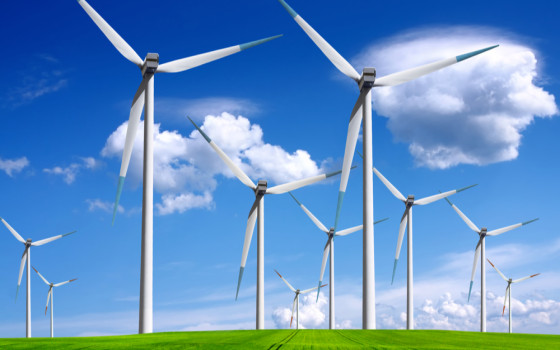
European agreement to reach 45 percent of renewable energy sources by 2030

- Europe and Arabs
- Thursday , 30 March 2023 16:14 PM GMT
Brussels: Europe and the Arabs
The European Commission said in Brussels that the provisional agreement reached today between the European Parliament and the Council "on behalf of member states" is to strengthen the EU directive on renewable energy.
"This transaction brings the EU one step closer to completing 'Fit for 55' legislation to deliver the European Green Deal and REPowerEU targets," the Commission said in a statement.
The agreement raises the EU's binding renewable energy target for 2030 to a minimum of 42.5%, up from the current target of 32% and nearly doubling the current share of renewable energy in the EU. The negotiators also agreed that the EU aims to reach 45% renewable energy sources by 2030.
The agreement reaffirms the EU's determination to gain its energy independence through faster deployment of domestic renewable energy, achieving the EU's target of reducing greenhouse gas emissions by 55% for the year 2030. Expanding and accelerating renewable energy on a large scale. Power generation, industry, buildings and transport will lower energy prices over time and reduce the EU's dependence on imported fossil fuels.
A larger share of renewable energy sources to achieve a carbon-neutral economy
Licensing procedures will be easier and faster under the new law. Renewable energy will be recognized as a dominant public interest, while maintaining a high level of environmental protection. In regions with high renewable energy potential and low environmental risks, Member States will establish acceleration zones dedicated to renewables, with particularly short and simple licensing processes. The interim agreement also promotes cross-border cooperation in the field of renewable energy sources.
The agreement includes objectives and measures to support the absorption of renewable energy sources in various sectors of the economy. The revised directive reinforces annual targets for renewables for the heating and cooling sector and for renewables used in district heating systems. It introduces a specific benchmark of 49% renewable energy for energy consumption in buildings by 2030 to complement EU building legislation and guide member states' efforts.
As a major energy consuming sector, the industry was included for the first time in the Renewable Energy Directive. The agreement sets indicative targets (1.6% of annual increase in renewable energy use) as well as a binding target to reach 42% of renewable hydrogen in total industry hydrogen consumption by 2030. The agreement also strengthens the regulatory framework for the use of renewable energy in transportation (reducing gas intensity global warming of 14.5% or 29% share of renewable energy in final energy consumption), including a joint sub-target of 5.5% for advanced biofuels and renewable fuels of non-biological origin, including a minimum of 1% for renewable fuels from Non-biological origin. These targets support the EU's ambitions for renewable hydrogen deployment.
The agreement also contains provisions to support the integration of energy systems through electricity and waste heat absorption as well as an improved system of guarantees of origin to improve consumer information.
More sustainable use of bioenergy in line with ambitious climate goals
The agreement promotes bioenergy sustainability standards, in line with the growing climate and biodiversity ambition of the European Green Agreement. In the future, these standards will apply to smaller installations (equal to or greater than 7.5MW) rather than the 20MW limit under the current directive. The agreement includes provisions to ensure that forest biomass is not sourced from certain areas that are of particular interest from a biodiversity and carbon stock perspective. In addition, the agreed rules stipulate that woody biomass must be used with the highest economic and environmental added value (the so-called consecutive use). Subsidies for energy produced through the use of sawn logs, veneer logs, industrial roundwoods, logs and roots will be prohibited.
On the next step, the European Commission statement said, "Today's provisional agreement requires formal adoption by the European Parliament and the European Council. Once this process is completed, the new legislation will be published in the Official Journal of the Union and enter into force."
The European Green Deal is the EU's long-term growth strategy to make Europe climate neutral by 2050. The revision of the Renewable Energy Efficiency Directive is one of the "fit 55" proposals put forward by the Commission in July 2021 to make the EU's climate, energy, land use, Adequate transport and tax policies to reduce net greenhouse gas emissions by at least 55% by 2030, compared to 1990 levels. Accelerating and increasing the use of renewable energy sources by the end of the next decade is critical for Europe to become the world's first climate-neutral continent by 2050 and to make the European Green Deal a reality



No Comments Found