
President of the European Commission: We do not want to sever economic, social, political and scientific relations with China, but there is an urgent need to rebalance our relationship on the basis of transparency, predictability and reciprocity.

- Europe and Arabs
- Tuesday , 18 April 2023 15:19 PM GMT
Brussels: Europe and the Arabs
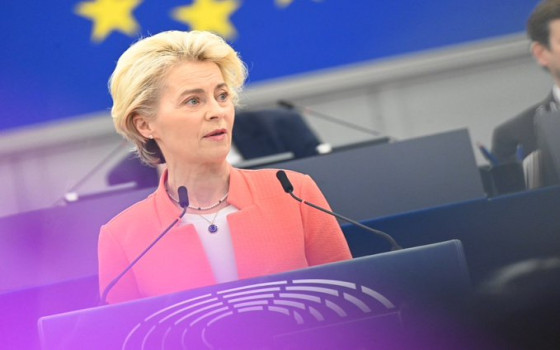
European Commission President Ursula von der Leyen said that in the past decades, China has become an economic powerhouse and a major global player.
It is now reducing its dependence on the world while increasing the world's dependence on itself. “And for this we need to develop a new approach. Our approach must be based on reducing risks, but not separating. And for this we need: a more competitive and resilient economy, secondly better use of trade defense tools and thirdly addressing emerging or sensitive technology leakage through investment controls and fourthly cooperation with partners This came in von der Leyen's intervention during a session of the European Parliament held on Tuesday in Strasbourg on relations with China. Having this discussion is urgent and good. And most importantly, I say this because this relationship is too important for us to define our European strategy and principles for dealing with China. I believe we can - and must - create our own distinct European approach that also leaves room for us to collaborate with other partners as well. And the starting point for that is the need to have a very clear and shared picture of the risks and opportunities in our engagement with China. This means acknowledging - as well as saying clearly - that the CCP's actions have now caught up with its stated ambitions and the hardening of China's overall strategic stance over the past years. For example, displays of military force in the South China Sea, East China Sea, and on the border with India directly affect our partners and their legitimate interests. Or about the Taiwan issue. The "one China" policy of the European Union is long-standing.We have consistently called for peace and stability in the Taiwan Strait and we stand strongly against any unilateral change of the status quo, in particular by the use of force. We must also never shy away from talking about the deeply concerning and grave human rights violations in Xinjiang. And just as China has been ramping up its military posture, it has also ramped up its policy of economic and trade coercion as we have seen from Lithuania to Australia and the targeting of everything from pop bands to trade brands. We have also seen these tactics directed right here in the House of European democracy. And I want to express my solidarity to those Members of the European Parliament who have been unfairly sanctioned by the Chinese Communist Party just for calling out human right violations. And all this is symptomatic for the fact that China has now turned the page on the era of ‘reform and opening' and is moving into a new era of ‘security and control'. I heard this in Beijing from many European companies who have witnessed first-hand this shift towards security and away from the logic of open markets and free trade. And to strengthen that security and control leverage, China is openly pursuing a policy of reducing its dependency on the world – that is completely okay, that is their right –, but while increasing the world's dependency on itself. You know the examples, for example, whether it is on critical raw materials or the renewable energy, on emerging tech like artificial intelligence, quantum computing or biotech.
Having this clear-eyed assessment of the Chinese Communist Party's actions and direction of travel – actually, including its relations with Putin's Russia and its attitude towards the war in Ukraine – is a pre-requisite for today's discussion. And it will allow us to develop an approach that is tailored to our economic and national security imperatives. One that we can all rally around. And one that is clearly understood in Europe, in the world and crucially also in China itself. And this last point is one of the key reasons I felt it was important to make the trip to Beijing alongside President Macron. It was a chance to discuss with President Xi the shared challenges that we need to work on together – whether in our bilateral trading relation or on global issues like debt relief, climate change and nuclear non-proliferation. But equally important, the trip was necessary to ensure that we are as honest and clear in our messaging in Beijing as we are in Brussels or here in Strasbourg. This is a core part of our efforts to de-risk through diplomacy – by reducing the space for misunderstanding and miscommunication regardless of how difficult the conversations may be. The point I made in Beijing is that we do not want to cut economic, societal, political and scientific ties. We have many strong links and China is a vital trading partner – our trade represents some EUR 2.3 billion a day. Most of our trade in goods and services remains mutually beneficial. But there is an urgent need to rebalance our relationship on the basis of transparency, predictability and reciprocity. What we want is China to respect the level playing field when it comes to access for our companies to the Chinese market, to respect transparency about subsidies, to respect the intellectual property. And beyond this, we also know that there are some areas where trade and investment poses risks to our economic and national security, particularly in the context of China's explicit fusion of its military and commercial sectors. This is why the central part of our future China strategy must be economic de-risking.
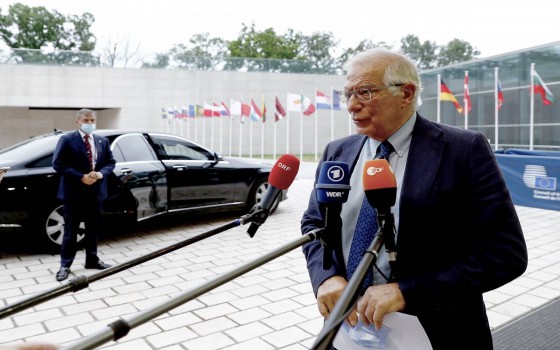
As the High Representative said, in 2019, the Commission and the EEAS collectively proposed a strategic update of our China policy. Since then, the world has changed enormously. China has changed. Europe has changed. That is why our European strategy has to adapt, too.
A few weeks ago, when I gave my speech on China, I said that ‘a strong European China policy relies on strong coordination between Member States and EU institutions, and on a willingness to avoid the divide and conquer tactics that we know we may face.' We have already in the recent days and weeks seen those tactics in action. And it is now time for Europe to move to action, too. Now is the time to demonstrate our collective will, it is time to jointly define what success looks like, and to show that unity that makes us strong.



No Comments Found