

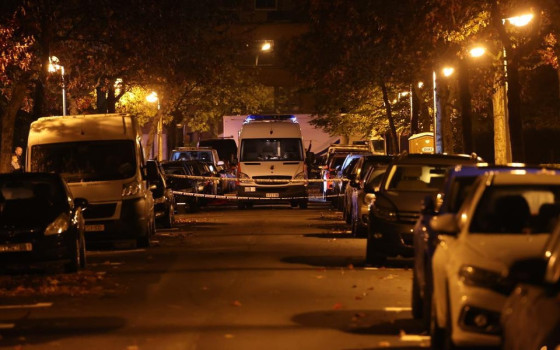
Belgian security uses neighboring countries and Interpol to identify 22 women who are victims of murder

- Europe and Arabs
- Thursday , 11 May 2023 1:37 AM GMT
Brussels: Europe and the Arabs
22 women were killed, but no one knew anything about the identity of each victim, so the Belgian police decided to search for answers in neighboring countries.
And according to what the media in Brussels revealed on Wednesday morning, the Belgian, Dutch and German police launched a joint operation, and it aims to identify the victims, and this will happen with the help of Interpol.
This is what made some describe it as outside the European scope and said that it is an international campaign to identify 22 unknown and murdered girls and women.
The investigators believe that the answers to the unsolved cases can be found in the neighboring countries. After you publish the pictures and information available on each of the victims found by the police.
More than two years ago, media reports reported that the gradual return to normal life in Europe was accompanied by an escalation of women's murders again, after a deceptive decline in light of the restrictions, as the lifting of the stone for men of violent nature was tantamount to a "loss of control."
Among the women who were victims of violence, media reports at the time referred to Shahiniz, who was burned alive by her husband in France, five women who were killed within three weeks in the spring in Sweden, and others who were killed in Spain. Faces that head the newspapers and are covered by the news bulletins continuously.
In the rare European countries that provide official statistics for the year 2021, whether official or issued by associations, the numbers unequivocally indicate this trend. One such country is Spain, where a woman is killed every three days by her husband or ex-husband since the state of health emergency was lifted in May, compared to an average of one woman per week.
In Belgium, 12 murders of women took place by the end of April, compared to 24 for the whole year 2020. As for France, 56 women have been killed to date, according to the “Women’s Murder by Their Partners or Ex-Partners” association, compared to 46 in the same period in 2020.
"When women regain their freedom, the aggressors feel they are losing control and their reaction is more violent, as evidenced by the wave of femicides in the past months," Victoria Rozelle, head of the Spanish government's team against male violence, told AFP.
And she continued, "When we opened the door to restrictions, we also opened the door to another epidemic, the male epidemic that was hiding behind it."
Spain was the first European country to pass a law in 2004 that makes the victim's gender an aggravating circumstance in the event of an assault, determined to "finally" eradicate this "scourge", according to what Socialist Prime Minister Pedro Sanchez announced after the recent increase in the number of such crimes.
“help”
And with the imposition of home confinement across Europe, monitoring domestic violence has become more difficult.
The victims, who are obliged to stay in their homes, were forced to coexist with the executioner, and they no longer had any options for seeking help except in a very hidden way.
Returning to Spain, distress requests increased during the quarantine that extended between mid-March and mid-June 2020 by 58% compared to the same period in 2019, with a sharp rise in online query requests, reaching +458% of these requests. Silent” as described by the Ministry of Equality.
Victoria Rozelle commented, "This reflects the situation of women who could not even make a phone call from their homes."
The same trend was recorded in Italy and Germany, with a sharp increase in the number of calls to emergency numbers dedicated to domestic violence in April and May 2020.
In the United Kingdom, the “Refuge” organization that helps victims of domestic and domestic violence received, between spring 2020 and February 2021, twice as many calls as it usually receives.
Purple pizza and mask
Women remained victims of violence throughout the period of confinement, when they were imprisoned in their homes with their husbands or partners, under their continuous close surveillance. How can they, in this case, seek help?
In Italy, the police have assigned them an emergency number that they can call and say, “I would like to order a Margherita pizza,” which is a signal that means that they are subjected to violence or fear violence, and then the police send a patrol.
In Spain, women could enter a pharmacy, which is one of the rare shops that remained open during the stone, and request a “violet mask.”
Angelis Carmona, head of the Spanish Observatory against Domestic and Gender-related Violence, noted that contacts have increased, but complaints and homicides have decreased under the restrictions.
The number of femicides decreased in 2020 in France, Italy and Spain, with 90, 67 and 45 women being killed, respectively, by their partners or ex-partners. In Belgium, the number remained stable at 24 women.
This phenomenon is not surprising, according to Angelis Jaime de Pablo, head of the Themenes Women's Association, as the home stone constituted the "ideal scenario for the exercise of violent control," and she considers that the current increase in murders was "expected."
And often the man moves to carry out the act of killing when announcing separation or divorce or the beginning of a new emotional relationship, and in fact the stone postponed these motivating circumstances.
“After the health crisis is over, many victims realize that they have the tools to end the relationship,” said Carmine Ruiz-Repoyo, a sociologist specializing in gender-based violence. This is where the high risk of murders lies.”





No Comments Found