

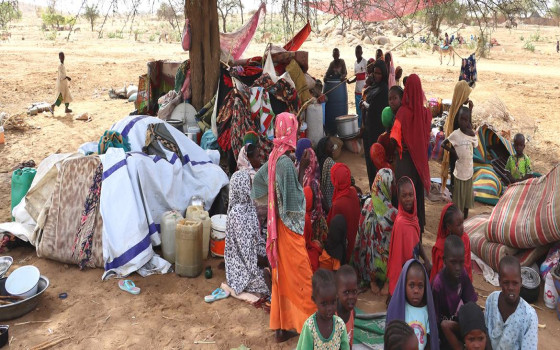
200,000 Sudanese have fled the country - and the United Nations is expanding relief. Half a million children have left their homes

- Europe and Arabs
- Saturday , 13 May 2023 14:16 PM GMT
Khartoum - New York: Europe and the Arabs
The United Nations High Commissioner for Refugees announced that about 200,000 people have fled Sudan so far due to the ongoing war since April 15.
Meanwhile, the United Nations and its partners continue to scale up the humanitarian response, despite the continuing violence.
UN spokesman Stephane Dujarric said that the World Food Program has delivered food assistance to about 50,000 people in Kassala, Gedaref and White Nile states since resuming its operations in late April.
UNICEF provides therapeutic food in response to the malnutrition crisis. This includes 34,000 boxes of aid being shipped from France.
Dujarric said these supplies are particularly important in the wake of the burning of a baby food factory in Khartoum.
The fire completely destroyed the factory's machinery, as well as enough supplies to treat around 14,000 malnourished children, according to UNICEF.
The facility was producing therapeutic food for children suffering from the most serious forms of malnutrition, another example of the direct impact of violence and looting on the humanitarian situation, Dujarric said.
UNICEF estimates that at least 450,000 children have fled their homes - including 368,000 internally displaced persons and 82,000 who have fled abroad.
For its part, the UNHCR warned that the situation is critical, and that the humanitarian response suffers from a significant lack of funding in Sudan as well as in neighboring countries in Chad, South Sudan and Ethiopia.
UNHCR reported the deployment of its teams on the ground and the speedy provision of aid with its partners, but made it clear that the intensification of its operations would urgently require new funding.
The Secretary-General of the United Nations welcomed the signing by both parties to the conflict in Sudan of a declaration of commitment to protecting civilians and ensuring the safe passage of humanitarian aid.
He hoped that this declaration would ensure that relief operations can be urgently and safely scaled up to meet the needs of millions of people in Sudan.
For her part, Lenny Kinsley, media officer of the World Food Program in Sudan, called on the Sudanese army and the Rapid Support Forces to abide by what they agreed upon in Jeddah and to "translate it realistically" on the ground by securing safe humanitarian corridors for the delivery of aid and the safe exit of the displaced from Khartoum.
This came in an exclusive interview with United Nations News, in which Ms. Kinsley touched on resuming the program's activities in the country after it was forced to suspend it following the killing of three of its staff on the first day of fighting on April 15.
Regarding the latest developments on the ground since the resumption of the program's operations on the ground, Lenny Kinsley said: The latest we have reached is that we have been able to support 50,000 people through emergency food packages in three states, which are Gedaref, Kassala and White Nile.
This includes pre-existing refugees and internally displaced persons. Currently, we are focusing our efforts on aid distributions to the newly displaced in Gezira state, most of whom have fled Khartoum. This is the first time that the World Food Program has distributed food and emergency aid in Gezira State.
It's a major logistical operation to establish distribution capacity and set up relief operations in a state where we haven't had a base of operations before. So our teams are working around the clock to make this happen.
The first trucks loaded with food have arrived in Gezira State, and distributions will begin in the coming days. And as I said, this is for the newly displaced who have just fled Khartoum with little or nothing but what is on their backs. So supporting those people who are bearing the brunt of the conflict is crucial





No Comments Found