
Head of the UN Mission in Iraq: The government opens an important window of opportunity to overcome challenges
- Europe and Arabs
- Friday , 19 May 2023 13:41 PM GMT
New York - Baghdad: Europe and the Arabs
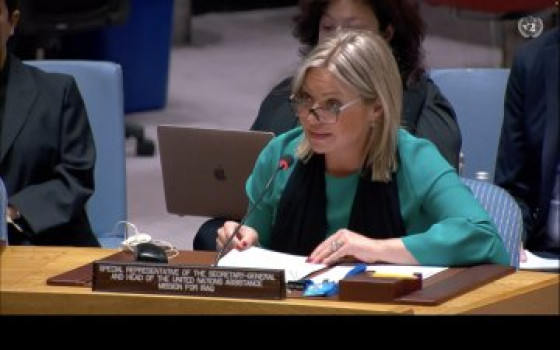
The Special Representative of the Secretary-General of the United Nations in Iraq, Jeanine Hennis-Plasschaert, said that the country faces a "very bumpy road" fraught with current fragility inherited from previous decades, and is exposed to new weaknesses. Also in it, "in her speech before the Security Council on Thursday, Ms. Hennis-Plasschaert said that the instability that Iraq experienced in the recent past was the result of" corruption, weak governance, the presence of informal armed actors, impunity, factional politics, and poor service delivery. unemployment, inequality, and overreliance on oil.
However, she stressed that the formation of the Iraqi government in October opened "an important window of opportunity."
The Special Representative said that the Government had indicated its determination to address a number of pressing issues facing the country and was trying to avoid unrest that might threaten to destabilize the prevailing political stability.
She noted that it is impossible to predict the unknowns that could include the emergence of potential disruptors, but she said: “What we do know is that any government in this situation needs time. that existed before October 2022, the harsh reality is that there is no time to waste."
Ms. Hennis-Plasschaert called on the Iraqi parties to prioritize the national interest and stressed the need to allow constructive interaction between the opposition and the coalition, including through public exchanges between decision-makers, political leaders and the broader civil society.
She said that Iraq has a long to-do list, stressing that "narrow or partisan actions will not help achieve it."
The Special Representative also focused on the need to pass a federal budget quickly to achieve some government goals, such as providing adequate public services.
She highlighted the need to diversify the Iraqi economy and implement major structural reforms, adding that the country's dependence on oil and high employment rates in the public sector "cannot continue indefinitely."
She said this would be a major challenge because successive governments "chose the easier way" by creating public sector jobs to quell civil unrest rather than developing a private sector that generates jobs. "This has led to a wage bill that no country can afford," she added.
Ms. Hennis-Plasschaert commended the government's outspoken stance on the negative effects of corruption, which stem from the system as it has been established over the past two decades. She said the independence of state institutions was paramount, but noted that "vested interests will undoubtedly make the required systemic reform an uphill struggle."
challenges of the Kurdistan region
The Special Representative turned to the Kurdistan region of Iraq, where she said that the differences between the two ruling parties in recent months have pushed the region to the "edge of the abyss".
She noted that the region's cabinet met on Sunday and said: "At this stage, I can only express hope that the parties will rise to the challenge now, bridge differences, and work for the benefit of all people. One look at the history or geography of the Kurdistan Region of Iraq confirms The urgency of the need for sustainable solutions.
Ms. Hennis-Plasschaert said that the parliamentary elections in the Kurdistan Region of Iraq, which had been postponed to 18 November, were long overdue. He stressed the need to find an agreement on the outstanding electoral issues, because "another delay would harm public confidence."
The most dangerous climate issue
The Special Representative emphasized that the water file represents "the most serious climate emergency in Iraq".
According to estimates, the country will only have the capacity to meet 15 percent of its water needs by 2035, as 90 percent of Iraq's rivers are polluted, and 7 million people currently suffer from lack of access to water.
Ms. Hennis-Plasschaert said this was an important multiplier of threats to Iraq's stability, and she welcomed the attention given by the Government to this issue. She also noted reports that comprehensive modernization plans for Iraq's water management systems are underway, adding that this will be vital in meeting the demands driven by population growth and urbanization.
She added, "The fair sharing of resources among Iraq's neighbors is equally important. If water is dealt with in a spirit of competition, everyone will lose. Bold local actions and close regional cooperation are the only solution to success."
Huge potential
The Special Representative acknowledged the "huge potential" of Iraq and was convinced that many of the drivers of instability could be addressed through the implementation of ambitious government plans. “Accountability, the rule of law and respect for human rights are equally essential to prevent a recurrence of crisis cycles,” she said.
She told the members of the Security Council that the time has not come to complacency and consider that Iraq has overcome adversity, expressing her hope that all actors remain committed to the country's progress.


No Comments Found