
European Greens to field Spitzenkandidaten duo in 2024 EU elections
- Europe and Arabs
- Sunday , 4 June 2023 15:20 PM GMT
Brussels: Europe and the Arabs
The European Greens will present a pair of leading candidates (Spitzenkandaten) for the next presidency of the European Commission. The Greens also grew with four new member parties: two Portuguese, one Slovenian and one Hungarian.
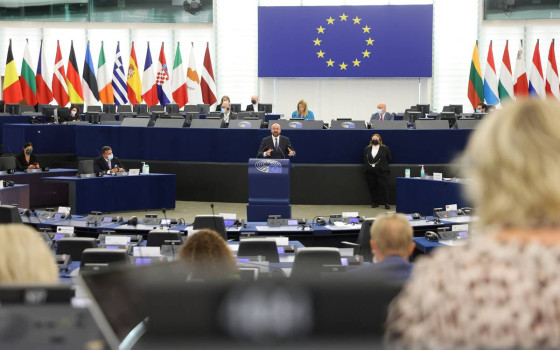
According to what came in a statement, a copy of which we received at dawn on Sunday, the two decisions were taken on Saturday by more than 120 delegates from all 44 members of the European Green Party bloc, who met in Vienna, Austria.
The Greens also strongly condemned the coalition of conservative, liberal and far-right political forces attacking European nature and climate legislation. Melanie Vogel and Thomas Weitz, co-chairs of the European Green Party, said:
“We are very pleased with the vast majority of delegates who voted to put forward a pair of top candidates (Spitzenkandaten) for the 2024 EU elections. In line with our feminist values, at least one of them must be a woman. For us, the Green Party, transparency about the main candidates is paramount. "The importance of giving citizens the democratic choice they deserve in EU elections. As a citizen, you have the right to know who will take power as the next President of the European Commission with your vote. Back-door trading between European Council member states for the EU's highest office can no longer be tolerated."
The duo of top candidates will be elected at the electoral conference February 2-4, 2024 in Lyon, France.
Green family grows
Yesterday in Vienna, four political parties from Eastern and Southern Europe became new members of the European Green Party: the Slovenian party VESNA - zelena stranka, the Portuguese parties PAN and LIVRE and the Hungarian party Párbeszéd - A Zöldek Pártja. In addition, Progresīvie, who had joined the family in Riga, became a full member.
Social urgency and climate affect every European citizen. Across Europe, people are rising to fight climate change and to protect democratic freedoms. Our ongoing fight for climate and social justice is attracting new sides. Co-Chairs Melanie Vogel and Thomas Weitz said that at least 4 new parties from Eastern and Southern Europe have joined the Green family in the run-up to the 2024 European elections.
Attacks on climate and nature policies
The EU Green Deal was born after the green wave in the 2019 EU elections, with European Greens achieving a historic result after a campaign focused on climate protection and social justice. The Green Deal is essential to combating climate change, creating jobs through a just transition, and ensuring Europe's independence from Russian energy.
“In recent weeks, we have seen members of the European People’s Party (EPP) and Renewed Europe unite with the far right in a backlash against nature at EU level and across Europe. They propagate false narratives of the far right and attack the Nature Conservation Act, the EU Green Deal, and its policies. Climate. We will protect these policies. It is time to focus on implementing them and phasing out fossil fuels now. So that our children and grandchildren can grow up in a fair, just and green Europe," concluded Melanie Fogel and Thomas Weitz.
The green family is growing. The number of members of the European Green Party increased from 44 to 48. Within the European Union, the party is currently allied with the European Free Alliance bloc and together they form the fourth largest political bloc in Parliament and currently have 74 members.
In 2014, all European political parties put forward candidates for the post of President of the European Commission, known as Spitzkenkänden. This contributed to achieving transparency and giving citizens a clear political choice. In 2014, when the European People's Party (EPP) became the largest group in the European European Parliament, Jean-Claude Juncker's Spitzinkandedat became President of the Commission. In 2019, EPP introduced Manfred Weber to Spitzekandidat. But in the end, the heads of state and government of the Council of the European Union decided to entrust the post of President of the Commission to Ursula von der Leyen, who was not a candidate at that time.



No Comments Found