
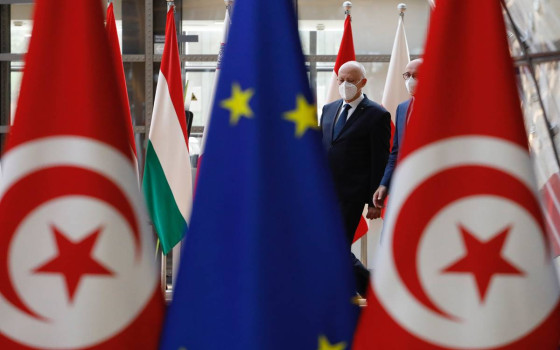
European leaders discussed relations with southern Mediterranean countries and welcomed work on a mutually beneficial partnership package with Tunisia
Pledge to solve the Cyprus problem and demanded the foreign policy coordinator to prepare a report on relations with Turkey

- Europe and Arabs
- Friday , 30 June 2023 20:3 PM GMT
Brussels: Europe and the Arabs
The final statement of the discussions of the leaders of the European Union countries during the Brussels summit on international relations was issued in Brussels. The statement touched on relations with the countries of the southern and eastern Mediterranean, Latin American and Caribbean countries, and others.
"The European Council discussed preparations for the EU-CELAC summit. It will be an opportunity to renew and strengthen a partnership based on common values, history and culture, and to agree on a positive and forward-looking agenda. Regular and structured dialogue between the two regions will ensure the follow-up and implementation of concrete actions in areas of interest," the statement said. Common interest, including trade and investment The European Council stresses the importance of dealing together with global climate and environmental crises, growing inequality, opportunities for digital transformation, the need to diversify supply chains, as well as unprecedented threats to global security and the rules-based order.
The European Council held a strategic discussion on the EU's relations with partners in the southern neighborhood. In this context, the European Council welcomes the work carried out on a comprehensive, mutually beneficial partnership package with Tunisia, building on the pillars of economic development, investment and trade, green energy transition, migration and people-to-people contacts, and supports the resumption of. Political dialogue in the context of the Association Agreement between the European Union and Tunisia. It stresses the importance of promoting and developing similar strategic partnerships between the European Union and partners in the region.
Referring to the EU-Western Balkans Summit Declaration in Thessaloniki of 21 June 2003, the subsequent Sofia, Zagreb, Brdo and Tirana declarations and their earlier conclusions, in particular those of 23-24 June 2022, the European Council reiterates its full and unequivocal commitment to the perspective of EU membership in Western Balkans and its support for accelerating the merit-based accession process and related reforms.
The European Council condemns the recent violence in northern Kosovo* and calls for an immediate de-escalation of the situation, on the basis of key elements already identified by the European Union on 3 June 2023. The parties should create conditions for early elections in all four municipalities in northern Kosovo. Failure to calm tensions will have negative consequences. The continuation of the EU-facilitated dialogue led by the High Representative and the speedy implementation of the agreement on the path of normalization and its Implementation Supplement are essential. This includes the creation of the Association/Community of Serb Majority Municipalities.
In line with the commitments on multilateralism made at the EU-AU Summit of 17-18 February 2022, the European Council supports the enhanced presence of the African Union in international forums, in particular in the G20.
Middle Eastern
. With reference to its previous conclusions, the European Council remains fully committed to reaching a comprehensive settlement of the Cyprus problem, within the framework of the United Nations, in accordance with relevant UN Security Council resolutions and in line with the principles on which the European Union was founded and the acquis. The European Union calls for a speedy resumption of negotiations and is ready to play an active role in supporting all phases of the UN-led process, with all appropriate means at its disposal.
. Referring to its previous conclusions on the EU's relations with Turkey, including those in June 2021 and the March 2021 Statement, and in light of the recent elections in Turkey, the European Council invites the High Representative and the Commission to report to the European Council on the state of EU-Turkey relations, building on the tools and options identified by the European Council, and with a view to moving forward in a strategic and forward-looking manner.
other items
The European Council recognized the challenges posed by sectoral and cross-border crises and natural and man-made disasters, many of which are exacerbated by climate change and the evolving security landscape in Europe and the world. It stresses the importance of enhancing resilience in strategic areas through an all-risk approach to preparedness and response using relevant mechanisms, including the Union Civil Protection Mechanism.



No Comments Found