
The conclusion of the European Union-Latin America and the Caribbean summit...towards a closer, stronger and renewed partnership

- Europe and Arabs
- Wednesday , 19 July 2023 0:24 AM GMT
Brussels: Europe and the Arabs
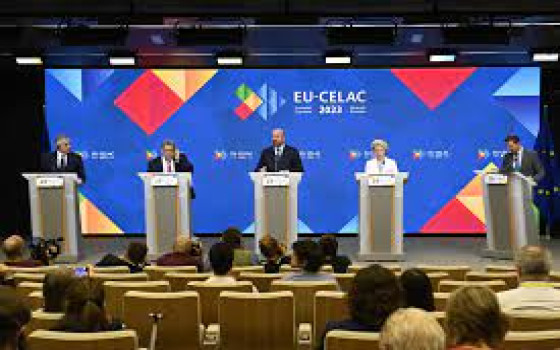
On Tuesday, the summit of the European Union and the countries of Latin America and the Caribbean (CELAC) concluded in its third edition, which was hosted by Brussels over two days. With the participation of the heads of state and government of the member states of the European Union and the 33 countries of the Community for the first time in eight years.
According to a source from the EU institutions in Brussels at the conclusion of the summit, European Commission President Ursula von der Leyen said: “The EU-CELAC summit felt like a new beginning between old friends. These are times of great geopolitical change, and like-minded friends need to Like-minded European Union, Latin America and the Caribbean to move closer. This is what we are doing with the new investment agenda of the Global Gateway, according to which we will invest more than 45 billion euros in the region. We want to bring benefits to local communities, to create value chains locally, in the region. This is the spirit of our partnership.”
The series of meetings began with the EU-LAC Business Roundtable on Monday morning, with Chair von der Leyen presenting the EU-LAC Global Gateway Investment Agenda (GGIA). It includes more than 135 projects to make a just green and digital transition a reality on both sides of the Atlantic and revolves around four pillars: a just green transition, inclusive digital transformation, human development, health resilience, and vaccines.
On this occasion, the President announced that Team Europe had committed more than 45 billion euros to support the strengthened partnership with Latin America and the Caribbean until 2027. The summit strengthened the partnership between the European Union and the countries of the Community of Latin American and Caribbean States on common priorities, such as digital. Green transitions, combating climate change and biodiversity loss, health, food security, migration, security and governance or combating transnational crime.
During the summit, the EU strengthened its energy cooperation with Argentina and Uruguay by signing two memorandums of understanding. The first identifies key areas of cooperation, including renewable energy, hydrogen and methane emissions reduction and stresses the need to provide a socially just energy transition. The latter highlights renewable energy, energy efficiency and renewable hydrogen as key areas of cooperation as both the EU and Uruguay strive to reach climate neutrality by 2050.
As part of the EU's Global Gateway strategy, during the EU-CELAC summit, the European Investment Bank (EIB) and Bank Santander signed a €300 million loan to support the installation of a series of small, self-contained solar PV plants. in Brazil. Similarly, the European Investment Bank also announced a €200m loan to Banco del Estado de Chile to finance new homes with better energy efficiency standards and a €100m loan to support Chile's growing renewable hydrogen industry.
The EU also signed a Memorandum of Understanding with Chile on establishing a Partnership on Sustainable Raw Materials Value Chains, which will contribute to security of supply in Europe while creating jobs and growth in Chile.
In the digital sphere, the European Union, Argentina, the Bahamas, Barbados, Brazil, Chile, Colombia, Costa Rica, the Dominican Republic, Ecuador, El Salvador, Guatemala, Honduras, Jamaica, Mexico, Panama, Paraguay, Peru, Suriname, Trinidad and Tobago, and Uruguay have agreed to deepen their partnership by creating the EU-Latin America and the Caribbean Digital Alliance. It provides a framework for collaboration on digital matters for the benefit of citizens in both regions and affirms commitment to digital transformation.
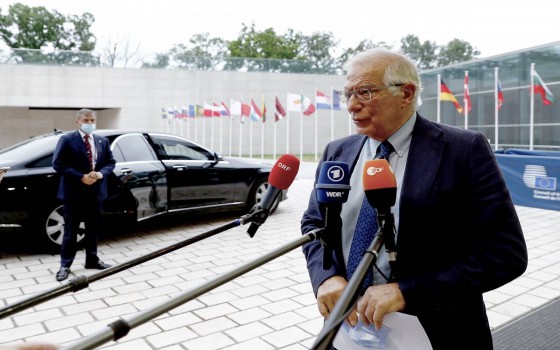
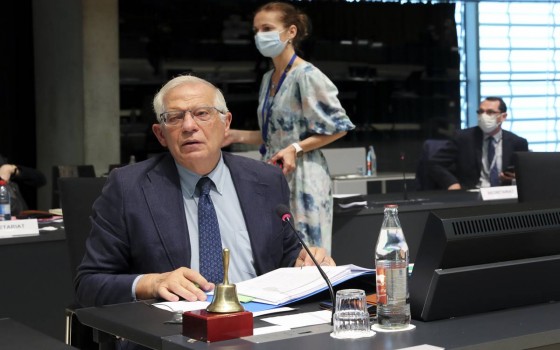
On the sidelines of the summit, Foreign Policy Coordinator Josep Borrell signed, on behalf of the European Union, three memorandums of understanding on bilateral consultations with Honduras, El Salvador and Ecuador, providing frameworks for deepening cooperation efforts and engaging in dialogue on common agendas.
To respond to the unprecedented increase in humanitarian needs in Haiti, the European Union has also announced the release of €10 million in emergency funding. It will enable humanitarian organizations to step up the response and address the most urgent needs, with a primary focus on food and nutrition.



No Comments Found