
UN official: The Sudanese seek peace and we must help them
- Europe and Arabs
- Monday , 14 August 2023 14:58 PM GMT
New York: Europe and the Arabs
A high-level UN official called on the two parties to the conflict in Sudan to stop the fighting and give priority to the supreme interest of the Sudanese people rooted in peace and stability, noting that the displaced and refugees want to return to their homes to practice their normal lives.
Edem Wasorno, Director of Operations and Advocacy at the United Nations Office for the Coordination of Humanitarian Affairs (OCHA) spoke at length with UN News about the UN’s efforts to assist millions of Sudanese whose lives have been turned upside down since the outbreak of conflict between the Sudanese Armed Forces and the Rapid Support Forces on 15 April. /April.
The conflict has so far caused nearly four million people to flee their homes, while more than 20 million people in the country face the threat of severe hunger.
Mrs. Edem and Surno recently visited Sudan and Chad, where she met the displaced and refugees in the two countries and saw for herself the great suffering they were going through. And she tried to paint a picture of the situation on the ground, and Edem and Surno said: I worked in Sudan before - that is, before this war. I was in Sudan from 2004 to 2005 with the Office for the Coordination of Humanitarian Affairs, and before that with UNHCR in different areas. Sudan is like home for me. Sudan is a country whose people are kind and have a culture of warmth and sharing. When I was in Sudan nearly 20 years ago, the conflict was spot on. The conflict was raging in Darfur. I was the first OCHA Protection Officer sent to deal with legal protection issues, negotiating access to sites in South Darfur, in Nyala city for example.
At the time, one of us was coming to Khartoum as a kind of recreation. After 20 years, I went to Port Sudan. Of course, I couldn't get to Khartoum because it's a war zone. The United Nations cannot access now. We are trying to go back, but we can't because of the security situation. I stayed in Port Sudan, which I last visited in 2003 when I went diving in the Red Sea.
After 20 years, the city of Port Sudan has become a place hosting hundreds of internally displaced persons. The temperature in the city reaches 48 degrees Celsius during the peak period of the day with a lot of humidity. In the different gathering sites are hundreds of people who fled different parts of Sudan for their lives, including the capital, which was a place of rest and rest the last time I was in Sudan.
The picture is not fair to the daily life of the people of Sudan in general. But let me paint a picture of a woman I spoke to called Hawa, a mother, grandmother, and merchant who lived her daily life on the outskirts of Khartoum in Omdurman. And fled with the beginning of the war. She was able to get her usual monthly salary to buy insulin injections, because she has diabetes. Today, Eve cannot buy insulin injections.
That was the picture I saw when I was in Port Sudan for five days, talking to the average person who does not want to ask for humanitarian assistance. Khartoum was a resting place where we go to relax. But even so, people from Khartoum are now asking for help. I also spoke to emergency responders, the people who deal with water, sanitation, sanitation and food in Khartoum. I asked them what a day in the life of a person in Khartoum looks like. It's an ongoing nightmare, they said, because you don't know if you'll be held by either side. You don't know if you will disappear. But they keep moving forward because - in the face of it all - they are more determined than ever to provide humanitarian assistance.
On the announcement of the World Health Organization, that the health situation in Sudan has reached very dangerous levels. More than two-thirds of hospitals remain out of service amid increasing reports of attacks on health facilities. Regarding the efforts of the United Nations to address this problem, Edem and Surno said: The United Nations, according to my understanding, from a humanitarian perspective, cannot fix the problem of bombing cities, for example. What we can do, and have been doing, is urge the warring parties in Sudan to avoid targeting civilian assets in accordance with the Geneva Conventions.
What I understood from the World Health Organization when I was on the ground is that most of the health facilities in Khartoum are not functioning.
And again - please forgive me - for continuing to focus on Khartoum because Khartoum was the place people would turn to when there was conflict in other parts of the country.
Khartoum is the urban center and it is the capital of this country and things were going very well there. Khartoum was the place where 6 million people did not need our help. Suddenly you are under siege.
For example, when you are in Wad Madani and you want to travel for treatment, you go to Khartoum, or when you are in Darfur, you go to Khartoum, and also from Port Sudan and other places. Therefore, the facilities that were completely destroyed by the war were of great importance.
The United Nations, together with its partners Médecins Sans Frontières and the International Committee of the Red Cross, provide essential services with the minimum they can do on a daily basis.
Sudanese emergency responders also risk their lives every day to ensure they help those in need and they have a lot of creativity. The Sudanese have a high resilience. Families in the diaspora send money to help their families fleeing inside the country to ensure that mothers, daughters, sons and children receive some needed help.
Edem and Surno: There are many initiatives happening in the region. There are talks sponsored by the African Union and others sponsored by the Intergovernmental Authority on International Development (IGAD). There was a memorandum that came out of the Quartet meeting and it was the Under-Secretary-General for Affairs Humanity, Martin Griffiths is present and has managed to put certain conditions on the table so that we can do our work as humanitarian workers.
There is also a request that both sides come to the table - as happened during the Jeddah talks - so that we can negotiate access quickly and on a large scale.
24.7 million people - nearly half of Sudan's population - need humanitarian assistance or some basic services. 18.1 million people are targeted by the United Nations and its partners. Amongst this, we have barely reached 3 million people with some form of assistance. And I'm talking about helping every day, every minute.
We are humanitarian negotiators, negotiating access for the people we are trying to reach. If the fighting does not stop, you will not be able to increase the assistance with the required speed and scope.
UN News: According to the United Nations Mission in Sudan (UNITAMS), the fighting in Darfur has seriously affected civilians. What is the United Nations doing to help people there?
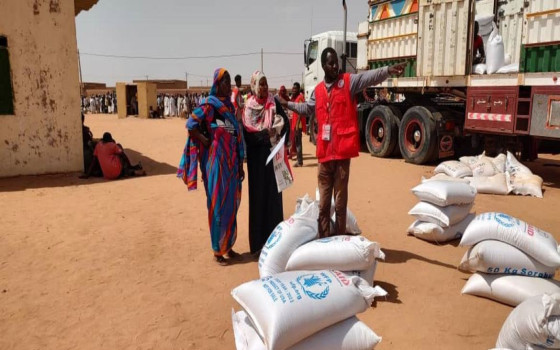
Edem and Surno: Let me speak from a humanitarian perspective, because the UN has different entities. There is a political arm of the United Nations, and there is a humanitarian section and another for development, rights and security...etc. I'm talking about humanitarian assistance. Through the initiatives we talked about, humanitarian workers have been able to reach people. Under-Secretary-General Martin Griffiths is personally involved in an effort to advance the humanitarian agenda which has resulted in the dispatch of 780 truckloads by OCHA.

No Comments Found