
The Special Representative of the Secretary-General of the United Nations warns of an exacerbation of the situation in Libya if a comprehensive political agreement is not reached
- Europe and Arabs
- Wednesday , 23 August 2023 12:58 PM GMT
New York - Tripoli: Europe and the Arabs
The Special Representative of the Secretary-General of the United Nations in Libya said that the situation will worsen and cause more suffering for the people there if a comprehensive political agreement is not reached that paves the way for peaceful, inclusive and transparent elections across the country. According to the United Nations news bulletin, which we received a copy of on Wednesday morning.
Abdullah Batili's statements came in a briefing he gave to the Security Council on Tuesday regarding the latest developments in Libya.
Batelli said that the current events in Libya and the region show that the temporary arrangements are fraught with risks of violence and disintegration, adding that "it is necessary to restore stability in Libya to maintain regional security."
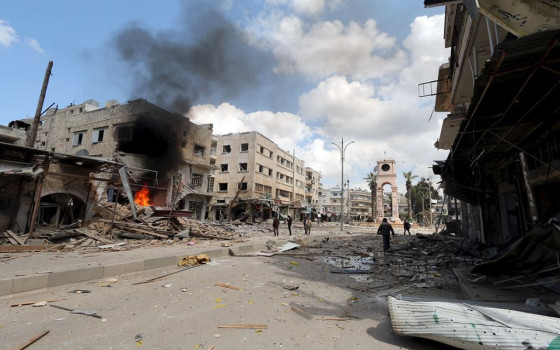
He added that the fragile stability that had prevailed in the country since last August was dissipated by the violent clashes that took place this month between the two largest armed groups, the Radaa Anti-Terrorism and Organized Crime Agency, and the 444th Brigade, which resulted in the death of at least 55 people and the wounding of a hundred others.
The UN official stated that these developments demonstrate the lack of leadership and control over the fragmented security services in western Libya and the fragility of the security situation, adding that they "undermine current efforts to create a security environment conducive to elections, and highlight the urgent need to form legitimate authorities and unified military and security institutions."
"The armed groups and security forces that commit acts of violence against citizens must be held accountable," he said.
Three main goals
The Special Representative of the Secretary-General of the United Nations in Libya affirmed that he continues to intensify his consultations with the concerned parties in Libya in order to achieve three main goals, the first of which is to persuade the House of Representatives and the High Council of State to consider the proposals submitted by the High National Elections Commission, other Libyan actors and the United Nations Support Mission To address the legal loopholes and technical shortcomings in the draft electoral laws prepared by the 6+6 committee of the two houses.
The second objective is to explore the possibility of convening a meeting of the main stakeholders or their representatives to reach a political agreement on the four politically contested issues. The third objective includes the continuity of dialogue between the security and military authorities to create a security environment that enables progress in conducting elections and achieves lasting stability for the country.
"I am pleased to inform you that the President of the Presidency Council has notified me of his intention to invite the leaders of the two councils to meet to draft electoral bills, in light of the observations of key stakeholders," Batelli said.
The UN official urged the two councils and the 6 + 6 committee to resume work and finalize the drafting of electoral laws to make them enforceable in order to draw up a reasonable timetable for the elections.
He stressed that "the existence of a unified government agreed upon by the main parties is imperative to lead the country to elections."
Cautious optimism
The Special Representative of the Secretary-General welcomed the Libyan Presidential Council’s decision to establish the Supreme Finance Committee and the positive steps towards unifying the country’s central bank, saying that these steps “give us cautious optimism that the actors in Libya are able – through political will – to cooperate to address issues of common concern in order to common good.”
Batili called on the Supreme Finance Committee in Libya to turn the discussions into effective measures to achieve transparency, accountability and fairness in state expenditures.
He also urged the central bank to continue its efforts to reverse the effects of a divided public financial system.
Human rights violations
The UN official expressed his concern about human rights violations, including kidnappings, arbitrary detention and disappearances in the east and west of the country.
He called for an immediate end to these practices, the release of those arbitrarily detained, and the conduct of independent investigations.
Batelli noted that the United Nations Support Mission in Libya (UNSMIL) was recently allowed to partially visit a detention center in Tripoli, calling for more consistent access to places of detention across the country.
He also expressed his concern about "the grave humanitarian and human rights situation of migrants, refugees and asylum seekers on the Tunisian-Libyan border."
He said that despite a recent agreement between the Tunisian and Libyan authorities regarding the transfer of several hundred individuals, people continue to be forced to cross borders into remote desert areas where they face harsh conditions where there is no water or food.
The Special Representative of the United Nations Secretary-General for Libya concluded his briefing by addressing the moral political responsibility of all leaders in Libya to end the temporary open-ended arrangement, break the current stalemate, and stop thwarting the legitimate aspirations of Libyans to hold elections and achieve peace and prosperity.
Obstacles to civil society
The representative of civil society, Noura Al-Jurabi, spoke to the session via video link, where she said that Libyans are still facing many challenges to build a society based on freedom, justice and equality.
Al-Jarabi, who works as a journalist and resides outside Libya, said that one of the obstacles to achieving this goal is the restrictions imposed on civil society in Libya. ".
And she called for the abolition of those "oppressive laws," stressing that this step is necessary before holding any elections, and that the abolition of these laws forms the basis for a free and fair vote.
It also demanded the establishment of an independent committee for civil society organizations to ensure that no political, security or intelligence agency interferes in the work of these organizations, as they put it.


No Comments Found