
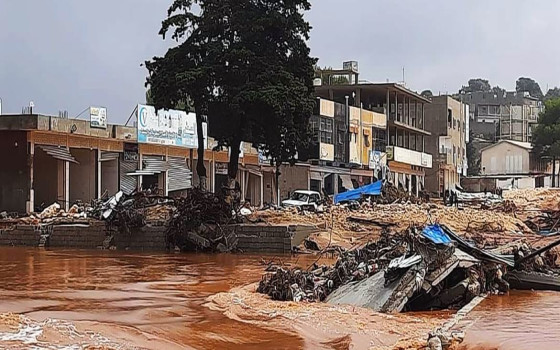
In conjunction with the announcement of the displacement of more than 16 thousand children due to floods in Libya. The European Union and the United Nations are discussing coordination of political efforts and an agreement to assist all Libyans

- Europe and Arabs
- Friday , 29 September 2023 14:16 PM GMT
Brussels - New York: Europe and the Arabs
UNICEF reported the displacement of more than 16,000 children in eastern Libya following floods caused by “the most violent storm recorded in the history of Africa.” According to what was stated in the United Nations daily news bulletin, a copy of which we received on Friday morning
UNICEF warned in a statement yesterday, Thursday, of the threat to the psychological and social safety of children, noting that many of them have been affected by the lack of basic services, such as health, education, and supplies of safe drinking water.
UNICEF has been working with the authorities and partners since the beginning of the tragedy to respond to the urgent needs of children and families in a number of affected areas, including Derna, Al Bayda, Sousse and Al Marj.
Adele Khader, UNICEF Regional Director for the Middle East and North Africa, said that children are always among the most affected and vulnerable groups when disasters strike.
The regional director, who just returned from a visit to Al-Bayda and Derna, added:
“I have seen the devastating toll the floods have had on children and families. I met families suffering from a huge psychological burden and spoke to children in severe psychological distress, many of whom cannot sleep and are unable to interact and play. The memory of what happened still haunts their dreams and thoughts.”
Ms. Adele Khader said that it is time to focus on recovery, including supporting the reopening of schools, providing psychosocial support, rehabilitating primary health care facilities, and rehabilitating water networks.
She stressed that "the tragedy has not ended. We must not forget the children of Derna and Al-Bayda."
The number of child victims has not yet been confirmed, but there is a fear that hundreds of them may have lost their lives in the disaster, given that children make up about 40 percent of the population, according to UNICEF.
Diseases and severe damage to infrastructure
UNICEF explained that children are once again facing further disruption to their learning and the risk of deadly disease outbreaks due to severe damage to health and education infrastructure.
“In the affected area, four schools were destroyed and 80 other schools were partially damaged out of 117 schools affected, while some of them are housing displaced families.”
UNICEF noted that waterborne diseases are a growing concern due to water supply problems, significant damage to water sources and sewage systems, and the risk of groundwater contamination.
In Derna alone, it is estimated that 50 percent of water systems have been damaged.
Continuous support for affected children
UNICEF reported that it had worked - from the first day of the disaster - to support children in eastern Libya:
“65 metric tons of relief supplies were delivered to affected areas, including medical supplies for 50,000 people for three months, family hygiene kits for approximately 17,000 people, 500 winter clothing sets for children, and 200 ‘School in a Box’ school kits.” And 32,000 sets of water purification tablets.
UNICEF also sent mobile child protection and psychosocial support teams to help children overcome the psychological toll resulting from the disaster.
“As we continue our life-saving response efforts, we also call on the authorities and donors to invest in a long-term recovery that is equitable, resilient and child-centred,” Khader added.
UNICEF said it is re-evaluating its $6.5 million humanitarian response appeal to integrate initial recovery efforts with a focus on education, health and water.
To date, UNICEF has received about 25 percent of this much-needed funding.
European Foreign Policy Coordinator Josep Borrell met with Abdullah Bathéli, Special Representative of the Secretary-General of the United Nations and Head of the United Nations Support Mission in Libya. According to a statement distributed in Brussels on Thursday evening, the two sides exchanged views on the current situation in Libya and discussed how to coordinate and strengthen political efforts to support the path towards... Peace and stability in Libya. Borrell reaffirmed the European Union's firm and consistent support for the facilitation initiative led by Abdullahi Bathéle. They both affirmed the commitment of the European Union and the United Nations to work together to reach a sustainable political solution, based on a comprehensive inter-Libyan dialogue.
The European official and the United Nations Special Representative also discussed the devastating consequences of the deadly Storm Daniel. Borrell noted that the European Union had immediately responded to Libya's request by activating the EU Civil Protection Mechanism (UCPM) and had already provided in-kind assistance. Furthermore, the European Union has mobilized €5.7 million in humanitarian funding to provide essential services to affected populations.
Both Borrell and the UN envoy stressed the importance of continuing to help all Libyans in these difficult circumstances.


No Comments Found