

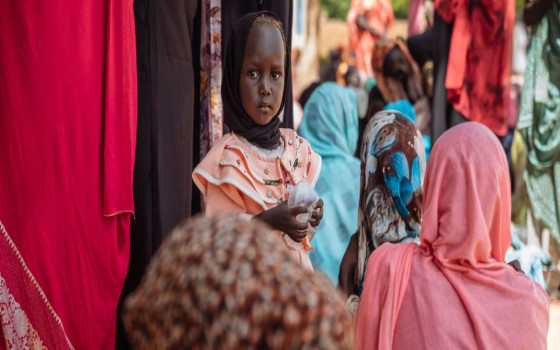
The conflict in Sudan is creating the fastest growing displacement crisis in the world. Continuing fighting has forced 5.4 million people to leave their homes.

- Europe and Arabs
- Friday , 6 October 2023 13:20 PM GMT
Geneva: Europe and the Arabs
As intense fighting continues in Sudan, the United Nations said the conflict has created the world's fastest-growing displacement crisis, threatening to overwhelm the organization's best efforts to help those in need of support.
This came in a press conference at the United Nations headquarters in Geneva, held by Clementine Nkwita Salami, the United Nations Humanitarian Coordinator in Sudan and Deputy Special Representative of the Secretary-General there.
Nkweta Salami said the past six months had caused untold suffering and forced more than 5.4 million people to leave their homes. She pointed out that nearly 30,000 people flee every day because of the fighting, "some of them with nothing but the clothes they are wearing." According to what was reported in the United Nations daily news bulletin, a copy of which we received on Friday morning
Nkweta Salami said she met mothers in Sudan who told her they “didn’t know how they were going to find the next meal for their children.”
She also met families residing in "temporary shelters struggling to obtain food and water, unable to access health care and education for their children and without job opportunities for their breadwinners."
The UN official said that half of Sudan's population - 24.7 million people - now need humanitarian assistance and protection.
Last month, the United Nations and its partners delivered 3,000 tons of life-saving aid supplies on 66 trucks to six states.
But the humanitarian official in Sudan stressed the need to provide more support in a safe, frequent and rapid manner. She pointed out the need to reach 18 million people and stressed that the United Nations will not abandon this goal.
Clashes broke out in Sudan on April 15 between the Sudanese Armed Forces and the Rapid Support Forces. The fighting was initially concentrated in and around the capital, Khartoum, as well as Darfur, but Nkweta Salami expressed her fears about the possibility of the conflict spreading to Gezira State, which is Sudan’s breadbasket.
“This will have serious consequences for food security,” she said. She added that the violence has already paralyzed the health sector in Sudan, with 70% of all hospitals out of work.
Humanitarian workers are concerned about reports of increasing cases of sexual and gender-based violence, enforced disappearances, arbitrary detention, and gross violations of human and child rights.
In addition to the loss of life and destruction due to the war, the Sudanese people have faced further shocks in recent weeks as heavy rains and floods affected more than 70,000 people in 7 states, raising concerns about high rates of waterborne diseases.
A cholera outbreak has been declared in Gedaref state in the east of the country, and humanitarian workers are investigating whether the disease has spread to Khartoum and South Kordofan.
The Humanitarian Coordinator in Sudan called on the warring parties to recommit to their previous pledges to stop the escalation of fighting, reduce harm to civilians, and refrain from any disproportionate attacks.
She said that providing aid in war zones is very complex, dangerous and time-consuming, and often involves negotiations with different armed groups to reach remote communities.
Despite these challenges, she said that relief teams are intensifying their efforts to reach the most vulnerable communities in Sudan. She said the humanitarian team on the ground is committed to continuing the work.
Displaced people killed in Darfur
In a statement issued before the press conference, the United Nations Humanitarian Coordinator in Sudan expressed extreme anger at reports that 6 displaced persons were killed and about 2,300 others displaced after their shelters were burned during clashes between the Sudanese Armed Forces and the Rapid Support Forces near the Hasahisa camp in Central Darfur state in September 26.
She noted that community leaders in the camp reported an urgent need for shelter, food, protection and health assistance.
“As is the case in many areas of Sudan, violence limits humanitarian access and inhibits efforts to provide aid,” she said.
The UN official added that attacks on civilians and displaced persons camps are unacceptable. It urged all parties to the conflict to adhere to their obligations to protect civilians and civilian infrastructure and to respect international humanitarian and human rights laws.





No Comments Found