
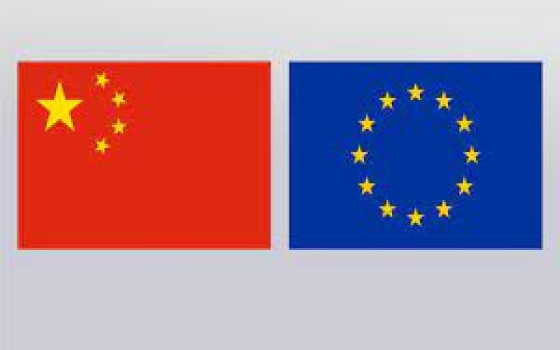
The European Union emphasizes the increasing complexity of relations with China. At the conclusion of the 12th strategic dialogue between the two sides, they discussed the situation in the Middle East region, the war in Ukraine, climate change, and debt management.
- Europe and Arabs
- Saturday , 14 October 2023 12:15 PM GMT
Brussels: Europe and the Arabs
High Coordinator for Foreign Affairs and Security Policy Josep Borrell and Director of the Office of the Central Foreign Affairs Commission and Minister of Foreign Affairs of China Wang Yi held the 12th EU-China Strategic Dialogue on 13 October 2023 in Beijing. They discussed bilateral relations between the European Union and China in light of the upcoming summit between the European Union and China. Key international and regional issues included the latest events in the Middle East, which occupied a central place in the dialogue. In addition, they discussed Russia's aggressive war on Ukraine and the situation in Afghanistan.
They also touched on global challenges such as climate change, global health and debt management.
Reviewing developments in relations between the European Union and China, High Representative Borrell stressed the increasing complexity of these relations and the common interest in pursuing a constructive and stable relationship, according to what was stated in a European statement issued in Brussels by Borrell’s office, which also stated, “He also reaffirmed the validity of the multifaceted approach followed by the Union.” European Union towards China, in all its dimensions, and stressed the importance of continued high-level engagement to discuss bilateral and global issues and address differences. Both welcomed the increasing number of high-level contacts in recent months.
High Representative Borrell expressed fundamental and specific concerns about human rights in China.
He reiterated the EU's willingness to engage with China wherever possible in addressing global challenges, including climate change, debt and global health.
High Representative Borrell raised Russia's unprovoked and illegal war of aggression against Ukraine. He conveyed the European Union's expectations that China - a permanent member of the United Nations Security Council - would take a more decisive stance to defend the United Nations Charter and use its influence on Russia to stop its war against Ukraine and its blatant disregard for international law. He stressed the need for China to continue to refrain from supplying weapons or priority battlefield materials to Russia.
He also stressed the negative impact of Russia's war against Ukraine on global food security, and called on China to urge Russia to stop illegal attacks on and obstruction of Ukrainian food exports and to rescind its decision to withdraw from the Black Sea Grains Initiative.
The High Representative raised the recent terrorist attacks launched by Hamas against Israel and called for the release of the hostages. They both stressed the urgent need to make international efforts to prevent further aggravation of the situation and its spread to the region. He reiterated the European Union's condemnation of all attacks against civilians, recalling the parties' obligations under international humanitarian law to allow unhindered access to water, food and medicine. They agreed on the urgent need to work to stop the escalation and that the two-state solution is the only way forward.
Regarding Afghanistan, they expressed their common concern about the volatile security situation and the deprivation of women and girls' rights.
The discussion lasted more than four hours, and both parties agreed on the need to keep this dialogue channel open.



No Comments Found