
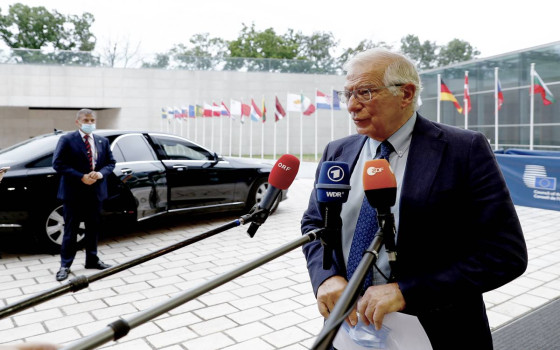
Borrell: There are limits to Israel’s right to self-defense, and normalizing relations with Arab countries is not enough to achieve peace. Since the Oslo Accords, the international community has not committed to implementation, and settlements have multiplied.
- Europe and Arabs
- Wednesday , 18 October 2023 16:38 PM GMT
Brussels: Europe and the Arabs
Joseph Borrell, the European Union's foreign policy coordinator, delivered a speech before the open session of the European Parliament in Strasbourg about the situation in Gaza and Israel, and Borrell's office in Brussels published the text of the speech, which was as follows:
These are the moments when we must call upon the voice of reason, to overcome the emotions that the tragic events we have experienced produce in all of us. We condemn the unspeakable horror of the attacks against Israel. Those attacks against the civilian population that left many dead,
Let's repeat that again. Let us also assume that Israel, of course, has the right to defend itself. It has always been this way and anyone who saw themselves attacked in such a brutal way would have the right to defend themselves. But I think we are all united in saying that the right to defense, like all rights, has limits. In this case, they are the limits imposed by international law and, in particular, international humanitarian law.
Yes, we condemn these terrible terrorist attacks, but I also believe we must condemn the deaths - the civilian casualties - that are occurring in Gaza, which now number up to 3,000 people. Because condemning one tragedy should not prevent us from condemning another. Showing our compassion for the dead, the victims of terrorist attacks, should not - and does not preclude - showing our feelings for other dead people.
In these tragic moments, I believe that the European Union must base its response on four principles: firmness, humanity, cohesion, and a proactive political stance in the face of this conflict.
The firm begins with a clear condemnation of Hamas, which - as the [Spanish Foreign Minister, José Manuel Albarez] said - cannot be linked to the Palestinian people. For us, Hamas is a terrorist organization, and it has clearly demonstrated this by its actions in recent days.
Hamas boycotts any attempt to achieve peace. He opposed UN and Arab League resolutions, which opened the way for a possible peace agreement between Israel and Palestine. Hamas wants to make Israel disappear. He does not want peace, he wants destruction. But he also makes it impossible for the Palestinians to achieve a just peace with his actions. They are also victims of Hamas. For this reason, we cannot hold the entire Palestinian people, and all residents of Gaza, responsible for the terrorist act carried out by Hamas.
The firmness also includes demanding the release of hostages. This links to the second line of action, which is humanity. Wars also have their rules. Wars are terrible, and what we saw, well, and what we explained without yet knowing whom to attribute responsibility for the massacre that occurred in that hospital, is another aspect of the horrific war. But wars also have their rules, and they are fixed in international law. We have said this on several occasions in reference to other conflicts: cutting off water and basic supplies to the population is not consistent with the law of war. At this moment, water has been cut off in Gaza and there are more than 3,000 dead, a quarter of them children. We cannot hold all Gazans responsible for the criminal actions of Hamas.
The third principle is political cohesion. And so I think we can say that we are all, united in what I have just said. In rejecting Hamas and demanding respect for international and humanitarian law by everyone. Let the attacks against defenseless civilians end wherever they are.
We must do this in such a way that the action of individual Member States is compatible with the common action of the [European] Union, and the policies of the Community are also compatible. This raises the issue of aid to the Palestinian Authority and the issue of humanitarian aid to the victims of Gaza. The President of the Commission's decision to triple our humanitarian aid is a good example of this political cohesion.
Unfortunately, humanitarian aid must arrive. He cannot enter because all access roads are still closed. Egyptian Foreign Minister [Sameh Shoukry] repeatedly called for an end to the bombing of the infrastructure that allows this urgent humanitarian aid to pass through.
The fourth, perhaps at this moment, is the one in which we should invest more political energy, which is the proactive stance to resolve this conflict. I was in Gaza during the 2008 bombings, and since then I have witnessed four such wars. I deeply fear that if we do not stop the cycle of violence, it will be repeated.In a few more years.
The conflict between Israel and Palestine must be addressed, because peace between the Arab countries and Israel, which is good news, does not automatically bring peace between Israel and Palestine, which must also be achieved. As an Israeli reserve soldier who was called up said in a statement to the press: “The strongest army to defend my country is peace.” As long as peace is not achieved, there will not be an army strong enough to guarantee peace in Israel.
But peace will not come alone, peace must be built. Let us realize that we, in the international community of which we are a part, have not done everything we were required to do to put the Oslo Accords - now thirty years old - into practice. We announce the two-state solution every day, but as the representative of Palestine at the United Nations said to me during the week of the UN General Assembly: “What are you doing to achieve that, other than announcing it?”
Since Oslo until now, the number of Israeli settlers and settlers from the occupied territories has tripled. The area of a potential Palestinian state has been reduced and divided into a maze of disconnected spaces. Well, no matter how far-fetched this solution may seem to us, and no matter how difficult it may be, we have no other solution. Because what is the alternative? If there are not two countries, then there can only be one country, so how can one live within this country? Under what circumstances, both? If we have only one solution, we must muster our political energy – and Europe has plenty of it – to build it.
The normalization of [Israeli] relations with Arab countries are not enough. With this attack, Hamas may have wanted to provoke an Israeli reaction that would make the normalization of relations between Israel and Saudi Arabia impossible. Perhaps this was one of their strategic goals. It is not all madness in their actions, and perhaps there is also a strategy behind it to prevent progress towards peace.
We have worked with our Special Envoy to the Middle East, Sven Koopmans, with Jordan, with Egypt, with the Arab League, and with the Kingdom of Saudi Arabia, to launch - or rather launch - a process that could lead us to these two countries. We must recalibrate and increase this effort. We gathered at the United Nations 60 countries, and almost all of them spoke in favor of this solution.
Let us commit here today, and this will be the best way to honor the dead on both sides, and build peace between them, which can only happen through a political structure that has already been agreed upon, and is already in the Security Council resolutions. The United Nations, and that it needs the political momentum that Europe can also help provide it.
Today, in the Security Council [United Nations], the resolution submitted by Brazil yesterday, on which the vote was postponed today, will continue to be discussed. What we vote on in the Security Council, and how we communicate our political position in this conflict, will determine the role Europe will play in the world for many years to come.
This morning I heard the sound of Al-Azhar Mosque in Cairo. It has caused me great concern because this conflict is unfortunately leading towards a conflict between the Islamic world and the Christian world, and we cannot allow that. Because the safety of our streets depends on it. Because global geopolitical balances also depend on it. We must make a great effort to avoid this drift, to prevent the conflict from spreading to the border with Lebanon.



No Comments Found