
Following the American veto on a resolution regarding Gaza and Israel...an international warning against the expansion of the conflict and a change in course in the Middle East as a whole.
- Europe and Arabs
- Thursday , 19 October 2023 13:53 PM GMT
New York - Doha: Europe and the Arabs
The United Nations Special Coordinator for the Middle East Peace Process expressed his fear that “we stand on the brink of a deep and dangerous abyss that could change the course of the Israeli-Palestinian conflict, if not the Middle East as a whole.” According to what was stated in the United Nations daily news bulletin, a copy of which we received on Thursday morning
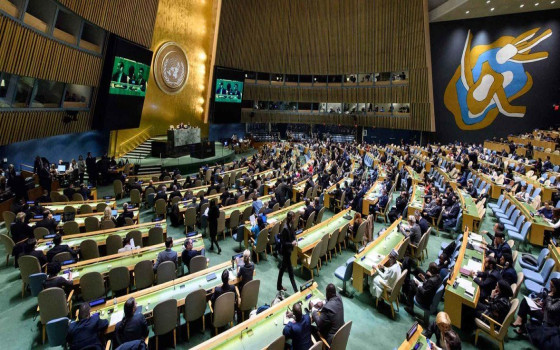
Winsland's speech, which he delivered via video technology, came from Doha yesterday, Wednesday, in a session held by the UN Security Council on the situation in the Middle East, including the Palestinian issue, during which he also listened to a briefing from the United Nations Emergency Relief Coordinator who is visiting the region.
The session came after the UN Security Council voted on a Brazilian draft resolution on Gaza and Israel. 12 members supported the project, the United States opposed it, and Russia and the United Kingdom abstained from voting. The draft resolution was not adopted because the United States - a permanent member of the Council - used its veto.
In his speech before the Security Council, Tor Wensland stated that this is one of the most difficult moments that the Israeli and Palestinian peoples have faced during the past 75 years.
He said: “The massacre and despicable acts of violence and terrorism committed by Hamas against Israelis on October 7 are engraved in our collective memory. Entire families were killed. Women and children were kidnapped to the Gaza Strip and are still detained to this day. There is no justification or excuse for such "Terrorist acts, and I condemn them unequivocally."
Mr Wensland told council members: “We are at war and wars are full of horrific scenes of violence and tragedy. I watched in horror, as I am sure you all did, reports of large numbers of casualties in a place that is supposed to be a protected site, safe from danger, a place To heal. Hundreds of Palestinians - sick, health workers and those seeking shelter - were killed when the Al-Ahli Hospital in Gaza City came under deadly fire. The circumstances of this disaster and responsibility for it still need to be clarified, and we will need a full, wide-ranging, fact-based investigation, "But the outcome of all this is very clear, Mr. President. It is a terrible tragedy for those it has befallen."
Expansion of the conflict
The Special Coordinator said that, after decades of conflict and occupation, the international community has collectively failed to bring the parties to a just and sustainable political solution, and stressed that the risk of expansion of this current conflict is “very real and very serious.”
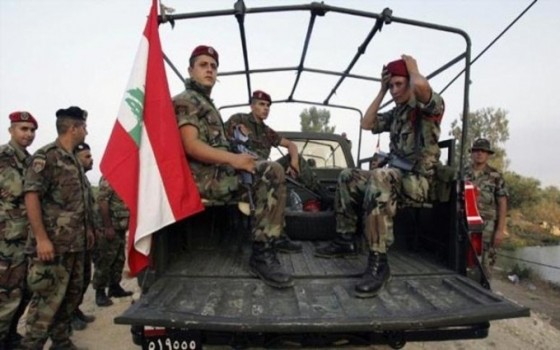
Regarding the West Bank and Lebanon, he said: “There must be no miscalculation, no provocation, and no step that closes the door to our current efforts.”
The Special Coordinator said that his absolute priority is to work to reduce “these existential threats,” and he is in constant contact with the widest range of parties.
Long term solution
The UN Coordinator for the Middle East Peace Process said that diplomacy these days is “a very difficult matter” and that there is a need to allow time and space to achieve three basic goals: “The immediate and unconditional release of all hostages by Hamas. Secondly, and quickly, allowing humanitarian aid to reach the Palestinians in Gaza.” "Without restrictions. The third thing must be to make a collective effort to end hostilities and prevent any further expansion of the conflict in the region."
Mr. Wennesland stressed that the only way to “stop the bloodshed and prevent its recurrence” is to pave the way towards a long-term political solution, in line with UN resolutions, international law and previous agreements.
An embodiment of the devastating impact of conflict
The Under-Secretary-General for Humanitarian Affairs, Martin Griffiths, expressed his "dismay and despair" at the explosion that occurred at the National Baptist Hospital in northern Gaza.
In his briefing to the same Security Council session, the Emergency Relief Coordinator offered his sincere condolences “to the grieving families affected by this painful tragedy.” He also wished a speedy recovery to all those injured.
Griffiths added that this tragedy is "an embodiment of the devastating impact of this conflict on civilians, and its catastrophic consequences if it continues to escalate."
He reiterated that, under international humanitarian law, parties to armed conflict must protect civilians and civilian facilities, and take constant care to preserve them.
The UN official said that international humanitarian law “provides special protection for medical personnel and facilities to ensure that the wounded and sick receive the medical care they need.”
He added that it is essential that the parties respect their obligations under international humanitarian law, "and it is our collective responsibility to use all our influence to ensure that they do so."
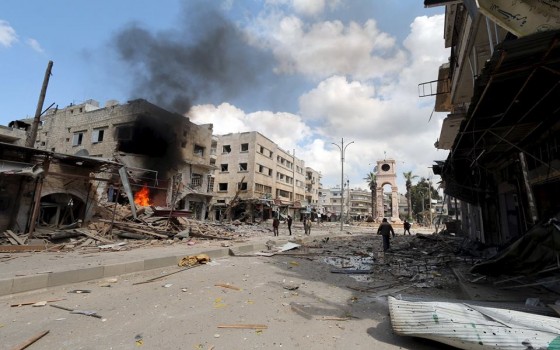
Griffiths touched on the losses suffered by the health sector, saying that since the seventh of this month, 28 health workers have been killed in Gaza and 23 were injured, while many health facilities have been severely damaged. He said the destruction of the Baptist Hospital put more pressure on Gaza's dilapidated health care system.
Immediate and secure humanitarian access
The emergency relief coordinator said that the October 7 incursion into Israel and the taking of hostages was “wrong, contrary to the law, unreasonable and unacceptable,” reiterating the demand for their release.
He spoke about the displacement of more than a million civilians from their homes to other places in Gaza, saying that they no longer have a place to escape from the destruction. "Whether civilians move or stay, they must be protected and they must have access to the basics to survive," he stressed.
He stressed that this means that the United Nations and its humanitarian partners “must be able to provide relief to civilians in need throughout Gaza, without hindrance.”
He pointed out that the United Nations and other humanitarian organizations have humanitarian supplies, medical teams, and reserve staff on standby to help those most in need.
Griffiths added, "What we do not have, and what we desperately need, is safe and immediate humanitarian access to all parts of Gaza."
He also stressed that there is a need for more funding for United Nations organizations - including UNRWA and the World Food Program - that provide emergency assistance For the Palestinians.
He stressed that what everyone needs now is for “humanity and rationality to triumph,” and for emergency efforts to be made to prevent a further decline in this “cruel disaster.”
The situation in the West Bank
The UN official said, "Gaza is not the only place of concern," noting that the situation has also deteriorated in the West Bank.
He added that last week was the bloodiest for Palestinians in the West Bank since the United Nations began recording deaths in 2005, while incidents of settler violence rose from three incidents per day on average to eight incidents.
"The widespread closures throughout the West Bank are affecting the ability of local communities to access basic services," he said.
He warned that there was a "real danger that the situation could get out of control.



No Comments Found