

UNRWA: Hunger and despair in Gaza have turned into anger towards the international community, and the level of destruction is unprecedented

- Europe and Arabs
- Tuesday , 31 October 2023 13:17 PM GMT
New York: Europe and the Arabs
The UN Security Council held an emergency meeting on the situation in the Middle East, including the Palestinian issue, to discuss the escalation in the occupied Palestinian territory and Israel and to listen to briefings from UN officials on the current situation. According to what was stated in the daily news bulletin of the United Nations, a copy of which we received on Tuesday morning.
The Security Council meeting came at the request of the two Council members: the United Arab Emirates and China. In addition to the fifteen members of the Council, the Commissioner-General of the United Nations Relief and Works Agency for Palestine Refugees (UNRWA), the Director of the Humanitarian Financing and Resource Mobilization Department at the United Nations Office for the Coordination of Humanitarian Affairs, and the Executive Director of UNICEF spoke during the session.
UNRWA is the last lifeline in Gaza
Philippe Lazzarini, Commissioner-General of UNRWA, told members of the Security Council that the horrific attacks launched by Hamas on Israel on October 7 were shocking, and that the continued bombing by Israeli forces on Gaza is also shocking.
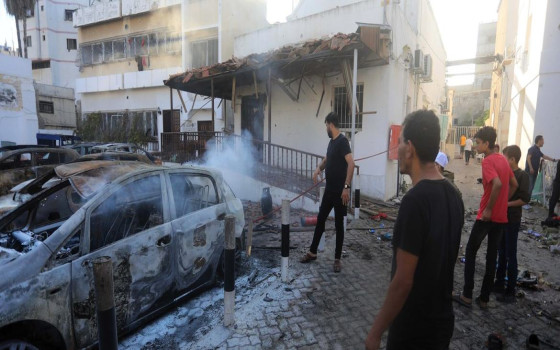
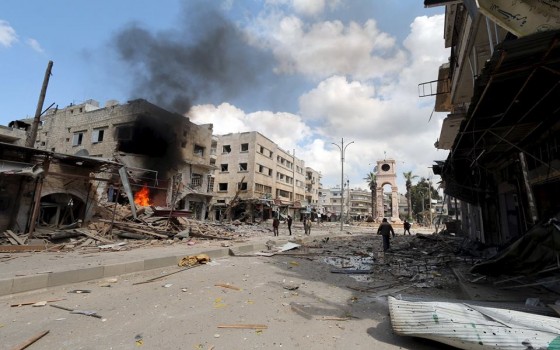
He added that the level of destruction is unprecedented, stressing that there is no safe place in Gaza. He touched on the evacuation orders issued by the Israeli forces to civilians to head south, and described what happened and is still happening as “forced displacement.”
Lazzarini spoke about hunger and despair in Gaza, which turn into anger towards the international community and UNRWA, which represents it in the Strip. He described the siege imposed on Gaza as collective punishment, and said that the agency is the last remaining lifeline for the Palestinians in Gaza.
Lazzarini stated that he lost 64 of his fellow UNRWA workers in Gaza during the past three weeks. He informed the council members that he received news two hours ago of the killing of his colleague, “Samir,” head of the Security and Safety Department in the central region of the Gaza Strip, who died along with his wife and children.
The UN official indicated that this is the highest number of UN aid workers killed in conflicts during such a short period of time.
He talked about running out of fuel, water, food and medicine. He said that the system used to allow relief into Gaza will fail if the political will is not available to make the flow of supplies feasible and proportionate to the unprecedented humanitarian needs.
The UN official said that the people of Gaza feel that they are not being treated like other civilians. “Most of them feel that they are stuck in a war that they have nothing to do with. They feel that the world equates them all with enthusiasm.” He stressed that "the atrocities committed by Hamas do not absolve Israel of its obligations under international humanitarian law."
Lazzarini stressed the need to strictly comply with international humanitarian law and ensure the safe and unhindered flow of humanitarian aid to Gaza and its various parts, stressing the importance of an immediate ceasefire for humanitarian purposes, the protection of civilians and the release of hostages. He also called for funding UNRWA so that it can continue its humanitarian operations.
The Security Council also heard a briefing from the Executive Director of the United Nations Children’s Fund (UNICEF), Catherine Russell, who called on the Council to immediately adopt a resolution reminding the parties of their obligations under international law:
“It calls for a ceasefire, calls on the parties to allow safe and unimpeded humanitarian access and to release all abducted and detained children immediately and safely, and urges the parties to provide children with the special protection they deserve.”
She stressed the need for the Council to give priority to the displacement crisis that is currently worsening. She added that more than 3,400 children were killed in Gaza, while another 6,300 children were injured since the start of the escalation, which means that more than 420 children are killed or injured every day in Gaza. She said that this number "should shake the depths of every one of us."
It also indicated that at least 37 children were killed in the West Bank, including East Jerusalem, and more than 30 Israeli children, while at least 20 children remain hostage in Gaza.
She reported that children in both Israel and the State of Palestine were exposed to “terrible shock,” the consequences of which could last a lifetime.
Russell concluded her briefing by saying, “On behalf of all the children trapped in this nightmare, we call on the world to do better.”
"No place is safe"
In turn, the Director of the Humanitarian Financing and Resource Mobilization Department at the United Nations Office for the Coordination of Humanitarian Affairs, Lisa Doftin, said that it is difficult to convey “the scale of horror” that people in Gaza are experiencing, as they have become increasingly desperate, while searching for food, water and shelter amid an ongoing bombing campaign. "It wipes out entire families and neighborhoods."
In her speech on behalf of the United Nations Emergency Relief Coordinator, she noted that “nowhere is safe” in Gaza, adding that providing humanitarian relief is “very complex and difficult” due to bombing and destruction of infrastructure, as well as fuel shortages.
She expressed grave concern about allegations of military installations in close proximity to hospitals, and the Israeli authorities' request to evacuate hospitals, saying that for those on life support and children in incubators, "their transfer would almost certainly amount to a death sentence."
The UN official touched on the situation in the occupied West Bank, noting the killing of dozens of civilians there, and the increasing incidents of settler violence, which led to the displacement of hundreds of civilians.
The violence and closure of checkpoints, she said, hindered access to basic services and food distribution, and work permits were suspended for between 150,000 and 175,000 Palestinians from the West Bank working in Israel and the settlements. She stressed that this situation causes "severe harm" to the West Bank economy and Palestinian institutions.
“We have very real concerns about what lies ahead,” Doftin said, warning that there is a real danger that this war could escalate and spread to the broader region.





No Comments Found