

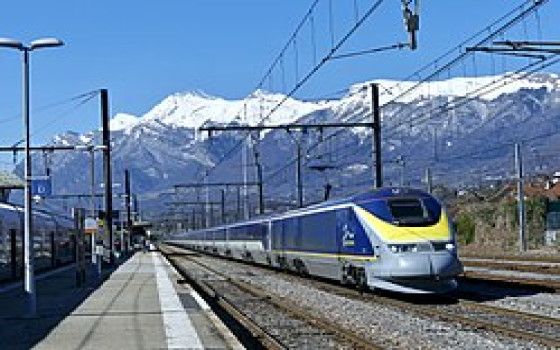
The European Commission approves the acquisition of the land transportation business of the French company Talis by Japanese Railways Company Hitachi, subject to conditions.

- Europe and Arabs
- Tuesday , 31 October 2023 14:53 PM GMT
Brussels: Europe and the Arabs
The European Commission has approved, under the EU Merger Regulation, the proposed acquisition of the road transport business of Thales ('GTS') of France by Hitachi Railway of Japan. The approval is conditional on full compliance with the commitments made by Hitachi Railway.
According to a statement issued by the Commission’s headquarters in Brussels, Hitachi Rail and Thales GTS are the leading suppliers of signaling services for mainline railways in the European Economic Area (“EEA”). Both display interlocks and automatic roadside train protection systems. Hitachi Railway also manufactures and supplies rolling stock for major trains and urban trains
The Commission's investigation showed that the deal, as initially notified, would have reduced competition, led to higher prices and reduced innovation in the markets for major railway signaling projects in France and Germany.
In these markets, the deal would have brought together two close competitors and the combined entity would have gained very high market shares.
Suggested treatments
To address the Commission's initial competition concerns, Hitachi Rail offered to divest mainline signaling platforms in France and Germany for interlocking, overlay and stand-alone projects.
These commitments fully address the competition concerns identified by the Commission. They will maintain competition by eliminating horizontal overlap between parties in the French and German markets regarding interlocking systems and automated roadside train protection systems for the main signaling platforms.
These commitments follow constructive discussions between the Commission and the parties which resulted in a successful proposal to divest Hitachi Rail's independent businesses in France and Germany, including international sites. Structural divestitures eliminate concerns that arise when merging companies are close competitors, because they immediately replace competition that would have been lost as a result of the merger.
These commitments will enable the buyer to manage the divestment business as a viable competitive force in the market on a permanent basis. The Committee will closely monitor the divestment process, including the selection of any suitable buyer for the divested companies which must be approved by the Committee.
Following the positive feedback received in the context of the Commitments Market Test, the Commission concluded that the deal, as amended under the Commitments, would no longer raise competition concerns. The decision is conditional on full compliance with the obligations.
The UK Competition and Markets Authority (‘CMA’) also reviewed the deal. In order to address the CMA's concerns, Hitachi Rail has also committed to divest its mainline signaling business in the UK.
Companies and products
Hitachi Railway, Inc. is a wholly-owned subsidiary of Hitachi Limited, headquartered in Japan, and is a global provider of transportation solutions including rolling stock, signaling systems, turnkey solutions, maintenance services and components.
Headquartered in France, Thales GTS offers diversified solutions across four core business lines: (1) Mainline Signaling, (2) Urban Rail Signaling, (3) Integrated Communications and Supervision Solutions and (4) Revenue Collection Systems.
Interlocks ensure the safe passage of trains by controlling and blocking access to parts of the tracks to avoid collisions. Automated roadside train protection systems reduce the risk of train drivers failing to respond to signal commands
The Commission was first notified of the transaction on 4 October 2022, but the parties withdrew their notification on 3 November 2022 in light of competition concerns identified by the Commission. The parties re-notified the Commission of the transaction on September 14, 2023.
The Commission has a duty to assess mergers and acquisitions involving companies whose turnover exceeds certain thresholds (see Article 1 of the Merger Regulation) and to prevent concentrations that would significantly impede effective competition in the EEA or any significant part thereof.
The vast majority of notified mergers do not pose competition issues and are liquidated after a routine review. From the moment of notification of the transaction, the Commission generally has a total of 25 working days to decide whether to grant approval (first stage) or to initiate an in-depth investigation (second stage). If commitments are proposed in the first phase, the Commission has an additional 10 working days, bringing the total duration for the first phase case to 35 working days, as in this case.





No Comments Found