
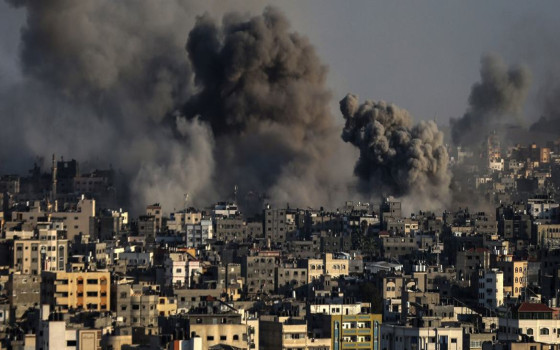
The United Nations: The attacks on Jabalia camp may amount to war crimes. Failure to act now on the crisis between Israelis and Palestinians will have consequences that extend far beyond the region.

- Europe and Arabs
- Thursday , 2 November 2023 12:48 PM GMT
New York - Gaza: Europe and the Arabs
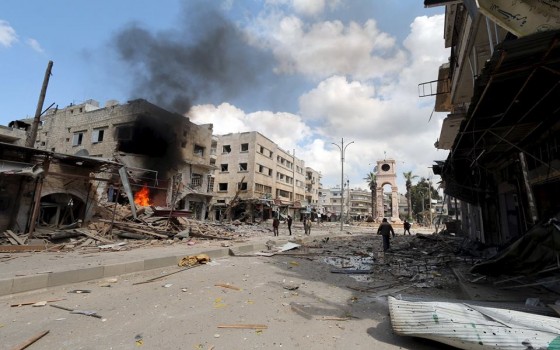
The United Nations Human Rights Office expressed serious concerns that the attacks on the Jabalia refugee camp in Gaza were disproportionate and may amount to war crimes “given the large number of civilian casualties and the extent of the destruction following Israeli air strikes” on the camp.
The Secretary-General of the United Nations expressed dismay at the escalation of violence in Gaza, including the killing of Palestinians, including women and children, in Israeli air strikes on crowded residential areas in the Jabalia camp, and the attacks that occurred in the past two days, according to what was stated in the daily UN news bulletin that we received. A copy of it this morning.
UN Emergency Relief Coordinator Martin Griffiths said the recent attacks on Jabalia refugee camp represent “the latest atrocity to befall the people of Gaza as the fighting enters a more horrific phase, with increasingly horrific humanitarian consequences.”
United Nations spokesman Stephane Dujarric said in the daily press conference that the Secretary-General reaffirms the need for all parties to adhere to international humanitarian law, including the principles of distinction between objectives, proportionality in operations, and taking caution and precautionary measures.
The spokesman added that Secretary-General António Guterres condemns in the strongest terms any killing of civilians.
He said that Guterres continues to call on all parties to put an end to this shocking violence, pain and suffering, and also continues to call for the immediate and unconditional release of the hostages currently being held in Gaza.
The Secretary-General also called for the entry of vital humanitarian aid into Gaza in the amount necessary to meet the growing needs of the Palestinian population.
Horrific effects on children
UNICEF expressed horror at the attack on the camp, and said: “While we have no estimates of the losses caused by the attack on children, homes were leveled to the ground, and it appears that hundreds were injured and killed, and reports indicate that many children were among the victims.”
The two attacks on the camp, on Tuesday and Wednesday, came after 25 days of continuous bombardment, which, according to UNICEF, reportedly led to the killing of more than 3,500 children - not including the number of victims on Wednesday - and the wounding of more than 6,800 children.
This means that more than 400 children were killed or injured every day, for 25 consecutive days. The organization stressed that this cannot become the new normal.
UNICEF stated that refugee camps and settlements for internally displaced persons and the civilians who reside there are protected under international humanitarian law. She said that the parties to the conflict have a duty to respect them and protect them from attack.
The United Nations Children's Fund said that attacks of this scale on densely populated residential neighborhoods could have completely indiscriminate and unacceptable effects.
She added that children have already endured a lot, and stressed the need for the killing and detention of children to stop. She stressed the need for children not to be the target of attacks.
UNICEF reiterated its urgent call on all parties to the conflict to immediately cease fire for humanitarian purposes, ensure the protection of all children, and provide safe and unhindered humanitarian access to deliver life-saving aid on a large scale throughout the Gaza Strip, in accordance with international humanitarian law.
In the same context, after concluding his visit to the Middle East, the Under-Secretary-General for Humanitarian Affairs, Martin Griffiths, said that failure to act now on the crisis in Israel and the occupied Palestinian territory - which he described as a global crisis - “will have consequences that go far beyond the region.”
In a statement issued yesterday, Wednesday, the emergency relief coordinator said that the events taking place in the region since October 7 “will leave indelible scars on the lives of millions.”
He pointed out that Israel was shocked after the "brutal and horrific killing" of about 1,400 people, while the families of more than two hundred hostages are still living in anguish, worried about their loved ones.
On the other hand, in addition to the escalation in the West Bank, women, children and men in Gaza are “being starved, traumatized and bombed to death,” and have “lost all faith in humanity.”
Mr Griffiths said the recent attacks on Jabalia refugee camp represent “the latest atrocity to befall the people of Gaza as the fighting enters a more terrifying phase, with increasingly horrific humanitarian consequences”.
The UN official stressed that this situation cannot continue. He called for the immediate and unconditional release of the hostages, and to ensure the safe, immediate and widespread provision of vital necessities to Gaza, including fuel.
He added: "The crossing of more than two hundred trucks into Gaza so far after strenuous negotiations provides some relief, but it is not enough at all."
Mr Griffiths urged the warring parties to agree to humanitarian truces in the fighting to provide more aid to the people of Gaza, and to allow the sick and wounded to seek medical care, “and for those who wish to flee to do so safely.”
“Put simply, we need the parties to respect their obligations under international humanitarian law, including by remaining vigilant in the conduct of military operations to avoid harm to civilians and civilian objects,” he said.
He stressed the need for everyone to use their influence with the parties to ensure respect for the rules of war, calm the conflict and avoid its extension.



No Comments Found