

Gaza: The United Nations stresses the importance of coordination regarding “humanitarian pauses” to the fighting... and warnings of the spread of infectious diseases

- Europe and Arabs
- Friday , 10 November 2023 17:1 PM GMT
New York - Gaza: Europe and the Arabs
Stephane Dujarric, spokesman for the Secretary-General, stressed the importance of coordination with the United Nations regarding any humanitarian halt to the fighting in Gaza, especially with regard to timing and location. This came in response to journalists' questions about reports regarding the White House's announcement that Israel agreed to the humanitarian suspension of military operations in northern Gaza for four hours daily. According to what was stated in the United Nations daily news bulletin, a copy of which we received
“It is clear that for this to be done safely for humanitarian purposes, it must be agreed with all parties to the conflict in order for it to be effective,” Stephane Dujarric said in his daily press conference.
Escape from northern Gaza
This comes at a time when people are still fleeing from northern Gaza to the south, mostly on foot, in the midst of intensified hostilities, with about 50,000 people evacuated on Wednesday, according to humanitarian workers.
There were reports of continued clashes and shelling on and around the evacuation road, putting civilians heading south at risk. Stephane Dujarric pointed to reports that there were bodies on the road.
He added that hundreds of thousands of people are still in northern Gaza, and that they are facing a difficult humanitarian situation in which they are struggling to obtain the minimum amount of water and food in order to survive.
Aid flow
Dujarric also spoke about efforts to deliver more aid to Gaza through the Rafah crossing, the only access point to the besieged Strip.
As of Wednesday, 106 trucks carrying food, medicine, medical supplies, bottled water and hygiene products have entered Gaza. This brings the total number of trucks that have entered through Rafah to 756 since October 21.
Dujarric said that this number represents a small percentage of the badly needed supplies, and pointed out that fuel has not yet entered the sector.
Regarding the consequences of the fuel scarcity, the spokesman said that Al-Quds Hospital in Gaza City was forced to stop its main services the day before yesterday, Wednesday, and that Al-Awda Hospital - the only one that provides reproductive services - in northern Gaza warned of its imminent forced to stop working.
Wednesday also saw the delivery of the second batch of much-needed medical supplies and medicines to Al-Shifa Hospital in Gaza City since the outbreak of the conflict on October 7. These materials were provided by the World Health Organization and UNRWA.
United Nations spokesman Stephane Dujarric quoted colleagues at the World Health Organization as saying that "the quantities delivered are not sufficient to meet immediate needs."
Honoring colleagues killed in war
Stephane Dujarric also announced that Monday will witness the lowering of the United Nations flag in honor of the 99 UNRWA employees who have been killed during the bombing and fighting so far.
UN offices around the world are being asked to do the same and observe a minute of silence
The World Health Organization has sounded the alarm about the rapid spread of infectious diseases in Gaza with the disruption of health facilities, water and sanitation networks, and called for accelerated humanitarian access to various parts of the Strip, including fuel, water, food and medical supplies.
In a press release, the organization said that fuel shortages led to the closure of desalination plants, forcing people to drink contaminated water and increasing the risk of the spread of bacterial infections. The fuel shortage also disrupted all solid waste collection, creating an environment conducive to the rapid and widespread spread of insects and rodents that can transmit diseases.
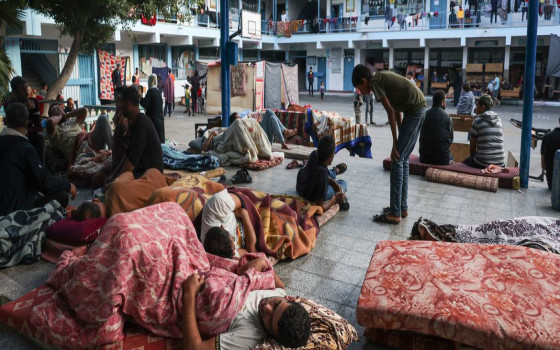
The organization stressed that the risk is double for displaced populations in particular, as a large number of them live in overcrowded shelters that lack personal hygiene facilities and adequately safe water.
The organization also warned that damage to water and sanitation networks and a decrease in cleaning supplies have made it impossible to adhere to basic infection prevention and control measures within health facilities, including among health workers. This is in addition to the risk resulting from the interruption of routine vaccination work, the shortage of medicines needed to treat communicable diseases, and limited communications, which in turn leads to the ability to detect early potential outbreaks.
It is noteworthy that since mid-October, more than 34 thousand cases of diarrhea have been reported, more than half of which are among children under the age of five, which represents a significant increase considering that the average did not exceed two thousand cases of infection per month among this age group during the years 2021. And 2022.
There were also 8,944 cases of scabies and lice, more than a thousand cases of chicken pox, 13,000 cases of skin rashes, and 55,000 cases of upper respiratory infections.
The World Health Organization urged all parties to the conflict to adhere to their obligations under international humanitarian law to protect civilians and civilian infrastructure, including health care facilities. It also called for the unconditional release of all hostages and a ceasefire on humanitarian grounds to avoid further human suffering and put an end to the loss of life.





No Comments Found