

New Israeli massacres in Gaza preceded the truce... and humanitarian agency trucks are waiting for the green signal

- Europe and Arabs
- Friday , 24 November 2023 13:51 PM GMT
Brussel: Europe and arabs
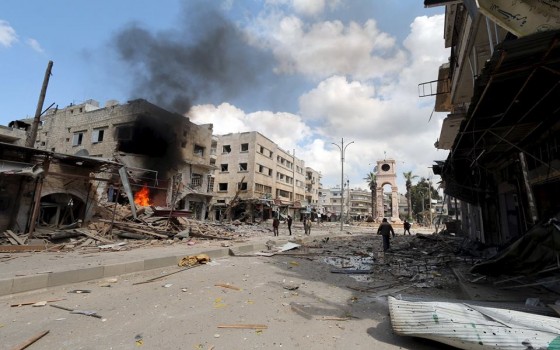
On Thursday evening, the Israeli occupation forces committed new massacres in the Gaza Strip, while continuing their intense bombardment on the north, center and south of the besieged Strip.
Medical sources reported that a number of people were martyred and others were injured, in a series of raids launched by occupation aircraft, in conjunction with violent artillery shelling, on the Turkmen area in the Shujaiya neighborhood, east of Gaza City.
The occupation aircraft also bombed two civilian vehicles on the Nuseirat-Mughraqa road, in the center of the Gaza Strip, leading to the death of 11 people, of whom ambulance crews were able to recover 6 martyrs.
The sources also reported that the occupation aircraft launched raids on various parts of the city of Khan Yunis, south of the Gaza Strip. The occupation bombed a house in the Khan Yunis camp, resulting in martyrs and wounded, who were transferred to Nasser Hospital in the city. The occupation also launched raids on the “Block” area. 2" and near Market Street in the Nuseirat camp in the middle of the Gaza Strip, which resulted in martyrs and wounded.
The United Nations humanitarian agencies also continued their preparations to bring more aid into the Gaza Strip, while reports were received indicating the postponement of the implementation of the agreement between Israel and Hamas on a four-day humanitarian truce and the exchange of a number of hostages and detainees.
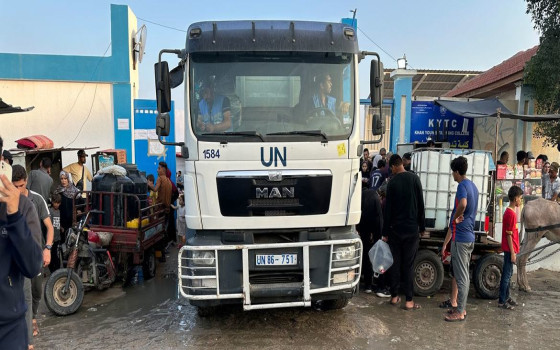
In preparation for the agreement to enter into force, the Executive Director of the World Food Programme, Cindy McCain, said that the program “is mobilizing its efforts to increase aid inside Gaza as soon as permission for safe entry is granted.”
McCain said that WFP trucks "are waiting at the Rafah crossing, loaded with food destined for families in shelters and homes throughout Gaza, and wheat flour for bakeries to resume their work."
The latest United Nations humanitarian reports indicated that wheat flour is no longer available in markets in northern Gaza, and that bakeries are not operating due to lack of fuel, water, flour, and structural damage.
McCain's statements come in the wake of a statement by the United Nations Emergency Relief Coordinator, Martin Griffiths, about the organization's readiness to increase the volume of aid brought into the Strip and distributed throughout Gaza.
According to the United Nations Office for the Coordination of Humanitarian Affairs, just over 73 trucks loaded with food aid provided by the World Food Program have entered Gaza since the resumption of limited aid deliveries through the Rafah crossing from Egypt on October 21, which is far less than the required needs.
Need for fuel
The Executive Director of the World Food Program expressed her hope that the agreement on the entry of fuel into the Gaza Strip would be implemented “so that our trucks can carry much-needed supplies, and that bread can once again become available as a lifeline for hundreds of thousands of people every day.”
About 75,000 liters of fuel entered Gaza from Egypt yesterday, Wednesday, after Israel last week allowed the daily entry of limited quantities of fuel for basic humanitarian operations, according to the United Nations Office for the Coordination of Humanitarian Affairs.
The office said that fuel distribution is being carried out by the Palestine Relief and Works Agency (UNRWA) to support food distribution and operate hospital generators, water and sanitation facilities, shelters and other services.
The Under-Secretary-General for Humanitarian Affairs and United Nations Emergency Relief Coordinator, Martin Griffiths, said last week that about 200,000 liters of fuel are needed per day in Gaza.
More sick and wounded evacuated
In another development, the World Health Organization announced the completion of a new evacuation operation, the day before yesterday, Wednesday, for 190 wounded and sick people, their companions, and medical workers from Al-Shifa Hospital in Gaza City. The evacuees were transported in an ambulance convoy to the south of the Strip.
The organization reported that this development is a joint effort between United Nations agencies and partners in the humanitarian field, led by the Palestine Red Crescent Society.
The Office for the Coordination of Humanitarian Affairs quoted reports from the Palestinian Red Crescent that the evacuation operation “lasted approximately 20 hours, as the convoy was disrupted and subjected to inspection as it passed through the barrier separating the northern and southern Gaza Strip,” expressing its regret that the lives of patients were being exposed to danger.
The evacuated dialysis patients were transferred to Abu Youssef Al-Najjar Hospital in Rafah, Gaza, while the other patients were transferred to the European Hospital in the Gaza Strip in Khan Yunis.
The office said it believed an estimated 250 patients and staff were present at Al-Shifa Hospital, which is no longer operational.
Meanwhile, Wednesday saw the smallest number yet of displaced people leaving northern Gaza to cross to the south using the “corridor” opened by Israeli forces along the main traffic route, Salah al-Din Street, according to the UN Office for the Coordination of Humanitarian Affairs.
The office said that only about 250 people had moved to the south, noting that this decrease was largely due to expectations resulting from a humanitarian truce that had not yet entered into force.
It is noteworthy that about 1.7 million people in Gaza have been internally displaced - equivalent to approximately 80 percent of the Strip’s population - since October 7, 2023.
The Palestinian News Agency reported that the surroundings and gates of the Indonesian Hospital and its electricity generators were subjected to air and artillery bombardment from the Israeli army, according to Sky News.
According to the agency, Israeli aircraft bombed the main generator of electricity in the Indonesian hospital, which led to a complete blackout in all its departments.
Israeli tanks positioned around the hospital also bombed its surroundings and main gates.
Medical sources affiliated with the Palestinian factions said: “Parts of the Indonesian hospital were bombed, and there is fear for the lives of patients and doctors.”
Social media users and Palestinian news pages published videos that they said were of the burning of the main electricity generator in the Indonesian hospital.
This bombing came hours before the truce agreement between Hamas and Israel entered into force.
The Israeli army explained that “with the entry into force of the temporary ceasefire, Israeli forces will be stationed at the ceasefire lines inside the Gaza Strip and will move within them.”
Israeli forces will be stationed at the ceasefire lines inside the Strip and will move within them.
Israeli army spokesman Avichai Adraee said: “With the entry into force of the temporary ceasefire, our forces will be stationed at the ceasefire lines inside the Strip and move within their borders. Our forces will be stationed in areas that are not densely populated and will continue to carry out administrative and logistical movements on the Netzarim axis and the road.” "coastal."
Adraee added: "Including this, the movement of residents from the south of the Gaza Strip to the north will not be allowed in any way, but only from the north to the south. Uncoordinated movement of trucks from the south to the north of the Gaza Strip will also not be allowed."
On Thursday evening, the Qatari Foreign Ministry spokesman confirmed that the temporary truce in the Gaza Strip would begin at 7 a.m. tomorrow, Friday. The Al-Qassam Brigades, the military wing of the Hamas movement, also issued an explanatory statement regarding the temporary truce and prisoner exchange mechanism that had been announced.
As the war on Gaza entered its 48th day, Israeli forces intensified their raids on various areas of the Gaza Strip before the temporary truce entered into force, causing dozens of deaths and injuries. While the death toll from the Israeli bombing on the Gaza Strip exceeded 14,854, including more than 6,150 children and nearly 4,000 women.





No Comments Found