

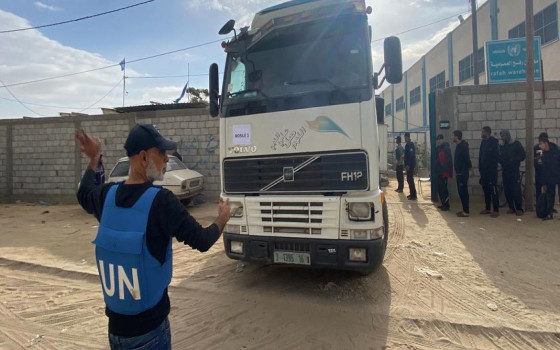
The scope of relief in Gaza continues to expand in light of the humanitarian truce

- Europe and Arabs
- Friday , 1 December 2023 15:9 PM GMT
New York - Gaza: Europe and the Arabs
The United Nations Office for the Coordination of Humanitarian Affairs said that the humanitarian truce in Amish, on its seventh consecutive day, enabled the Egyptian and Palestinian Red Crescent Societies and United Nations agencies to expand the scope of delivering relief and basic materials to the Gaza Strip and throughout its entirety. According to what was stated in the United Nations daily news bulletin, a copy of which we received on Friday morning
The Secretary-General of the United Nations stated before the UN Security Council yesterday, Wednesday, that the level of aid is completely inadequate to meet the huge needs of more than two million people.
United Nations spokesman Stephane Dujarric said that UN agencies were able yesterday to deliver life-saving medicines and surgical supplies to two hospitals in Gaza City, Al-Ahly and Al-Sahaba.
It is estimated that these supplies meet the emergency needs of 100 patients in each of the two hospitals, which also received about 10,000 liters of fuel, sufficient to operate generators for up to 7 days.
Despite the truce, Dujarric said, there has been no improvement in access to water for residents in the northern Gaza Strip, as most of the main water production facilities remain closed due to fuel shortages and damage.
Quoting the Office of Humanitarian Affairs, the spokesman indicated the continued expansion of the delivery of aid, including fuel, to hospitals, water and sanitation facilities, and shelters for displaced people in the southern areas of the Gaza Valley, where the majority of displaced people reside.
He pointed out that cooking gas, which has entered from Egypt on a daily basis since the beginning of the truce, is available on the market in one of the distribution centers in Khan Yunis, albeit in quantities much smaller than the demand.
It is noteworthy that the Director-General of the World Health Organization, Dr. Tedros Ghebreyesus, expressed his concern about the high risk of infectious diseases in migrant shelter centers, due to severe overcrowding and the disruption of the health system and water and sanitation networks.
He pointed out that more than 111,000 cases of acute respiratory diseases and 36,000 cases of diarrhea were recorded in children under five years old.






No Comments Found