

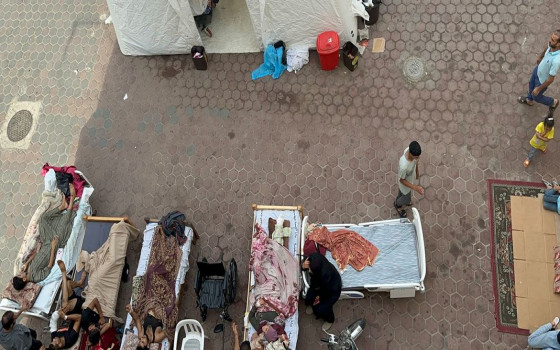
International organizations: Only a ceasefire can save the children of Gaza, and we are approaching the darkest times for humanity.

- Europe and Arabs
- Wednesday , 6 December 2023 14:4 PM GMT
Geneva - Gaza: Europe and the Arabs
“This war on children has resumed with ferocity, on a scale beyond anything we have seen in the south of the Strip, and certainly with a force more horrific than anything we have seen in the north,” said James Elder, spokesman for the United Nations Children’s Fund (UNICEF). He stressed that only a ceasefire can save the children of Gaza at the present time.
Speaking via video from Cairo to reporters in Geneva after the end of his visit to the Gaza Strip, Elder commented on “the Israeli army’s allocation of so-called safe zones” for civilians in Gaza, noting that there is no safe place in the Strip. He added:
“In the current context of so-called safe zones, they are not scientific, they are not rational, they are not possible. I think the authorities are aware of that. I think it is cruel. I think it reinforces the indifference towards children and women in Gaza. I have seen in hospitals from south to north that this indifference "Deadly. It's heartbreaking and confusing."
He continued, saying: "In this specific case in Gaza, Israel is the occupying power. It is the one that must provide food, water and medicine." According to what was stated in the United Nations daily news bulletin, a copy of which we received this morning
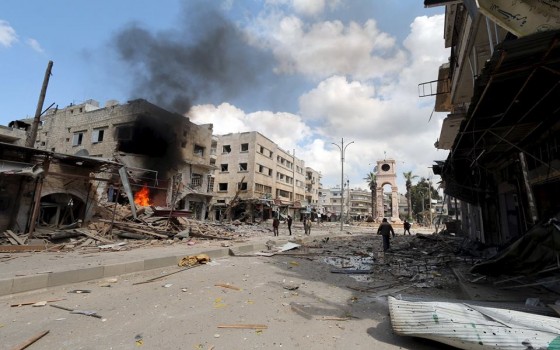
The UNICEF spokesman said that hundreds of thousands of people are moving inside the Strip, at this moment, in the midst of a large-scale bombing, amounting to two hundred raids yesterday, stressing that the only possible way to create truly safe spaces in Gaza that protect human life, is for “the hell to stop.” That falls like rain from the sky.”
He warned that this situation represents "the perfect storm for disease outbreaks." According to UNRWA, at least 19 additional colleagues were killed during the air strikes, bringing the total number of UNRWA staff killed in Gaza to 130 since 7 October.
It is reported that about 16,000 people were killed in Gaza and tens of thousands were injured during the same period.
For his part, the representative of the World Health Organization in the occupied Palestinian territory said that the situation in the Gaza Strip is deteriorating hour after hour in light of the continuing violent bombardment, including in Khan Yunis and Rafah in the south of the Strip.
Dr. Richard Peppercorn pointed out an increase in the number of displaced people coming from the central and southern regions of the Strip, heading to areas further south. At the press conference of UN agencies in Geneva, Pepperkorn spoke from Rafah in southern Gaza, describing the state of despair and shock of the displaced.
He pointed out that about 16,000 people were killed, 60% of whom were children and women, in less than 60 days, in addition to more than 42,000 people being injured. "A child is killed every 10 minutes in Gaza on average, and we are approaching humanity's darkest hour," he said. He stressed the need to stop the bombing and loss of lives, stressing the need for a sustainable ceasefire.
Peppercorn said that what is most concerning are the factors of weakness in the health field, represented by the weak infrastructure of the paralyzed health system in Gaza. He added that northern Gaza lacks almost any functioning health facility. He said that Al-Ahli Al-Arabi Hospital is very crowded and is working to stabilize trauma injuries at the present time.
He stated that the reports received from the hospital raise great concern, as people with multiple injuries are arriving there in light of the scarcity of supplies and support. He expressed concern about the situation at Kamal Adwan Hospital.
He said that what happened in northern Gaza should not be the plan set for the south. He stated that the number of hospital beds in Gaza decreased from 3,500 to 1,500 or less, adding that the situation cannot tolerate the loss of another number of beds while health needs are increasing.
He stated that the organization is doing everything possible to ensure the entry of supplies in a sustainable manner and to increase the number of hospital beds, which must reach 5,000 given the current needs.
Regarding displacement and overcrowding in shelters, Peppercorn pointed to the outbreak of infectious diseases and the reported presence of 120,000 cases of acute respiratory infections and 86,000 cases of diarrhea, which is significantly higher than the average number of cases before, in addition to jaundice, smallpox, and meningitis.






No Comments Found