
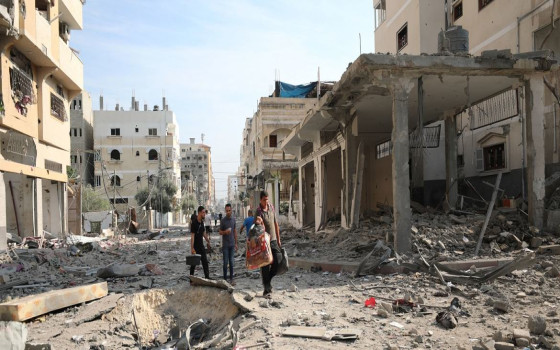
The situation in Gaza, Israel and the region is on the agenda of the European Union foreign ministers, and a French proposal to impose sanctions on settlers. And expectations of an important decision in the UN Security Council within hours.
- Europe and Arabs
- Friday , 8 December 2023 13:43 PM GMT
Brussels - Gaza: Europe and the Arabs - Agencies
The European Union institutions in Brussels said that the discussions of the Council of Foreign Ministers scheduled for next Monday will include an exchange of views on: the Russian aggression against Ukraine, the situation in Israel, the Gaza Strip and the region, the Sahel region, and the foreign policy dimension of economic security.
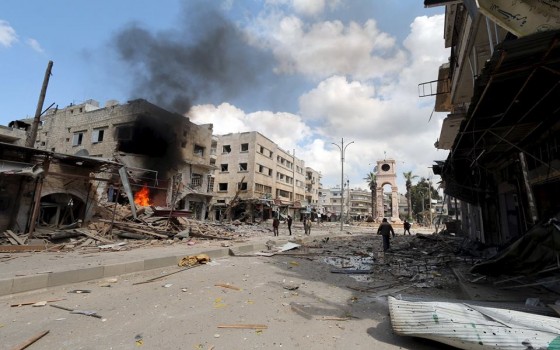
This came after the United Nations Under-Secretary-General for Humanitarian Affairs and Emergency Relief Coordinator said that there is no longer a (true) humanitarian operation in southern Gaza that “can be called by that name,” warning that the humanitarian program there “is no longer effective” and that it has become only a “response.” "For opportunities."
The World Food Program said that hunger is widespread throughout the Gaza Strip and that people feel increasingly desperate in trying to find food to feed their families. The program reported that cases of drought and malnutrition were rapidly increasing in the sector.
Monitoring conducted by the program via telephone shows that between 83 and 97% of families do not consume enough food, and in some areas up to 90% of families reported not eating any food for an entire day and night. 18% of those families experienced these conditions in More than 10 days during the past month.
In the same context, France intends to impose sanctions on Israeli settlers involved in acts of violence against Palestinians in the West Bank, and the French Foreign Minister will address this issue at the European level next Monday during a meeting in Brussels, according to what the Foreign Ministry announced Thursday.
"These acts of violence must stop, and the Israeli authorities must ensure this and prosecute their perpetrators," said Anne-Claire Lugendre, spokeswoman for the Foreign Ministry.
She added that on France's part, it also bears its responsibility, as it intends to take measures such as freezing assets at the French level as well as at the European level, noting that Minister Catherine Colonna will discuss this issue in the Council of Foreign Ministers next Monday in Brussels.
She explained that work is underway to identify the targeted figures, and said, "We are continuing our discussions with our European partners and hope that we can move forward at the national and European levels."
France has always condemned the acts of violence committed by extremist Israeli settlers against the Palestinians in the West Bank.
While Nasser Al-Qudwa, the former Palestinian Foreign Minister, said that the use of Article 99 of the United Nations Charter by the Secretary-General has nothing to do with what will emerge from the Security Council.
The former Palestinian Foreign Minister added, during the Happening in Egypt program, which was broadcast on Thursday evening on ABC Egypt, that Article 99 of the United Nations Charter draws the attention of the Security Council to a specific situation and thus the Council is forced to convene.
Nasser Al-Qudwa explained that the United Nations’ use of Article 99 angers Israel, which considers the mandate of Antonio Guterres, Secretary-General of the United Nations, a threat to world peace.
The former Palestinian Foreign Minister said: “We are closer to the Security Council taking an important decision regarding Gaza within a day or two at most, and the United States of America used its veto power about 30 times in the Security Council against draft resolutions regarding Gaza.”
On Thursday, the United Nations General Assembly adopted, by an overwhelming majority, 5 resolutions in favor of the Palestinian cause.
The official Palestinian News Agency, Wafa, said that the decision to provide assistance to Palestinian refugees received the support of 168 countries, against one country’s objection and the abstention of 10 countries, including the United States, Cameroon, Guatemala, Micronesia, Paraguay, Vanuatu, and Palau.
The second resolution concerned with the operations of the United Nations Relief and Works Agency for Palestine Refugees (UNRWA) also received a majority of 165 countries, with 4 countries objecting: Canada, Israel, Micronesia, and the United States, and 6 countries abstaining: Cameroon, Guatemala, Palau, Papua New Guinea, and Vanuatu. And Kiribati.
The third resolution, concerning the property of Palestinian refugees and the revenues coming from it, received the support of 163 countries, and 5 countries objected: Canada, Israel, Micronesia, Nauru, and the United States, with 9 abstentions from voting, while the fourth resolution concerning Israeli settlements in the occupied Palestinian territory, including East Jerusalem, obtained. And the occupied Syrian Golan, with the support of 149 countries and the objection of 6 countries: Canada, Hungary, Israel, Micronesia, Nauru, and the United States, and 17 countries abstained from voting.
The fifth resolution, regarding the work of the Special Committee concerned with investigating Israeli practices that affect the human rights of the Palestinian people and other Arab residents in the occupied territories, received the support of 86 countries, the objection of 12 countries, and the abstention of 75 countries from voting.


No Comments Found