

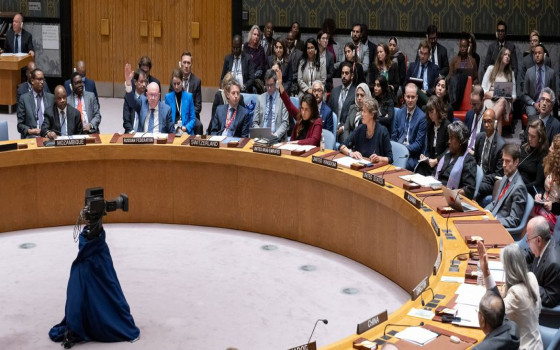
The most prominent reactions to the Security Council resolution on Gaza: It is not enough to stop the Israeli aggression machine, but it is a step to alleviate the suffering of the Palestinians.
- Europe and Arabs
- Saturday , 23 December 2023 17:13 PM GMT
Capitals: Europe and the Arabs - agencies
The Secretary-General of the League of Arab States, Ahmed Aboul Gheit, considered that Resolution No. 2272 adopted by the Security Council yesterday, Friday - which called for a truce and extended humanitarian corridors throughout the Gaza Strip - had come too late and that it was still far from what was required to be achieved, which is a complete ceasefire in the Strip. .
The Secretary-General said - in a statement today, Saturday - that the decision is an attempt to prevent famine in the Gaza Strip, and to save people, especially women and children, from a catastrophic situation, but it is not enough to stop the Israeli aggression machine, especially since it does not include a ceasefire.
He added that the decision came after procrastination and procrastination in response to Israel's desire, stressing that what is required is not only the introduction of humanitarian aid into the Strip, but also the protection of civilians from the continuous bombing, the achievement of a sustainable ceasefire, and the direct start of a major relief operation that includes hundreds of thousands who are now lacking the minimum. One of the necessary components of life.
Aboul Gheit pointed out that every step to alleviate the suffering of civilians in Gaza is a step in the right direction, but addressing the humanitarian catastrophe cannot be achieved through partial measures or palliative measures to absorb the anger of world public opinion over what is happening in Gaza.
The Secretary-General of the Arab League stressed that rejecting an immediate ceasefire is a license to kill, and that Arab efforts will not stop in order to reach an end to the war, calling on the United States to reread the situation and take the correct decision from both the humanitarian and political standpoints instead of being led by the desire of the Israeli extreme right. Inflicting collective punishment and comprehensive revenge on 2.3 million people in the Gaza Strip.
With the support of 13 members, and the United States and Russia abstaining from voting, the UN Security Council adopted Resolution 2720 on Gaza and Israel, which calls for “urgent steps to allow immediate, expanded, safe and unimpeded delivery of humanitarian assistance and to create the necessary conditions for a sustainable cessation of hostilities.”
The resolution - whose draft was submitted by the United Arab Emirates, an Arab member of the Council - requests the UN Secretary-General to appoint a “senior coordinator for humanitarian and reconstruction affairs who will be responsible in Gaza for facilitating, coordinating and monitoring all humanitarian relief shipments destined for Gaza and arriving from states that are not parties.” in conflict, and to verify its humanitarian character.”
The resolution also requests the new coordinator to urgently establish “a United Nations mechanism to expedite the provision of humanitarian relief shipments to Gaza” through these countries, in consultation with all concerned parties, with a view to expediting, facilitating and accelerating the process of providing aid while continuing to help ensure the arrival of aid. To its civilian destination. In addition, the resolution required the parties to the conflict to cooperate with the Coordinator to fulfill his mandate “without delay or hindrance.”
In her speech after abstaining from voting on the resolution, the Permanent Representative of the United States of America, Linda Thomas-Greenfield, said that her country “worked tirelessly to alleviate this humanitarian crisis” and to get the hostages out of Gaza and for a lasting peace.
Thomas-Greenfield thanked the UAE and other countries for working with her team in good faith, and added: “Today, this Council has provided a glimmer of hope, in the midst of a sea of unimaginable suffering.” However, she stressed that her country is "dismayed that the Council was once again unable to condemn the horrific Hamas terrorist attack on October 7."
She noted that much remained to be done to address the humanitarian crisis and lay the foundation for a lasting peace, but added: “Let us be clear, Hamas has no interest in reaching a lasting peace. Hamas is determined to repeat the atrocities of October 7 over and over again.” "And again. This is why the United States supports Israel's right to protect its people from acts of terrorism."
She said that her country supports the Council's support for the resumption of humanitarian truces in the Gaza Strip, noting Israel's readiness to reach another agreement in this regard. “It is now entirely up to Hamas,” she said. “Hamas must agree to additional truce periods. This is how we can bring in additional aid, save lives, and get more hostages out immediately.”
Russia's Permanent Representative to the United Nations, Ambassador Vasily Nebenzia, said that the Security Council resolution "had it not been supported by a number of Arab countries, we would of course have vetoed it." He stressed that his country constantly believes that the Arab world is capable of making decisions and bears full responsibility for them, “and this is the only reason why we did not obstruct that document,” referring to his abstention from voting on the draft resolution instead of using a veto against it.
Nebenzia criticized the current version of the resolution, over which lengthy negotiations took place. He said that responsibility for all possible consequences - resulting from the resolution in its current form - lies with the countries that gave their approval to the wording of the resolution, “which was imposed by the United States,” as he put it.
Russia's permanent representative said, "This is a tragic moment for the Council, and not a moment of victory for multilateral diplomacy. Rather, it is a moment of blatant, unprecedented and unprincipled blackmail, which reflects Washington's disdain for the suffering of the Palestinians and their hopes that the international community will put an end to all of this."
He stressed that clearly demanding a complete ceasefire by the Security Council “remains an inevitable necessity,” adding that “without that, and as the experience of Security Council Resolution No. 2712 has shown, implementing Security Council resolutions in Gaza will simply be impossible.”





No Comments Found